Economics

The Cambridge Economics course provides a rounded, rigorous education in economics which is valuable for a wide range of career paths.

Kings logo

Course overview

The Economics course at Cambridge offers students a rigorous training in a wide range of topics in economics with a strong academic focus on both theoretical and applied economics. In each of the three years, you will have at least two compulsory papers on microeconomics and macroeconomics. Other compulsory papers include mathematics, statistics, and econometrics, as well as economic history and politics. Optional papers are taken in the second and third years, and include labour economics, development economics, advanced mathematical methods, philosophy and history of economic thought, industrial organisation, banking and finance, public finance, and political economy. In the third year, students are expected to write a dissertation on a topic of their choice.

For more information about the course and its modules, visit the University website.


What is it like to study Economics at King’s?

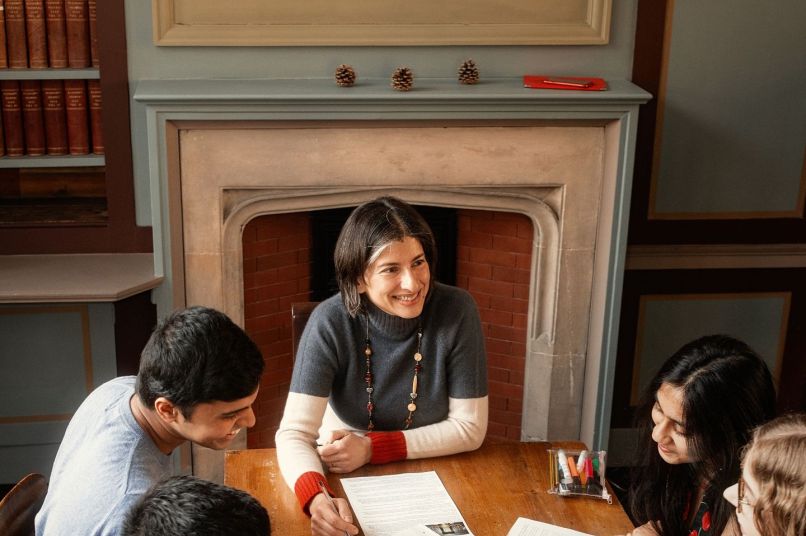
Economics students at King’s will usually have two to three hours of lectures each day in the Economics Faculty and will spend the rest of their day either studying, writing essays and solving problem questions, or attending supervisions. Students have one supervision per four to six lectures in each paper they are taking, which usually translates into two to three supervisions per week. Students also attend events such as open lectures and seminars organised by the Faculty of Economics. During supervisions, students will have an opportunity to discuss the content that is covered in the lectures, ask questions, and solve problems. At King’s, we usually admit around eight students in Economics per year. There is also a substantial number of postgraduate students in Economics at King’s, and together with the undergraduate students and fellows in Economics, they make a very vibrant community of about 40-45 economists in any given academic year. Most supervisions take place at college, in the rooms where John Maynard Keynes resided about 100 years ago. This makes the intellectual experience extra special!


What do we look for in an applicant to Economics?

The ideal Economics students are both technically strong with a high level of mathematical skills and adept with language for their economic arguments. They have good intuition and are intellectually curious about various facets of life. Economics is unique in that it combines STEM skills with social sciences, so applicants need to be strong in maths but also essay-based subjects.


Requirements

A Level: A*A*A with one A* in Mathematics

IB: 41-42 points overall with 7, 7, 6 at Higher Level

Subject requirements: Mathematics (A Level) or Mathematics Analysis and Approaches Higher Level (IB)

Admissions assessment: Test of Mathematics for University Admission (TMUA)

Written work: None
 

Admissions assessment

Candidates for Economics must take the TMUA, which is a pre-registration required test. For more information about the test, please see the University website.


Careers and graduate opportunities

An undergraduate degree in Economics opens many different doors. Many of our past graduates have gone on to work in the finance sector, in economic consulting, as economists in central banks, etc. Others choose careers as educators or join the civil service. Several of our recent graduates continue in higher education with Masters degrees, and often specialise in highly demanded subjects such as data science or financial economics. 
 

What is the best thing about studying economics at King’s?

The Economics community at King’s is very lively and energetic. There are several active, hands-on fellows in Economics at King’s that are friendly, approachable and care about your academic and professional development.


A top tip for applicants to Economics at King’s  

Be interested in current political and economic affairs, keep up with the news, and read as much economics press as possible (e.g. The Economist, The Financial Times, etc.). Learn to develop an argument in an analytical way, using your technical knowledge, intuition, and common sense.

People

Gareth Austin, smiling man with short hair wearing a blue suit and a yellow tie

Gareth Austin

Bio

Professor Gareth Austin became the Director of Research at King's in April 2025.

Read more
Gareth Austin
A woman wearing glasses and a black T-Shirt in front of a white background

Seda Basihos

Bio

Seda Basihos' primary research fields are Political Economy and Economic Growth, with a focus on technology and firm dynamics. She is also interested in Economic History and Development, particularly from the unified growth theory perspective.

Read more
Seda Basihos
Aytek Erdil, a smiling man with long brown curly tied back hair and a dark blue shirt

Aytek Erdil

Bio

Economic Theory, Market Design

Read more
Aytek Erdil
Elisa Faraglia, a smiling woman with dark hair tied back. She is wearing a cream jumper.

Elisa Faraglia

Bio

Elisa Faraglia (PHD New York University, BA Bocconi University) is a Professor of Macroeconomics and Finance at the Faculty of Economics of the University of Cambridge and a fellow at King’s college. Her research focuses on macroeconomics with particular interest in international finance, optimal fiscal policy, debt management, asset pricing and numerical methods. She is a research fellow at the Center of Economic Policy Research (CEPR) a member of the Money, Macro and Finance (MMF). She is a Director of Studies at King’s and a supervisor and King’s and has published in top economics journals. She has been fellow of the Cambridge Endowment for Research in Finance and the Euro Area Business Cycle Network (EABCN) coordinator.

Read more
Elisa Faraglia
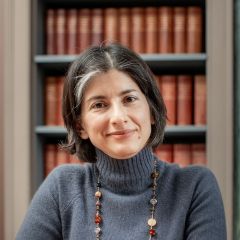
Cryssi Giannitsarou, smiling woman with short dark hair, a grey jumper and a beaded necklace sitting in front of a bookshelf

Chryssi Giannitsarou

Bio

Macroeconomic dynamics, fiscal Policy, growth and human capital, adaptive learning, networks in macroeconomics, asset pricing.

Read more
Chryssi Giannitsarou
A man with a dark jacket over a lighter, knitted jumper, standing in the sunshine outside a city building.

Christoph Hess

Bio

Christoph’s research specialises in the economic history of early modern China and East Asia. For his doctoral work, he reconstructed the institutional framework of inheritance in pre-industrial China through thousands of documents gathered from rural household collections in China. He is currently turning the findings from his doctoral dissertation into his first book, which examines how inheritance interacted with other institutions regulating marriage, migration, and the land market, to limit long-term capital accumulation. His main project as the Mervyn King Research Fellow at King’s will be a comprehensive study of living standards and wealth inequality in China between 1650 and 1950. He is especially interested in the effect of changes in wealth on broad measures of human welfare, such as nutrition, housing quality, and education. Christoph’s other interests include the rise of intellectual pragmatism in late imperial China, servantship and slavery, and rural entrepreneurship in post-reform China.

Christoph received his PhD from the University of Cambridge. Prior to that, he read for an MPhil in Cambridge and a BA in Philosophy and Economics at the University of Bayreuth. Other stations included Zhejiang University, Keio University, the Max-Planck-Institute for the History of Science, and the Max-Planck-Institute for Demographic Research.

Read more
Christoph Hess
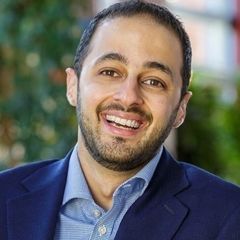
A smiling man with short dark hair beard. He is a wearing a blue shirt and jacket and is sitting in a plant filled room.

Kamiar Mohaddes

Bio
Research

Kamiar Mohaddes is an expert in the macroeconomics of climate change and sustainability at Cambridge University, where he is the Co-Director of the climaTRACES Lab, a new interdisciplinary research initiative at the University of Cambridge focusing on climate, nature, and sustainability. He is also the Deputy Director of the Cambridge Executive MBA programme and Fellow in Economics at King’s College, Cambridge, where he co-founded and directs the King’s Entrepreneurship Lab.

In addition to climate change and sustainability, Kamiar's research covers energy economics, economics of the Middle East, and applied macroeconomics more broadly. He is among the top 1% authors globally in IDEAS/RePEc (based on last 10 years of publications). His articles have been published in a number of edited volumes (Cambridge University Press, Oxford University Press, and Routledge) as well as in leading journals, including the Journal of Applied Econometrics, Journal of International Economics, Management Science, and the Review of Economics and Statistics. His research has also been covered in major international news outlets including the BBC, Bloomberg, The Economist, the Financial Times, the New York Times, Reuters, The Wall Street Journal, and the Washington Post. Kamiar’s work has been cited extensively by policymakers, including by more than 25 members of the United States Congress, the Congressional Budget Office, and the White House.

Kamiar has worked extensively on issues related to climate change and sustainability with both the public (including the United Nations, World Bank, Asian Development Bank, IDB) and the private sector (BCG, BNP Paribas, KPMG and many others). He is a regular visiting scholar at the International Monetary Fund and has previously served as a Departmental Special Advisor at the Bank of Canada. He has worked closely with colleagues at these institutions to, for instance, develop tools to help examine and disentangle the size and speed of the transmission of different global, regional, and national macroeconomic shocks. 

Kamiar obtained his PhD in economics from Cambridge as a Bill and Melinda GatesScholar.

You can find Kamiar on Twitter and LinkedIn. His publications are available on Google Scholar.

Read more
Kamiar Mohaddes
Robert Rowthorn, a man with short grey hair and a pale blue shirt. He is standing outdoors in front of some foliage

Robert Rowthorn

Bio

Research: Economic growth, employment and inequality; economics of the family. 

Read more
Robert Rowthorn
Paul Ryan, a smiling man with grey hair and glasses wearing a suit. He is outdoors with trees behind him

Paul Ryan

Bio
Research

Recent research projects include: apprentice discontent and collective action in twentieth century British metalworking industry; contemporary apprenticeship training in large British companies; financial attributes of apprenticeship in Britain, Germany and Switzerland; and the Apprentice Movement of 1968-75 in Germany.

Selected publications

1980    ‘The costs of training for a transferable skill,’ British Journal of Industrial Relations, November; 18(3), 334‑352.

1991    The Problem of Youth: the Regulation of Youth Employment and Training in Advanced Economies (ed. with P. Garonna and R.C. Edwards), Macmillan, London.

1995    ‘Trade union policies towards the Youth Training Scheme: patterns and causes,’ British Journal of Industrial Relations, March; 33(1), 1-33.

2001    ‘The school-to-work transition: a cross-national perspective’, Journal of Economic Literature, March; 39(1); 34-92.

2004    ‘Apprentice strikes in the twentieth century UK engineering and shipbuilding industries’, Historical Studies in Industrial Relations, Autumn; 18, 1-63.

2007    ‘Large employers and apprenticeship training in Britain’ (with H. Gospel and P. Lewis), British Journal of Industrial Relations, March; 45(1), 127-53.

2009    ‘The role of external inspection in the public services: the case of the UK training market’ (with P. Lewis), Public Administration, 87(4), 791-817.

2011    Financial aspects of apprenticeship training in Germany, Great Britain and Switzerland (with K. Wagner, S. Teuber and U. Backes-Gellner), Arbeitspapier 241. Dusseldorf: Hans-Böckler Stiftung.

2013  ‘Monopsony power, pay structure, and training’ (with S. Mühlemann and S.C. Wolter), Industrial and Labour Relations Review, Oct; 66(5), 1095-1112.

2025   The Apprentice Movement in the Federal Republic of Germany: Aufstand der Stifte, 1968-1975, Springer Nature, Cham, Switzerland. 

Read more
Paul Ryan
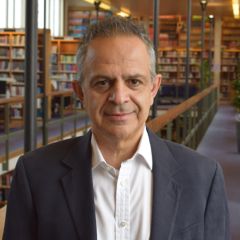
Hamid Sabourian, a smiling man with short grey hair wearing a white shirt and a navy blue jacket. He is in a Library.

Hamid Sabourian

Bio

Research: Economic Theory and Game Theory: in particular Asset Prices with Asymmetric Information; Bargaining; Bounded Rationality and Complexity; Evolutionary Game Theory; Implementation and Mechanism Design; Market Games; Repeated Games; Social Learning and Herd Behaviour, Voting.

Read more
Hamid Sabourian

The Directors of Studies for 2025-2026 are Prof. Aytek Erdil (Part I), Dr Kamiar Mohaddes (Part IIA), and Prof. Chryssi Giannitsarou (Part IIB).