News

Kings logo
Woman with glasses photographed at the seaside

Errollyn Wallen CBE becomes new President of The Royal Society of Musicians

Body

Errollyn Wallen (KC 1999) has been appointed President of The Royal Society of Musicians to succeed Dame Judith Weir (KC 1973).

One of the most widely acclaimed contemporary composers, Errollyn was the first woman to win an Ivor Novello Award for a body of classical work, and the first black woman to have a composition played at the BBC Proms. Her music, often inspired by the River Thames, has been performed at the opening ceremony for the 2012 Paralympic Games, as part of the 2022 Festival of Nine Lessons and Carols service, and even played in outer space.

She has established herself as a composer of international stature, a pianist and vocalist, a broadcaster and communicator and as a teacher and enabler of other musicians. The Royal Society of Musicians looks forward to the next stage in its long history under her Presidency, which marks the third successive Master of the Queen's/King's Music to hold the position, following Dame Judith and Sir Peter Maxwell Davies CH CBE.

Upon taking up the role of President, Errollyn said:

I am delighted to be succeeding Dame Judith Weir as President of The Royal Society of Musicians which provides such valuable support to musicians who are unable to work through accident or illness. I look forward to fulfilling my role and supporting this amazing charity in its vital and significant work for the musicians of the UK.

Speaking upon the completion of her Presidency, Dame Judith said:

It has been one of the great honours of my life to represent RSM as its President during the last decade. The Society is exceptionally well administered, and completely focused on its main charitable purpose. It is highly professional and yet instantly responsive to any musician who needs its help. I have found it enriching to better understand the changing landscape of musicians’ lives via RSM’s all-round view of our profession. I am therefore delighted that Errollyn Wallen CBE will now assume the role - we are all indeed fortunate that this inspirational and generous composer has agreed to take over RSM’s Presidency in the coming years.

The Royal Society of Musicians is the UK’s oldest music charity, set up in 1738 to support musicians in need. Today, it provides financial assistance, advice and guidance to music professionals across the UK who are unable to work due to physical or mental ill health. Open to all music professionals, it supports performers, teachers, technicians, administrators and everything in between, whatever genre they work in. RSM provides grants for physical and emotional therapies, access to specialist practitioners and short-term living expenses. 


Read more
Errollyn Wallen CBE becomes new President of The Royal Society of Musicians
Conductor Richard Farnes

Orchestra conductor Richard Farnes recognised in the King’s New Year Honours list

Body

Our congratulations to King's alumnus Richard Farnes (KC 1983), who has been awarded a CBE (Commander of the Order of the British Empire) for services to music in the New Year Honours list for 2026.

Richard’s distinguished career spans both symphonic music and opera. He was a Chorister in the King's College Choir before entering Eton College as a music scholar in 1977. He returned to King's as Organ Scholar in 1983, and later studied at the Royal Academy of Music, the Guildhall School of Music and Drama, and the National Opera Studio. He has conducted a wide range of orchestras in the UK and across the world. With the BBC Symphony Orchestra he has appeared at the BBC Proms in London and at the Dubai Proms. From 2004 to 2016 he was Music Director of Opera North in Leeds.

Read more
Orchestra conductor Richard Farnes recognised in the King’s New Year Honours list
Laidlaw Scholars at a workshop

The Laidlaw Scholars Leadership & Research Programme arrives at King’s

Body
Pairing innovation with leadership excellence through its new home at the King’s E-Lab, the Programme invests in the next generation of global citizens.

The Laidlaw Scholars Leadership & Research Programme empowers undergraduates to develop the skills and character to become ethical global leaders. The fully funded 18-month programme combines rigorous academic research, international experiences, and leadership development, cultivating integrity-driven leaders prepared to create meaningful, real-world impact. 

The programme includes two fully funded summers, first in the Scholar’s chosen organisation to learn on-the-ground, practical lessons in leadership and then to conduct a group research project in another part of the world; a tailored leadership and research training course with workshops, mentors and interactive sessions to develop skills relevant to success in both areas; and opportunities to engage with a vibrant, global community of passionate students, researchers and changemakers.

Now in its new home in the King’s E-Lab, the Laidlaw programme at the University of Cambridge is dedicated to nurturing the next generation of leaders with a dynamic fusion of innovation and entrepreneurial thinking, strengthening the programme’s commitment to supporting impactful projects, bridging a range of disciplines and backgrounds, and connecting people with a commitment to creating a more just and equitable future.

Full details of the programme can be found here.

Together with the Laidlaw Foundation, the E-Lab believes that good leaders come in all shapes and sizes: the quiet and the gregarious, the scientist and the poet, the musician and the athlete. Whatever a student’s passion or background - all have the potential to lead and this programme is an important way to immerse oneself in new challenges, to build exciting collaborations and to learn from the experience of leading in different contexts.

Maryam Bham, a student at Lucy Cavendish and part of this year's E-Lab residential cohort, says:

Entrepreneurship and leadership are not only about ideas, they are about people, connection, conviction, and courage. At the King’s E-Lab, I experienced a space where I could see those same values come to life.

Sophie Harbour, Executive Director of the King’s E-Lab and Fellow, adds:

The Laidlaw Leadership and Research Programme provides students with the opportunity to learn how to channel their creativity and compassion to drive meaningful impact. This aim sits at the heart of all our E-Lab activities and it is why we are so excited to provide a new home for the Programme and help provide valuable pathways for students of all disciplines to embrace the possibility of changing the world.

Applications for the 2025/2026 cohort are launching the week of the 24th November and Susanna Kempe, CEO of the Laidlaw Foundation, will be in King’s for a fireside chat with the Provost

Read more
The Laidlaw Scholars Leadership & Research Programme arrives at King’s
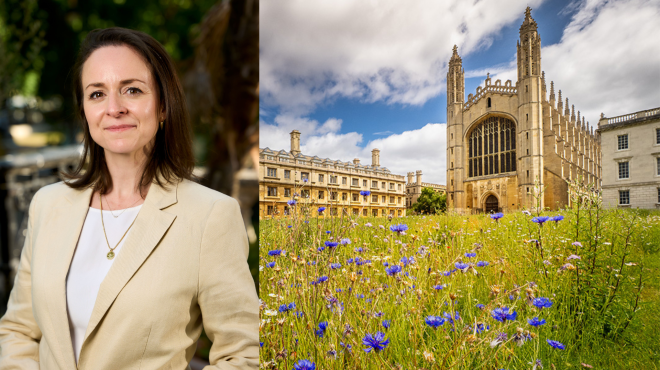
collage image of wildflower meadow and of a white male wearing glasses

New artist-in-residence to explore and challenge human ideas of climate crisis

Body

In a new and ambitious project, currently titled “A Normal Life”, artist Marcus Coates has joined King’s College as its artist in residence. Developed in collaboration with King’s, “A Normal Life” will put him – and by default us, as individuals – under the spotlight. The multi-faceted project will engage with, and be shaped by, world-leading scholars and business leaders, the community of King’s and the city of Cambridge.

The experience of living through today’s unfolding and deepening permacrisis poses profound and urgent questions to and of society, individual citizens, institutions and world leaders. Questions like “Who is accountable?” and “Who is responsible?” resonate ever more sharply as we call ourselves and others to account for bringing our people and our planet to the edge of the precipice. Contemporary artists, working at a distance from formal structures of power, are uniquely positioned to ask such difficult questions.

Marcus Coates is known for his sustained commitment to working at the intersection between nature and culture, and between art and science. Marcus makes films that address humanity and the natural world and explore the connections between them, working with drama and in collaboration. His 2022 series of films, entitled “The Directors” and produced by Artangel, has been widely acclaimed for its powerful and sensitive exploration of psychosis.

"The generous spirit of cross-disciplinary interaction which is at the core of the College has been a revelation to me. A place steeped in the past but profoundly rooted in the questions of today and the future,” commented Marcus. “My research for A Normal Life is informed by a range of disciplines from neuroscience, medieval English literature, history of law, evolutionary biology, politics and more." 

“It’s been remarkable and a great privilege being part of an ethos that celebrates thought and creates space for the imagination. 

Marcus Coates

Marcus will work with world experts with widely different perspectives to investigate our complicity in the earth crisis, as well as scrutinizing the cultural forces, the ideologies, values, and myths that shape our behaviour. His work will foreground those whose lives have been shaped by climate impacts – from small island nations threatened by rising seas to the farmers of the Fens facing unprecedented threats due to climate change – as well as those resolutely in denial of the crisis.

The project is co-curated by Clare Cumberlidge and Frances Morris (KC 1978) CBE, King’s College alumna and Honorary Fellow. “Marcus has received an incredible welcome from the staff and students at King's, a community which offers a near-perfect environment in which to develop and test his ambitious new project which focuses on personal responsibility in the era of climate emergency,” said Frances Morris. 

“Internationally renowned for its scholarship across the humanities and sciences, King's has a long track record of independent thought, challenging tradition and embracing cross-disciplinary innovation. Marcus's residency is generating multiple opportunities for research, reflection and imaginative collaboration with analytical and creative thinkers from across the College community.”

Marcus and the project team will organise a series of workshops and other opportunities for engagement across the College community in 2026.

Read more
New artist-in-residence to explore and challenge human ideas of climate crisis
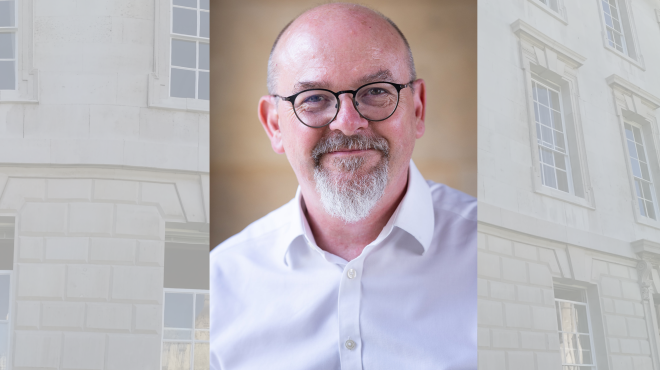
a headshot of a white man next to a decorative image of the Ivor Classical Awards 2025 logo

King's composer Professor Richard Causton shortlisted for an IVOR Classical award

Body

Richard Causton, University Professor of Composition and Fellow in Music, has been nominated for a 2025 IVORS Classical Award.

His composition If I Could Tell You (commissioned and premiered earlier this year by the Fidelio Trio) has been shortlisted for an IVORS Classical Award in the Best Small Chamber Composition category.

Judged by composers for composers, the IVORS Classical Awards recognise excellence in craft and creativity. They are the UK's flagship awards for classical composition. Presented by The Ivors Academy, they celebrate creative excellence in British and Irish composing. Previous winners include Sir Harrison Birtwistle, Errollyn Wallen CBE, Dame Judith Weir, Jonny Greenwood and Mark-Antony Turnage.

The final announcement is made at the Awards Ceremony on the South Bank on 11th Nov and also on BBC Radio 3. 

Find out about all the nominees for this year's IVORS Classical Awards.

Read more
King's composer Professor Richard Causton shortlisted for an IVOR Classical award
Day 2 hematoids

New lab-grown human embryo model produces blood cells

Body
Cambridge researchers have found a new way to produce human blood cells in the lab that mimics the process in natural embryos – a discovery that holds potential to simulate blood disorders like leukaemia, and to produce long-lasting blood stem cells for transplants. 


University of Cambridge scientists have used human stem cells to create three-dimensional embryo-like structures that replicate certain aspects of very early human development - including the production of blood stem cells.

These structures, which the scientists have named ‘hematoids’, are self-organising and start producing blood after around two weeks of development in the lab - mimicking the development process in human embryos. They differ from real human embryos in many ways, and cannot develop into them because they lack several embryonic tissues, as well as the supporting yolk sac and placenta needed for further development.

Hematoids hold exciting potential for a better understanding of blood formation during early human development, simulating blood disorders like leukaemia, and for producing long-lasting blood stem cells for transplants.

The human stem cells used to derive hematoids can be created from any cell in the body. This means the approach also holds great potential for personalised medicine in the future, by allowing the production of blood that is fully compatible with a patient’s own body. The new method mimics the natural developmental process, based on a self-organising human embryo-like model, where the cells’ intrinsic support environment drives the formation of blood cells and beating heart cells within the same system.

The findings are published today in the journal Cell Reports.

Professor Azim Surani, Emeritus Fellow of King’s, Director of Research at Cambridge’s Gurdon Institute and senior author of the paper, said: 

This model offers a powerful new way to study blood development in the early human embryo. Although it is still in the early stages, the ability to produce human blood cells in the lab marks a significant step towards future regenerative therapies - which use a patient’s own cells to repair and regenerate damaged tissues.

Professor Surani is the winner of the 2025 Kyoto Prize in the Life Sciences and Medicine. Read more about his work and this prestigious award here.


Image above shows day 2 hematoids: human stem cells start to self-organize into three-dimensional clumps establishing primary germ layers, including endoderm (red), ectoderm (green) and mesoderm (blue) derivatives. Primary germ layers give rise to all the tissues and organs of the body.

Read more
New lab-grown human embryo model produces blood cells
E-Lab residential programme 2025

The King’s E-Lab welcomes its 2025-2026 cohort of residential students

Body

The King’s Entrepreneurship Lab (E-Lab) is delighted to welcome a new cohort of students to the 2025-2026 Residential Programme. A total of 65 participants from 12 Cambridge Colleges will form the fifth cohort of the year-long programme at King’s. 

The incoming cohort of the Residential Programme will arrive on 28 September to get ready to kickstart a week of activities on entrepreneurship. Made up of PhDs, MPhils and undergraduates from across many Cambridge departments, the students will take part in a mix of spotlight talks, interactive workshops, pitch training and socials to build their entrepreneurial thinking. 

Read more
The King’s E-Lab welcomes its 2025-2026 cohort of residential students
Universidad Adolfo Ibáñez, Campus Peñalolén Sede Pregrado

Architecture exhibition opens in the College Chapel

Body

The exhibition ‘Andean Contours – University Buildings’ by José Cruz Ovalle will run until 28 September, exploring Chilean architecture and reflecting on the connections between architectural design and higher education.

José Cruz Ovalle is a renowned Chilean architect who has worked internationally, with projects in Spain, Argentina, Colombia, and, of course, his home country of Chile. This exhibition highlights two university campuses he designed and built in Santiago and Valparaíso.

For this installation, the easels that previously supported the ’50 Portraits’ exhibition have been transformed into a new structure. This time, they carry a bespoke design made of pliable wood, forming a meandering surface. The images are carved—not printed—onto specially coated wooden panels, and every element has been carefully designed and 3D-printed to honour the unique architecture of the Chapel.

Exhibition Opening

Monday 1 September 2025

King’s College Audit Room (from 5pm)

King’s College Chapel (from 6pm)

*

On Tuesday 2 September José Cruz Ovalle, Peter Clegg (designer of Stephen Taylor Court), and Michelle McNamara (Pritzker Prize Laureate) will present their work, focusing on university buildings.

These events are organised by Dr Felipe Hernández and supported by King’s College Cambridge and the Universidad Adolfo Ibáñez.


Read more
Architecture exhibition opens in the College Chapel
Basim Musallam by Rory O'Bryen

Basim Musallam (1943 - 2025)

Body

It is with great sadness that we share the news of Life Fellow Dr Basim Musallam's death on 21 August 2025.

Born in Lebanon, Basim was a highly distinguished historian of the Middle East who burst onto the academic scene in 1983 with his book Sex and Society in Islam: Birth Control before the Nineteenth Century. In addition to his many books, he wrote and starred in multiple episodes of a documentary series The Arabs - A Living History 1979 - 1983 which aired on Channel 4 (UK) and PBS (US).

Educated at the American University of Beirut and Harvard University, he joined the University of Cambridge as a lecturer in Islamic Studies in 1985 and later served as Director of the Centre of Middle Eastern Studies. 

He had been a Fellow of the College since 1990 and served the College in many capacities, most notably as Director of Studies in Oriental Studies/Asian and Middle Eastern Studies, as Vice Provost and also briefly as First Bursar. He was an extraordinary mentor to many younger Fellows, to whom he was willing to give endless time. 

*

A memorial event, open to all in the King's community, to celebrate Basim's life and work will take place in Hall on 31 January at 3pm. 

Read more
Basim Musallam (1943 - 2025)
Headshots of all participants in the SPARK programme

King’s E-Lab SPARK incubator reveals first cohort

Body

Created by the King's E-Lab, in partnership with Founders at the University of Cambridge, SPARK will act as an entrepreneurial launchpad. This programme will offer hands-on support, world-class mentorship and practical training to enable world-changing ventures covering challenges such as disease prevention and treatment, fertility support, and climate resilience. The combined networks of successful entrepreneurs and investor alumni and venture-building expertise brought by King’s E-Lab and Founders will address a critical gap to drive innovation. 

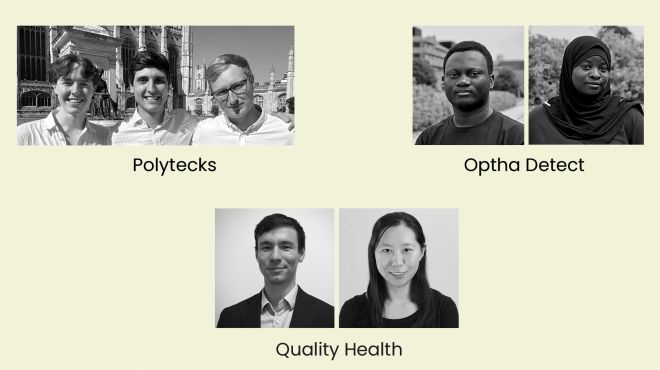
More than 180 applications were received for SPARK 1.0, reflecting strong demand for early incubation support. Of the 24 selected companies, focused on AI, machine learning, biotechnology and impact, 42% are at idea stage, 40% have and early-stage product and 17% have early users. Around half of the selected companies are led by women. Four of the startups are founded by King’s students.  

The intensive incubator will run for four weeks from the end of August. Each participant will receive specialised support from Founders at the University of Cambridge and King’s E-Lab mentors and entrepreneurs-in-residence to turn their concepts into companies that can attract both investment and ultimately grow into startups capable of driving economic growth. 

The programme is free for students graduating in summer 2025, postgraduates, post-docs, researchers, and alumni who have graduated within the last two years. This is made possible through University funding as well as a generous personal donation from Malcolm McKenzie (KC 1977), Chair of the E-Lab’s Senior Advisory Board.  

Kamiar Mohaddes, Co-Founder and Director of King's E-Lab, says: 

Cambridge has been responsible for many world-changing discoveries, but entrepreneurship isn't the first thought of most people studying here. Driving economic growth requires inspiring the next generation to think boldly about how their ideas can shape industries and society. We want SPARK to be a catalyst, showing students the reality of founding a company. We look forward to seeing this cohort turn their ambitions into ventures that contribute meaningfully to the economy.

Read more
King’s E-Lab SPARK incubator reveals first cohort
Library arches seen from Webb's Court

Jane Austen Open Day at King’s College Library

Body

King’s is taking part once more in Open Cambridge, the initiative that offers special access to the extraordinary spaces and places in Cambridge that are normally closed to the general public or charge admission. 

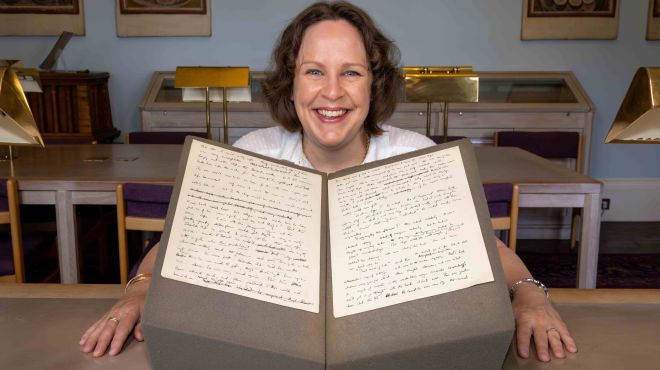
On Wednesday 17 September the College Library and Archives will host an exhibition to mark two hundred and fifty years since the birth of Jane Austen. The free exhibition will showcase first and early editions of the author’s well-known novels, the autograph manuscript of her unfinished novel Sanditon, and various documents that highlight the Austen family’s connection with King’s.

Wednesday 17 September, 10.30am-4pm 
King’s College Library

PLEASE NOTE: Access for this event is via the gate on King’s Lane (between Queen’s Lane and King’s Parade)

*

Earlier this year, the autograph manuscript of Jane Austen’s final novel, Sanditon, went on loan to Harewood House in Yorkshire as part of their exhibition Austen and Turner: A Country House Encounter.

The Sanditon manuscript was given to King’s College in 1930 by Jane’s great-great niece Mary Isabella Lefroy, in memory of her sister Florence and Florence’s husband, the late Provost Augustus Austen Leigh (1840-1905), who was one of Jane's great-nephews.

Read more
Jane Austen Open Day at King’s College Library
Susan Tomes and the two winners of the prize photographed playing piano

Susan Tomes Music Prize awarded to two students

Body

Now in its second year and established by renowned concert pianist and writer Susan Tomes (KC 1972), the Susan Tomes Prize for Music aims to recognise the positive impact that all forms of music have on the King’s community. Nominations are invited from Fellows, staff and students who had been moved by a moment of music making by a student of the College. 

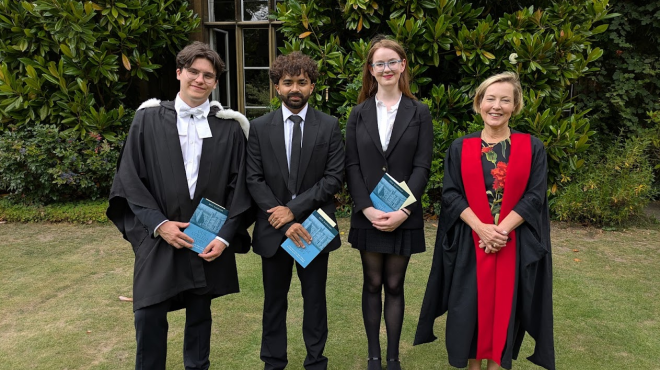
The winners of the 2025 Susan Tomes Prize are MPhil student Cristóbal Palisson (who has since graduated) and fifth year medic James Wang. They received a cash prize and a copy of Susan’s book The Piano: A History in 100 Pieces

Cristóbal (MPhil in Classics) was nominated for being “invaluable in resurrecting the Provost’s Lodge series”. Those nominating him mentioned that Cristóbal "has programmed a long series of engaging and enjoyable concerts. His passion and enthusiasm for the concert series is outstanding and when on occasion he has played piano in one, it has always been beautiful.”

James received the award with the following citation: “James Wang has excelled in countless classical, choral, and jazz settings at King’s as a talented pianist, singer, and multi-instrumentalist, but what is truly unique about James is his capacity to create an encouraging, inclusive, and meaningful environment for music making. James is undeniably a highly-skilled musician, and each time I have heard him play I have been astounded by his technique and emotional expression. More poignantly, though, when playing in 'Jazz Reflections' organised by James last term, I witnessed firsthand his open-mindedness, kindness, and nonjudgemental nature.”

*

Susan Tomes was the first woman to read music at King’s, arriving in 1972 as part of the first cohort of female undergraduates. She is one of the UK’s most renowned concert pianists and the author of seven books. Her most recent, Women and the Piano – a History in Fifty Lives, goes hand-in-hand with her performances of music by female pianist-composers who have historically been neglected.

Read more
Susan Tomes Music Prize awarded to two students