Fellows and researchers

More than 100 Fellows at King's carry out a wide range of research, from investigating the origins of the universe to uncovering the classical world. The term 'Fellow' encompasses Official Fellows, Research Fellows, Life Fellows as well as Honorary and Emeritus Fellows. Our College Research Associates also have a directory on this page.
Kings logo

Fellows' directory

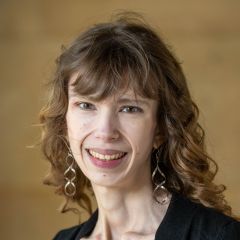
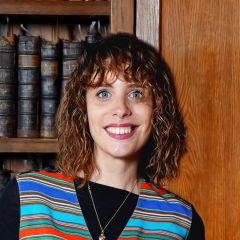
A smiling woman with long curly brown hair wearing a black cardigan. She is standing in front of a yellow stone wall.

Zoe Adams

Bio

Zoe's academic interests lie primarily in the realm of labour law, tort law, legal methodology, social ontology, and law and economics.  Zoe describes herself as a ‘critical’ legal scholar, embedding her work in a structural analysis of law’s relationship with capitalism. The issues she explores include the relationship between law and capitalism, and the role of legal concepts in shaping the latter’s development; questions of legal form, and their relationship with political strategy; the relationship between law, gender, and race; and, more generally, the role of law in the perpetuation, and legitimisation, of inequality within the framework of capitalist societies. 

A lot of her work focuses on UK labour law history, with particular emphasis on the history of wage and working time development; the history of industrial relations and legal frameworks governing trade unions and industrial action; and the law’s role in shaping the so-called ‘future of work’. Zoe  was awarded the Yorke Prize for her PhD thesis, "A Social Ontology of the Wage", and her first book, "Labour and the Wage: A Critical Perspective", was published by Oxford University Press in 2020.  It won the Yorke Prize, in 2020, and has since been shortlisted for both the SLSA Early Career Academic Book Prize, and the SLSA Hart Book Prize. Zoe’s second monograph, "The Legal Concept of Work" was published in November 2022. She is now in the planning stages of a third book, exploring the relationship between law and power. 

Read more
Zoe Adams
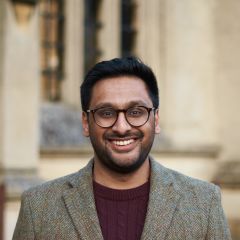
Ronojoy Adhikari, a smiling man with dark hair and glassed wearing a black jumper

Ronojoy Adhikari

Bio

Dr Ronojoy Adhikari's research interests include the statistical physics of soft materials and the application of mathematics, specifically probability theory, to problems in the natural and social sciences.

Read more
Ronojoy Adhikari
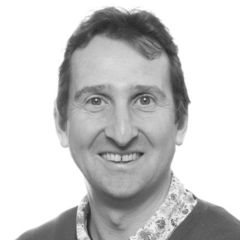
Sebastian Ahnert, a black and white photo of smiling man with mid length dark hair, stubble a shirt and a jumper

Sebastian Ahnert

Bio

Dr Sebastian Ahnert's reserach interests include:

  • The study of structural and functional complexity in biology from the perspective of algorithmic information theory, as well as interdisciplinary applications of algorithmic information theory more generally.
  • Network analysis, in areas of both method development and in interdisciplinary applications of network analysis to biology, the humanities, and social sciences.
Read more
Sebastian Ahnert
Anna Alexandrova, a smiling woman with short brown wavy hair wearing a black top and a grey blazer. She is standing in front of a brick wall.

Anna Alexandrova

Bio

Professor Anna Alexandrova explores the philosophy of science, especially of economics and psychology. She is particularly interested in the role and status of formal models in special sciences and in measurement of happiness and well-being.

Read more
Anna Alexandrova
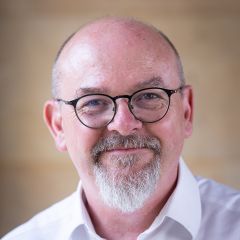
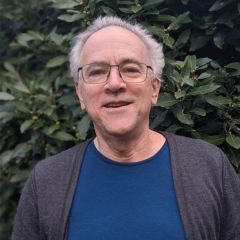
John Arnold, a smiling bald man with a short beard wearing glasses and a blue jumper

John Arnold

Bio

Professor John Arnold's research interests include:

  • Medieval religion and culture.
  • Heresy, inquisition, (un)belief.
  • Gender and sexuality.
  • Historiography.
Read more
John Arnold
Nick Atkins, a smiling man with brown hair and wearing a grey suit

Nick Atkins

Bio

Dr Nick Atkins works on the flow and heat transfer within the internal or secondary air systems of both aero propulsion and energy based gas turbines.

Read more
Nick Atkins
Gareth Austin, smiling man with short hair wearing a blue suit and a yellow tie

Gareth Austin

Bio

Professor Gareth Austin became the Director of Research at King's in April 2025.

Read more
Gareth Austin
Umang Bhatt, a smiling man with dark hair, a short beard and glasses. He is wearing a maroon jumper and a grey tweed jacket. He is standing outside a Cambridge College

Umang Bhatt

Bio

Umang is an Assistant Professor at the Cambridge Institute for Technology and Humanity (ITH) and its Centre for Human-Inspired Artificial Intelligence (CHIA). His research focuses on building trustworthy artificial intelligence (AI) systems for high-stakes deployment. He develops algorithms and tools that support effective human-AI interaction and manage the partnership between people and AI systems. Drawing on machine learning, cognitive science, philosophy, and law, Umang studies when and how AI systems can be trusted, integrated into human decision-making, and evaluated in ecologically valid settings. His group uses lab and field experiments to assess societal impacts of AI in various domains, with particular attention to healthcare, education, and national security, where human oversight of AI is essential.
 

Born and raised in Basking Ridge, New Jersey (USA), Umang earned his BS and MS at Carnegie Mellon University and his PhD in the Machine Learning Group at Cambridge. He was previously an Assistant Professor and Faculty Fellow at New York University’s Center for Data Science and a Senior Research Associate at The Alan Turing Institute. His work has been supported by the Responsible AI Institute, the Mozilla Foundation, and the Partnership on AI.
 

Read more
Umang Bhatt
Marcus Boeick, a smiling man with short blonde hair, glasses and a blue shirt

Marcus Boeick

Bio

Dr Marcus Boeick is a historian specializing in Modern German and European History. 

"My research and teaching focus on the intricate relationship between the public and private spheres throughout the 20th century, particularly at the intersection of the state, economy, and society. My initial book delved into the contentious history of mass privatization of state assets in post-socialist Eastern Germany during the early 1990s. Currently, my ongoing book project presents a comprehensive and empirically grounded history of private security in 20th-century Germany and Central Europe. My approach encompasses a wide array of sources, ranging from classical references in state archives to media coverage, oral interviews, and material artefacts. I consistently strive to unearth unheard voices "from below" and offer novel perspectives from overlooked areas. Concurrently, I contextualize Germany within its transnational connections and broader global frameworks. I place significant value on interdisciplinary and transdisciplinary collaboration across a diverse spectrum of fields. Born in East Germany shortly before the fall of the Berlin Wall, I completed my studies at Ruhr-University Bochum, situated in the former West German "rust belt" region. Over recent years, I held a Postdoc Fellowship at the Institute of Advanced Studies at University College London and a Guest Professorship at the Imre-Kertész-Kolleg at Jena University. In the past year, I have been awarded a John F. Kennedy Memorial Fellow at the Minda de Gunzburg Center for European Studies at Harvard."

Read more
Marcus Boeick
Giulia Boitani, a smiling woman with long curly brown hair wearing a red jumper against a bright blue background

Giulia Boitani

Bio

Dr Giulia Boitani is a College Teaching Officer in French and Italian at King’s, and the Director of Studies for our First Years.

"I work on medieval literature across Romance languages, particularly medieval French, Occitan and Italian.  My recent research focuses on the role of foundresses in medieval French prose romances, but I also look at medieval manuscripts and their particular idiosyncrasies (every single manuscript of any given medieval text is different!); representations of food and feeding in medieval literature; and the ways in which current critical practices – particularly eco-critical approaches - might engage with medieval thought.

I teach Introduction to French literature, film and thought (FR1) and Introduction to Italian Texts and Contexts (IT1/ITA3) in the first year; Medieval French Literature (FR3), and Translation and Oral Italian (ITB2) in the second, and medieval French and Occitan literature (FR7, FR15) in the fourth year; as well as paleography courses for our MPhil in in European, Latin American and Comparative Literatures and Cultures (ELAC)."

Read more
Giulia Boitani
Richard Bourke, a man with short dark hair and a grey shirt

Richard Bourke

Bio

Professor Richard Bourke works broadly in the history of political thought, mostly covering the enlightenment and its legacy. His interests include political ideologies, the philosophy of history, and the history of democracy. He has also published on modern Irish history. His most recent books include Empire and Revolution: The Political Life of Edmund Burke (2015) and Hegel’s World Revolutions (2023).

Read more
Richard Bourke
Mirjana Bozic, a smiling woman with dark tied back hair and a black polo neck jumper

Mirjana Bozic

Bio

Dr Mirjana Bozic studies language as a cognitive and a neural system. Her research focuses on the brain mechanisms that support language comprehension in monolingual and bilingual speakers.

Read more
Mirjana Bozic
Angela Breitenbach, a smiling woman with long blond hair wearing a white top

Angela Breitenbach

Bio

Professor Angela Breitenbach focuses on Kant, Philosophy of Science, Aesthetics

Read more
Angela Breitenbach
Jude Brown, a smiling woman with tied back blonde hair and a black jumper. She is standing in front of a monochrome abstract artwork.

Jude Browne

Bio

Professor Jude Browne is the Head of the Department of Politics and International Studies (POLIS) and The Jessica and Peter Frankopan Director of the University of Cambridge Centre for Gender Studies (on leave whilst HoD). She is a winner of the University of Cambridge Pilkington Prize and the inaugural winner of the Aaron Rapport Prize for excellence in teaching at Cambridge and she is Director of Studies for Human, Social and Political Sciences (Part II).

Jude Browne's research interests are focused on the concept of political responsibility, political theories of equality, feminist theory, lay governance, public interest, structural injustice, rights, and the impact of technology on society. Her most recent book is ‘Political Responsibility and Tech Governance’ published by Cambridge University Press (2025).

Read more
Jude Browne
Matei Candea, a smiling man with short dark hair and a beard wearing glasses and a casual blue jacket. He is outdoors in a mountain range

Matei Candea

Bio

Professor Matei Candea's research interests include freedom of speech, animals and science, Corsica, methor and theory (comparison, fieldsites, tarde)

Read more
Matei Candea
Richard Causton, a man with short dark hair and a grey jumper against a dark grey background

Richard Causton

Bio

In addition to composition, Professor Richard Causton writes and lectures on Italian contemporary music and regularly broadcasts for Italian radio.

Read more
Richard Causton
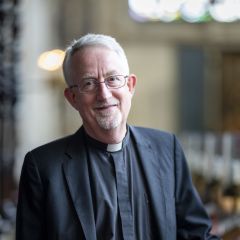
A white man wearing a clerical collar and black clothing stands in a church

Stephen Cherry

Bio

Stephen Cherry is Dean of Chapel at King’s College Cambridge. He is also a Fellow of the College and Director of Studies in Theology. A priest in the Church of England, Stephen was previously Director of Ministry the Diocese of Durham and a Residentiary Canon of Durham Cathedral. Before that he was a parish priest in Loughborough for 12 years. Stephen has written a number of books in recent years including Unforgivable? Exploring the Limits of Forgiveness (2024) and Healing Agony: Reimagining Forgiveness (2012). He has a PhD and first degree in theology and a BSc in Psychology. He has a practical interest in inter-faith relations.

Read more
Stephen Cherry
a man sitting at a table in a library

Ivan Collister

Bio

Ivan Collister joined King's in 2022 as First Bursar, one of the posts created by the Founder's Statutes for King's College in 1446. His research interests include labour history, electoral politics, and the history of social policy in modern Britain.

Read more
Ivan Collister
Francesco Colucci, a smiling man with curly dark hair, glasses and a white shirt

Francesco Colucci

Bio

Professor Francesco Colucci studies cells and genes of the immune system in pregnancy and cancer. His research interests include immunology; immunogenetics; trophoblast research; reproductive medicine; natural killer and other lymphoid cells.

Read more
Francesco Colucci
Laura Davies, a smiling woman with long brown hair, a white shirt and a green jacket

Laura Davies

Bio

Dr Laura Davies' research focuses on British literature of the long eighteenth century with a particular interest in life writing and the textual representation of experiences and ideas that resist language or narration, including sound, time, death, spiritual visions, and dreams.
She works on well-known figures such as Samuel Johnson and James Boswell, as well as a range of non-fiction prose including philosophical, religious, and medical texts. Laura founded and leads the interdisciplinary research and public engagement project 'A Good Death?'. 

Read more
Laura Davies
A white man with brown hair and brown-framed glasses

James Dolan

Bio

Dr James Dolan's scientific research is at the intersection of nanophotonics and soft matter physics. He investigated ways to use the (directed) self-assembly of liquid crystals and block copolymers to create two- and three-dimensional optical metasurfaces and metamaterials with dynamically reconfigurable optical properties. James' current research, however, focuses on science communication. He is interested in how scientists’ conceptions of science—what it is, how it works, and what its for—affect how and why they communicate their science. In addition, he is interested in science communication and improvised comedy (improv), exploring the use of improv both as a form of science communication training and as a novel form of public engagement.

James also serves as Financial Tutor.

Read more
James Dolan
Mark Dyble, a smiling man with short dark hair and a white t-shirt

Mark Dyble

Bio

Dr Mark Dyble is an Assistant Professor in Evolutionary Anthropology in the Department of Archaeology where he teaches evolutionary perspectives on human biology, behaviour, and health. Much of his research focuses on the evolution of human social behaviour and is informed by ethnographic fieldwork with hunter-gatherer communities in the northern Philippines, zoological fieldwork with wild meerkats in South Africa, and by computational and mathematical modelling. His central thesis is that social behaviour in humans (or any other species) is strongly related to social organisation: the size, demographic structure, and kinship composition of social groups.

Born and raised in Essex, Mark studied at Cambridge (Clare 2008), Oxford, and University College London before spells as a Research Fellow at the Institute for Advanced Studies in Toulouse (2016–17) and as a JRF at Jesus College, Cambridge (2017–19). He was a Lecturer at University College London for four years prior to returning to Cambridge in July 2023.

Read more
Mark Dyble
Aytek Erdil, a smiling man with long brown curly tied back hair and a dark blue shirt

Aytek Erdil

Bio

Economic Theory, Market Design

Read more
Aytek Erdil
Sebastian Eves van-den Akker, a smiling man with short blonde hair and glasses. He is wearing a navy blue sweater and is standing in front of a book shelf

Sebastian Eves-van den Akker

Bio

Sebastian is a geneticist, and Head of the Plant-Parasite Interactions group, with an interest in the genes that control a dialogue between kingdoms of life: the two-way molecular communication between plants and their parasites. He develops understanding from the position that the two organisms are one interlinked entity, studying the biology of the entire host-parasite complex. He uses genetics to dissect the communication between the two organisms, to understand how evolution drives novel forms and functions, through a development-altering relationship, that is phylogenetically and geographically widespread.

Recent highlights from the lab exemplify the fascinating biology of the study system, the connectedness of the kingdoms, and the central thesis that the two organisms are best studied when considered as one entity. The lab showed that: i) host and parasite each contribute to the cross-kingdom synthesis of Vitamin B5, defining the hologenome theory of susceptibility-gene discovery (Siddique et al., 2022, Nature Communications); ii) the nematode has evolved a novel form of precisely guided somatic genome editing to generate thousands of new transient effector alleles (Sonawala et al., 2024, Cell Genomics); and iii) that the nematode mobilises and ingests parts of the plant genome during infection (Ko et al., 2023 Molecular Biology and Evolution).

Selected recent publications:

U. Sonawala, H. Beasley, P.J. Thorpe, K. Varypatakis, B. Senatori, J.T. Jones, L. Derevnina, and S. Eves-van den Akker* (2024). “A gene with a thousand alleles: the HYPer-variable effectors of plant-parasitic nematodes.” bioRxiv 10.1101/2023.10.16.561705 – In press Cell Genomics.

C.A.M Marshall, M.T. Wilkinson, P.M. Hadfield, S.M. Rogers, J.D. Shanklin, ...S. Eves-van den Akker. (2023). “Urban wildflower meadow planting for biodiversity, climate and society: An evaluation at King's College, Cambridge” Ecological Solutions and Evidence 4(2), e12243.

S. Siddique, Z.S. Radakovic, C. Hill., C. Pellegrin, T.J. Baum, H. Beasley, O. Chitambo , D. Chopra, E.G.J. Danchin, E. Grenier, S.S. Habash, M.S. Hasan, J. Helder, T. Hewezi, J. Holbein, M. Holterman, S. Janakowski, G.D. Koutsovoulos, O.P. Kranse, J.L. Lozano-Torres, T.R. Maier, R.E. Masonbrink, B. Mendy, E. Riemer, M. Sobczak, U. Sonawala, M.G. Sterken, P. Thorpe, J.J.M. van Steenbrugge, N. Zahid, F. Grundler, and S. Eves-van den Akker*. (2022). The genome and lifestage-specific transcriptomes of a plant-parasitic nematode and its host reveal susceptibility genes involved in trans-kingdom synthesis of vitamin B5. Nature Communications. 13, 6190. 

Read more
Sebastian Eves-van den Akker

Research Fellows
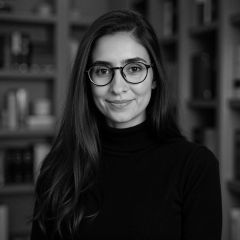
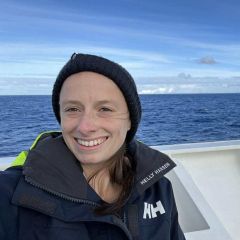
A smiling woman wearing a waterproof dark jacket and black knitted hat on a boat with the sea and blue sky in the background.

Anna Allen

Bio

Anna Allen is in the final stages of a PhD in computer science at the University of Cambridge. Originally from Tasmania, she holds a Master’s in Meteorology from the University of Melbourne and a BSc in Pure Mathematics and Theoretical Physics from the University of Tasmania. Her research applies machine learning to environmental sciences, with a particular focus on developing data-driven forecasting systems for both global weather and high-impact phenomena such as tropical cyclones, tornadoes, and wildfires. During her PhD, she worked part-time with the United Nations Environment Programme to develop an operational system for detecting large greenhouse gas emissions to inform mitigation strategies. 

As a Junior Research Fellow at King’s, she will work on developing end-to-end foundation models for Earth system observation and forecasting, spanning weather, ocean, and air quality prediction. This will include designing bespoke regional forecasting systems for low-resource areas by integrating intelligent sensor placement with AI forecasting models, with pilot projects already underway in the Arctic and planned for West Africa.

Read more
Anna Allen
A woman wearing glasses and a black T-Shirt in front of a white background

Seda Basihos

Bio

Seda Basihos' primary research fields are Political Economy and Economic Growth, with a focus on technology and firm dynamics. She is also interested in Economic History and Development, particularly from the unified growth theory perspective.

Read more
Seda Basihos
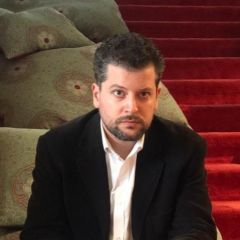
A man in a dark jacket and a white shirt in front of a red staircase

Francesco Bianchini

Bio

Francesco is a medievalist and a member of King's Silk Roads team. He has published on royal patronage of South Asian religions, Sanskrit manuscripts, Buddhist scriptural traditions and their Chinese translations (Perfection of Wisdom) and epigraphic sources. For the Silk Roads programme, he is looking at medical encounters and "healthscaping" between South Asia, Southeast Asia and China, with a focus on mobility and knowledge exchange. He has taught religion and history courses at Oxford, Heidelberg, Mahidol and Cambridge.

Read more
Francesco Bianchini
A bearded man, smiling, wearing a blue blazer, in front of the King's College Chapel and lawn.

Shannon Bonke

Bio

Dr Shannon Bonke is a renewable energy scientist researching catalysts for energy conversion and storage reactions, especially the synthesis of fuels from solar power. His research is interdisciplinary and explores catalytic mechanisms using complementary cutting-edge electrochemical and spectroscopic techniques.

Read more
Shannon Bonke
A woman in a blue top in front of a yellow wall

Katie Campbell

Bio

Katie is an archaeologist who works on the cities of medieval Central Asia and the Caucasus. She completed degrees in history and archaeology at the Universities of Exeter and York, and then worked on a variety of research and commercial archaeology projects across Central Asia and the Middle East, employed by organisations including the British Museum and the Universities of Oxford, London, Stanford and Copenhagen. 

Her doctorate, completed as a Nizami Ganjavi scholar at Oxford, examined archaeological evidence for the Mongol Conquest of the early 13th century and its impact on cities in Central Asia. 

While at King’s she will focus on cities over a longer period, from the 11th to the 15th century, charting changes in their fortunes against the backdrop of dramatic political, linguistic and cultural changes as Turkic and Mongol groups moved into the area.

Read more
Katie Campbell
A long haired smiling woman in front of a cream background.

Iris Hardege

Bio

Iris Hardege is a Royal Society University Research Fellow at the Department of Zoology, where she is interested in understanding how complex behaviours arise from anatomically different brain structures across the animal kingdom. Currently her research predominately focusses on the study of the surprising complexity of neurotransmitters and their receptors in the model organism C. elegans, and how they contribute to the generation of complex behaviours such as learning.

Iris completed her PhD in Medicine at the University of Cambridge in 2017 under the supervision of Dr Kevin O'Shaughnessy, where she studied potassium channels in the adrenal gland and their contribution to rare genetic forms of hypertension. She then went on to do postdoctoral work at the MRC LMB with Dr William Schafer to study ion channel receptors in C. elegans. In 2023 Iris started her own group at the Department of Zoology funded by a Royal Society University Research Fellowship.

Read more
Iris Hardege
A man with a dark jacket over a lighter, knitted jumper, standing in the sunshine outside a city building.

Christoph Hess

Bio

Christoph’s research specialises in the economic history of early modern China and East Asia. For his doctoral work, he reconstructed the institutional framework of inheritance in pre-industrial China through thousands of documents gathered from rural household collections in China. He is currently turning the findings from his doctoral dissertation into his first book, which examines how inheritance interacted with other institutions regulating marriage, migration, and the land market, to limit long-term capital accumulation. His main project as the Mervyn King Research Fellow at King’s will be a comprehensive study of living standards and wealth inequality in China between 1650 and 1950. He is especially interested in the effect of changes in wealth on broad measures of human welfare, such as nutrition, housing quality, and education. Christoph’s other interests include the rise of intellectual pragmatism in late imperial China, servantship and slavery, and rural entrepreneurship in post-reform China.

Christoph received his PhD from the University of Cambridge. Prior to that, he read for an MPhil in Cambridge and a BA in Philosophy and Economics at the University of Bayreuth. Other stations included Zhejiang University, Keio University, the Max-Planck-Institute for the History of Science, and the Max-Planck-Institute for Demographic Research.

Read more
Christoph Hess
A man with dark shoulder length hair and a beard

Reza Huseini

Bio

Reza Huseini is a historian of Iran, India and Central Asia. Growing up in Afghanistan, a country disrupted by war for the last four decades, his journey of education and research is set against an experience of forced migration. He studied history at JNU in New Delhi before moving to Leiden University with a Cosmopolis scholarship. There, for his second MA in history, he researched the historical and cultural interconnectivity between Iran, India and Central Asia. Reza is also a calligrapher of Persian. 

His doctoral dissertation, undertaken at Leiden University, investigated the diverse and dynamic processes of the early Muslim conquests of Bactria in the seventh and eighth centuries. To do so, he worked with a range of Arabic and non-Arabic documentary and literary sources together with other sources of material culture to analyse the consolidation and naturalisation of early Muslim rule in eastern Iranian regions. The diversity in populations, historical and cultural interconnectivity between Iran, India and Central Asia, and Reza’s experience of living in these regions, inspires his ongoing research into the formation of political ideologies. 

Reza’s research at King’s engages with political theories that fostered cohesion between the diverse societies of the Turco-Mongolian empires, which left their traces not only on language and culture, but also on the landscape of these regions.   

Current Projects:


(Under Contract with Edinburgh University Press)

The Arab Conquest of Bactria: Local Power Politics and Arab Domination (651–750 CE)

(Monograph)

The Mongols of Mughal History: Imagining World Empire in Sixteenth-Century India


Research:

Edited Volume or Journal Special Issue (peer reviewed)

2023- With Jelle Bruning, eds., “Textual Sources and Geographies of Slavery in the Early-Islamic Empire, ca. 600-1000 CE.” Journal of Slavery & Abolition Special Issue (136 manuscript pages.) https://doi.org/10.1080/0144039X.2023.2264110

Articles and Book Chapters (peer reviewed)

2025- "From Shadow to Light: Transition of Chinggisid Sacred Kingship under Ghazan Khan and its Rivaval under Akbar," in The Ethics of Idolatry: Sun and Cosmos Worship in Judaism and Islam, edited by Azafr Moin and Jonathan Schofer. Columbia University Press, forthcoming 2025.

2025 "Local Administration in the Late Antiquity Bactria: Documentary Evidence," in State Documents Colloquium, edited by Areou Azad. Edinburgh University Press, forthcoming 2025.

2024- With Jos Gommans. “New Dawn in Mughal India: Longue Durée Neoplatonism in the Making of Akbar’s Sun Project.” Journal of the Royal Asiatic Society. https://doi.org/10.1017/S1356186323000664 

2024- “Between the Arabs and the Turks: Household, Conversion and Power Dynamics in early Islamic Bactria (700–772 CE).” In The Ties that Bind: Mechanisms of Social Dependency in the Early Islamic Empire, edited by Petra M. Sijpesteijn and Edmund Hayes. Cambridge University Press, forthcoming 2024.

2024- “The pre-Mongol city of Balkh as seen by its residents: a report from the Fadaʾil-i Balkh,” in UNESCO Thematic Collection of Cultural Exchanges along the Silk Roads: Architecture, Monuments and Urbanism, edited by Elena Paskaleva and Michael Turner. UNESCO, Paris, forthcoming 2024

2023- “Slavery Represented in Bactrian Documents.” In Textual Sources and Geographies of Slavery in the Early-Islamic Empire, ca. 600-1000 CE, edited by Jelle Bruning and Said Reza Huseini, Special Issue, Journal of Slavery & Abolition. https://doi.org/10.1080/0144039X.2023.2264116

2022- “Thinking in Arabic, writing in Sogdian: Arab Sogdian Diplomatic Relation in the early eighth-century.” In From the Ruler of Samarqand to the Andalusian “Law of the Muslims”: Sogdian, Greek and Arabic Documents and Manuscripts from the Islamicate World and Beyond, edited by Andreas Kaplony and Matt Malczycki, 67–87. Leiden: Brill. https://doi.org/10.1163/9789004527874_004

2022- “The Rebellion of Ḥārith b. Surayj (116–128/734–746): A Local Perspective.” Al-ʿUsur al-Wusṭā 30 (2022): 516–53. https://doi.org/10.52214/uw.v30i.9040

2022- With Jos Gommans. “Neoplatonic Kingship in the Islamic World: Akbar’s Millennial History.” In Sacred Kingship in World History: Between Immanence and Transcendence, edited by Azfar Moin and Alan Strathern, 192–222. Columbia University Press, Doi: 10.7312/moin20416-010

2022- With Jos Gommans. “Neoplatonism and the Pax Mongolica in the Making of Sulh-i Kull: A View from Akbar’s Millennial History.” Modern Asian Studies 56 (2022): 870–901. Doi: 10.1017/S0026749X21000044

2021- “The Muqaddam Represented in the pre-Mongol Persian Documents from Ghur.” AFGHANISTAN 4, no. 2 (2021): 91–113. Doi: 10.3366/afg.2021.0074

2021- “Acts of Protection represented in Bactrian Documents.” Annales Islamologiques 54 (2021): 107–124. Doi: 10.4000/anisl.7655

2020- “The Idea and Practice of Justice Represented in Bactrian Documents.” Association for Iranian Studies, Newsletter 41, no. 2 (2020): 28–31.

2013- “Medieval Tibet in Perso-Islamic Sources.” Journal of Himalayan and Central Asian Studies 18, no. 4, CHINA SPECIAL (2013): 251–283.

2012- “Destruction of Bamiyan Buddha: Taliban Iconoclasm and Hazara Response.” Journal of Himalayan and Central Asian Studies 16, no. 2, BAMIYAN SPECIAL (2012): 1550

2012- “Discovery of Bactro-Achaemenid Site in Northern Afghanistan.” Yavanika: India Society for Greek and Roman Studies 14 (Rohilkhand University, May 2012).c.

Invited Comments and Opinion Essays (not peer-reviewed)

2020- “The Mughal Experiment with Islamic Extremism: A Sixteenth-Century Lesson for Today.” Leiden Islam Blog, Leiden University, available online https://leidenislamblog.nl/articles/the-mughal-experiment-with-islamic-extremism-a-sixteenth-century-lesson-for-today

2018- “Bactrian Documents: New Source for the early Islamic history of Tukharistan.” Humanities Common, available online https://emco.hcommons.org

2021- “Women in late Antique Bactrian Documents.” Leidenmedievalistsblog, available online https://leidenmedievalistsblog.nl/articles/women-in-late-antique-bactrian-documents

2021- “Thumbnail impression on clay sealings from early Islamic Bactria,” Material Cultures III, Humanities Common, available online https://emco.hcommons.org

2020- “Ownership notes in imperial Mughal codices.” Muse & Manuscripts: Lessons in codicology and Paleography, available online https://mouse.digitalscholarship.nl/lessons/babur


Presentations (selected)

2024 “Transition of Chinggisid Kingship under Ilkhanid Ruler Ghazan Khan and its Revival under Mughal Emperor Akbar,” Silk Roads Seminar Series, King’s College, Cambridge, 18 October.

2024 “War and Diplomacy in Medieval Khurasan,” Law, Society, and Politics in Afghanistan: Prospects for Dialogue, Inclusion, and Representation. ALPA Conference, American University, Washington DC, 11 October.

2024 “The Rebellion of Fāʾiq-i Khāṣṣa in Samanid Khurasan,” How Rebellion Ends: Conflict Resolution in the Late Antique and Early Islamicate World, 500-1000 CE. Hamburg University, 12 September. 

2024 “Forms of Political Structure in Medieval Khurasan,” Cambridge Afghanistan Series Conference, September 6.

2024 “A Sixteenth Century Mongol Observation of Tibet,” Lanzhou University, 3 August.

2024 “The Mongol Inspiration of Mughal Political Ideology,” Lanzhou University, 3 August.

2023- “Tarikh-i Alfi: Mughal Millennial History,” Ancient India-Iran Trust, Cambridge, 10 November.

2023- “Slavery in Eastern Iranian Regions: the case of Late Antique Bactria,” The Elahé Omidyar Mir-Djalali Institute of Iranian Studies, and Faculty of Music, University of Toronto, and Invisible East Project, Oxford, 16 October (Online).

2023- Chair and Discussant, History Panel, European Conference on Iranian Studies (ECIS 10), Leiden University, 24 August.

2023- “Form of Political Structure in the Late Antique Bactria,” European Conference on Iranian Studies (ECIS 10), Leiden University, 24 August.

2023- “Local Administration and Political Structure in Late Antique Bactria: Documentary Evidence,” State Documents from the Medieval Islamicate World, Trinity College, Oxford University, 21-23 June.

2023- “New Dawn in Mughal India: Longue Durée Neoplatonism in the Making of Akbar’s Sun Project,” Joint presentation with Jos Gommans for the conference on The Ethics of Idolatry: Sun and Cosmos Worship in Judaism and Islam, UT Austin, 17 April.

2023- “The Arab Muslim Conquests of Qum: Cooperation, Co-existence and the Rise of a New Urban Centre in Iran during the early Islamic Period,” Water & the Urban/Rural Nexus in the Medieval Islamic World, Radboud University, Nijmegen 30-31 March.

2023- “Tarikh-i Alfi: Akbar’s Millennial History,” Persian Impact on History, Literature and Culture of Central and South Asia, British Institute of Persian Studies and Institute of Language Studies and Research, Kolkata, 1-2 March.

2022- Chair and Discussant, Panel on Land Management and the Organisation of Production, A Hard Row to Hoe Conference, Oxford University, 12 December.

2022- “A Sixteenth Century Mongol Observation of Tibet: Mirza Haidar Dughlat and his Tarikh-i Rashidi,” Mongol and Inner Asia Studies Unit, Cambridge University, 15 November.

2022- “A Day in Late Antique Bactria,” (In Persian). For Invisible East Project, Oxford University, 13 October.

2022- “Local Political Autonomy and Overlordship in Late Antique Bactria,” Ahmad Shah Massoud: The Past, Present and Future of Afghanistan II, Emanuel College, Cambridge University, 22-23 September.

2022- “Zoroastrianism in Late Antique Bactria,” IV International Symposium of Young Scholars in the Humanities (ISYS), Ivane Javakhishvali Tbilisi State University, 29 May.

2022- “Slavery Represented in Bactrian Documents,” for Conference on Textual Sources and Geographies of Slavery in the Early Islamic Empire ca. 600-1000, Leiden University, Online Session on 3 March.

2022- “Mongol Nomads in Persianate Discourse,” King’s College, Cambridge University, 22 February.

2022- “Persian Documents form pre-Mongol Ghur,” Invisible East Project, Oriental Institute, Oxford University, 14 February.

2021- “Conquests and Trade in the Early Islamic East,” Networks and Ties of Exchange: Trade ND Merchants Across the pre-Modern Middle East (60-1000) Workshop Leiden University, 3 June.

2020- “Political Fragmentation in Central Asia on the eve of the early Muslim Conquests,” Online Symposium organized by the University of Bukhara, 27 April.

2019- “Between the Arabs and the Turks: The family of Mir b. Bek al-Bamiyāni in early Abbasid Bactria (750-772),” Ties that Bind Conference, Leiden University, 5 December.

2019- “Role of Bactrian local Elites in the Rebellion of Harith b. Suraij in Late Umayyad Khurasan (734-746),” Acts of Rebellion Conference, Leiden University, 7 November.

2019- “The Idea and Practice of Justice represented in Bactrian documents,” 9th European Conference for Iranian Studies, Freie Universität Berlin, 10 September.

2019- “The Idea and Practice of Justice represented in Eastern Iranian world in Late antiquity: The Case of Bactria,” Symposium Iranica, St. Andrews University, 12-14 April (could not attend because my Visa arrived later).

2019- “Early Muslim Patronage and its Impact on the Rise of Local Elites in the Early Islamic Bactria: The case of the Barmakids of Balkh,” NISIS Spring School, Granada, Spain 18-22 March.

2018- “Arab Sogdian Relations reflected in Documents of Mount Mugh,” International Institute for Central Asian Studies (IICAS), Samarkand, 27 September.

2018- “Thinking in Arabic, Writing in Sogdian: Arab Sogdian Diplomatic Relation in the Early Eighth Century Transoxiana,” The International Society for Arabic Papyrology (ISAP), Freie Universität Berlin, 21 March.

2018- “Shia-Sunni Ideological Conflict Represented in the 16th century Mughal Historiography: The Case of Tarikh-i Alfi,” Shia Studies Workshop, Leiden University, 16 November.

2017- “Marriage Regulations in the Eastern Iranian World in the Late Antiquity: The Documentary Evidence,” the Iranian World in Late Antiquity: A graduate Student Workshop, The Chicago Initiative for Global Late Antiquity, the University of Chicago Center in Paris, the Oriental Institute, and the EPHE Paris, 18 September.

2017- “Sixteenth Century Millennium and the Making of the Tarikh-i Alfi in Mughal India,” Global Nodes, Networks, Orders: Three Global History Workshops on Transformative Connectivity, Leiden University, 20 April.


Conferences and Colloquia

2024 Organiser, “Afghanistan: A Neglected Reality”. King’s College, University of Cambridge, 7 June 2024.

2023 Chair and Discussant, History Panel, European Conference on Iranian Studies (ECIS 10), Leiden University, 24 August.

2022 Chair and Discussant, Panel on Land Management and the Organisation of Production, A Hard Row to Hoe Conference, Oxford University, 12 December.

2021- present, Co-organiser of King’s Silk Roads Weekly Seminars.

2021 Co-organiser with Jelle Bruning, Textual Sources and Geographies of Slavery in the Early-Islamic Empire, ca. 600-1000 CE. Two rounds of online conferences on 3-4 December

2020 Co-organiser with Shuqi Jia, Contesting Empires: Sogdiana, Bactria and Gandhara between the Sasanians, the Tang, Turkic rulers, the Umayyads and the early Abbasids (ca. 600-1000 CE), Leiden University, 17-18 September (Virtual meeting).


Documentaries, Discussions (selected)

2024-Understanding Today’s Afghanistan, Mare Newspaper, March 28. https://www.mareonline.nl/wetenschap/de-amerikanen-hebben-nooit-hun-lesje-geleerd/

2024-A Night with Buddha Programme, organised by the Swedish Kulturhuset  Stadsteatern, Stockholm, March 10. https://www.youtube.com/watch?v=R0FZUZARU_8

2023- Influence of Buddhism on Islam (Ta’thiri Buddism bar Iran), BBC Persian Pargar17 June. https://www.youtube.com/watch?v=qjZG-JpPb18&t=1554s 

2023- History of Music in Iran (Sarguzasht-i Musiqi Iran), Part 2 Marjan TV Network (based in London), 6 February. https://www.youtube.com/watch?v=GI79GQmMZNA&t=3674s

2022- History of Music in Iran (Sarguzasht-i Musiqi Iran), Part 1 Marjan TV Network (based in London), 19 April. https://www.youtube.com/watch?v=nuk04nTzIys&t=332s

Read more
Reza Huseini
A smiling man with dark hair and wearing a dark shirt in front of an ivy covered wall.

Harin Lee

Bio

Harin combines big data with cross-cultural experiments to investigate the psychological foundations of music cognition. His varied experience ranges from conducting field experiments in the Bolivian Amazon to developing human-in-the-loop online paradigms for studying cultural evolution processes in artificial worlds. At King’s College, he will bring together these skill sets to analyse the temporal structures of music and speech collected from tens of thousands of radio stations around the globe, with the aim of uncovering the demographic, linguistic, and cultural dimensions of human rhythm.

Harin completed his PhD at the Max Planck Institute in Germany (MPI for Human Cognitive and Brain Sciences; MPI for Empirical Aesthetics). He has also spent time in industry (Deezer Research, Paris) and is a co-founder of aiar, an art-science collective that integrates real-time brain imaging into live audiovisual performances, including recent events at venues such as Berghain in Berlin.

Read more
Harin Lee
A smiling man with dark hair and glasses, standing in a green meadow.

Zhuangnan Li

Bio

Zhuangnan LI is a chemist and material scientist interested in next-generation energy storage technologies. His research focuses on atomically thin two-dimensional materials for high-energy, fast-charging and long-life batteries. He has demonstrated an electrochemical energy storage device that can be fully charged within 10 minutes, and retain about 99% of its initial capacity after running for 20,000 cycles. His recent study develops a metal-free battery system based on the earth-abundant sulfur element, which can store twice the energy of state-of-the-art commercial lithium-ion batteries. Currently, his primary research interests lie in development of fundamental understanding on material properties for next-generation energy storage.

Read more
Zhuangnan Li
Georgia Nasseh, a black and white image of a smiling woman with long dark hair and glasses wearing a dark jumper

Georgia Nasseh

Bio

Georgia is Research Fellow in the Literatures of the Global South at King’s College, Cambridge. After reading for a BA in English at Queen Mary, University of London (2013–2016) and an MSt in English at the University of Oxford (2016–2017), she completed a DPhil in Medieval and Modern Languages at the University of Oxford in 2023. Her DPhil research was concerned with multilingualism and translationality, with an emphasis on the work of Angolan author José Luandino Vieira. More broadly, she has research interests in colonial and anticolonial literatures, transnationalism and internationalism, and Cold War aesthetics, as well as colonial and decolonial linguistics, multi-, pluri-, and translingualism, and literatures written in and across European and African languages.

As a Research Fellow at King's, she is exploring how performance companies, festivals, and the space of the theatre have operated as transnational sites of internationalist activity across Africa and the Americas between the 1960s and the 1980s, foregrounding the literary and intellectual production of Portuguese-speaking nations within comparative frameworks. She is currently organising an international conference, ‘Translation Networks in the Decolonising World, 1950s–1970s’, which will take place at King’s in April 2026.

She has recently held a Senior Lectureship in Portuguese and a Departmental Lectureship in Brazilian and African Portuguese at the University of Oxford’s Faculty of Medieval and Modern Languages. Between 2022–2024, Georgia also acted as Co-ordinator of the Oxford Comparative Criticism and Translation (OCCT) Research Centre, based at St Anne’s College, Oxford where she organised the Centre’s activities and events — including seminars and panel discussions, workshops and conferencesinternational exchanges, in addition to the annual Oxford Translation Day — and contributed to the development of the Centre’s research agenda. In 2025, she acted as judge for the Stephen Spender Trust’s Portuguese Spotlight Prize.

Read more
Georgia Nasseh
A smiling woman with curly, shoulder length dark blonde hair, wearing a dark blue collared shirt open at the neck, in front of a yellow and beige background.

Rebecca Orr

Bio

Rebecca’s research looks at how postcolonial migration resulted in the emergence of new types of professional work and workplace in post-war Britain and its former colonies. Her doctoral thesis explored the constitutive role played by ‘European’ migrants of decolonisation in three sectors on the ascent—private security companies, universities and charitable organisations—to understand the social and economic consequences of decolonisation in Europe. As a research fellow at King’s, she is developing a project on postcolonial families in twentieth-century Britain, investigating intergenerational memory, race and belonging. At the centre of her research is an attempt to show how the arrival of postcolonial migrants reshaped not only citizenship legislation but also the organisation of work, political life and cultural production across Europe.

Rebecca received a BA in History from the University of Cambridge and an MA in Modern History from the University of Warwick. She worked as a research assistant for the Global History of Capitalism project at the University of Oxford before completing her PhD in History at the European University Institute.

Read more
Rebecca Orr
A smiling woman with shoulder length dark hair, wearing glasses and a grey blazer over a white shirt.

Minjung Park

Bio

MJ is a Kavli Institute Postdoctoral Fellow at Kavli Institute for Cosmology, Cambridge (KICC) and at the Department of Physics (Cavendish Laboratory). She is interested in understanding how galaxies formed in the early universe and how they evolved throughout cosmic time. Her doctoral thesis focuses on the formation of massive quiescent galaxies – galaxies that no longer form stars and remain red and dead (“quenched”). She uses both observational and theoretical techniques to study their star-formation histories, quenching mechanisms, and chemical abundances. She has also developed new stellar population models which can be used to fit observed galaxy spectra and derive accurate properties of galaxies (e.g., age and mass).

As a Research Fellow at King’s, she plans to apply the new models she developed to massive quiescent galaxies found in the early Universe, in the first billion years after the Big Bang. The new models will help reveal their true formation histories, answering one of the key questions in astronomy – how the first galaxies in the Universe grow into the most massive galaxies today.

MJ completed her PhD in Astronomy & Astrophysics at Harvard University in 2025. She is originally from Seoul, South Korea. She did her undergrad and master’s in astronomy at Yonsei University, where she studied the origin of diverse morphology/shapes of galaxies using high-resolution cosmological galaxy simulations.

Read more
Minjung Park
A man in a green top in front of a Venetian lagoon

Angus Russell

Bio

Angus works on the history of Mongol and post-Mongol Eurasia, with a particular focus on the politics and institutions of Rus’ and Moscow in the late medieval period. His doctoral thesis traced the evolution of fiscal models in the regions conquered by the Mongol khans. As part of his research fellowship at King’s, he hopes to explore the role language and translation can play in studying the cross-cultural interactions of pre-modern societies. Angus studied for his PhD in Slavonic Studies at Trinity College, Cambridge, after an undergraduate degree in History and Russian, and a master’s degree in Late Antique and Byzantine Studies at the University of Oxford.

Read more
Angus Russell
A smiling man standing on a rocky beach, holding a large stone in his hands and pointing and the different coloured stripes on it.

Nile Stephenson

Bio

Nile is the Roger Evans and Aey Phanachet Research Fellow in Co-evolution and Symbiosis. He is based in the Department of Zoology. His research broadly encompasses understanding how ecosystems change in time and space. In his fellowship, Nile will be focussing on how the ecological dynamics of coral reefs change as they experience the effects of climate change. In his work, he uses a range of mathematical models and field techniques to assess whole-ecosystem processes on coral reefs in the Seychelles, integrating spatial maps of coral reefs, behavioural data on sharks, and environmental data. A key aspect of his work is disentangling the drivers of ecosystem stability, and seeking to understand the fundamental properties that contribute towards stable states in ecology. He is also interested in how ecosystems have changed through deep time, particularly focusing on critical transitions in evolutionary history such as the evolution of animals.

Nile studied at Aberystwyth University and the University of Exeter before his PhD at the University of Cambridge (St. Catharine’s College), which he completed in 2025.

Read more
Nile Stephenson
A smiling woman with shoulder length dark hair, wearing a green and purple shirt.

Ruiyi Zhu

Bio

Ruiyi Zhu is a social anthropologist with a keen interest in global China. Her doctoral thesis focuses on Chinese labour migrants in Mongolia’s post-socialist extractive economy, demonstrating how domestic political economic processes influence patterns of transnational engagement. As a research fellow at King’s, she will build on previous research and transition her inquiry from labour surplus to protein deficiency within the broader framework of global China. Specifically, she will explore how biopolitics, nutritional science, and the transnational food industry shape Chinese dietary thoughts and practices. Ruiyi received her PhD from the University of Cambridge in 2023. Before returning to Cambridge, she was a Global Perspectives on Society Postdoctoral Fellow at NYU Shanghai. 

Read more
Ruiyi Zhu

Life Fellows

Michael Bate, a smiling man with short dark hair wearing a red t-shirt

Michael Bate

Bio

How the machinery underlying coordinated movement is assembled during embryonic development.

Read more
Michael Bate
Nick Bullock, a smiling bald man wearing a grey jumper and standing in front book shelves

Nick Bullock

Bio

Nick Bullock's research focuses on reconstruction in post WWII Europe, particularly in France and Germany.

Read more
Nick Bullock
Keith Carne, a smiling man with short grey hair and beard wearing a white shirt and a grey suit

Keith Carne

Bio

Geometric complex analysis, statistical theory of shape.

Read more
Keith Carne
Peter de Bolla, a man with grey hair, glasses and a grey shirt is giving speaking into a microphone

Peter de Bolla

Bio

Eighteenth century literature; Wordsworth; visual culture of the enlightenment; topics in the history and theory of criticism, especially Kant, Post Structuralism, Cavell.

Read more
Peter de Bolla
John Dunn, a smiling bald man with rectangular glasses and a black blazer in front of book shelves

John Dunn

Bio

My research is on the historical development of political ideas and the political significance of their application in practice. It has covered the political thought of Locke, the aetiology and political consequences of revolutions, the politics of postcolonial Africa, political thinking across the world and over time, and most recently the dynamics of regime persistence and change across the globe over the last century and their prospective implications for the human future now that that is so obtrusively in jeopardy. For the last three decades it has focused particularly on the diffusion of democracy as a term, a range of hazily associated ideas, and the very diverse regime that have claimed and continue to claim to realise some version of those ideas, especially in China, Japan, Korea, South Asia, and, alas most recently, the United Kingdom, Europe and the United States too.  

My main works are The Political Thought of John Locke, Modern Revolutions, Western Political Theory in the Face of the Future, The Cunning of Unreason: Making Sense of Politics, and Setting the People Free: The Story of Democracy.

Read more
John Dunn
George Efstathiou, a man with dark grey hair wearing a red shirt

George Efstathiou

Bio

Professor Efstathiou has wide interests in theoretical and observational cosmology and has contributed to studies of large-scale structure in the Universe, galaxy formation, dark energy and the cosmic microwave background radiation. He is a member of the Science Team for the European Space Agency Planck Satellite, launched in May 2009, which is mapping the temperature and polarization anisotropies of the cosmic microwave backround to unprecedented precision.

Read more
George Efstathiou
James Fawcett, a smiling man with short grey hair wearing a pale blue shirt, dark tie and grey jacket

James Fawcett

Bio

Axon regeneration in the Central Nervous System; plasticity and recovery from nervous system damage; the CNS injury response; a peripheral nerve repair prosthesis; clinical trials protocols for spinal cord injury.

Read more
James Fawcett
Iain Fenlon, a smiling man with sort grey hair wearing a pink shirt. He is sitting outside.

Iain Fenlon

Bio

Music from 1450 to 1650, particularly in Italy.

Read more
Iain Fenlon
Robert Foley, a smiling man with brown hair wearing a brown jacket and a purple scarf. He is outdoors in a sunny, mountainous region

Robert Foley

Bio

Rob's research covers human evolution; evolutionary theory and biology; evolutionary ecology and African prehistory.

Read more
Robert Foley
Anthony Giddens, a smiling man with short fair hair wearing a yellow shirt

Anthony Giddens

Bio

Double hermeneutic, duality of structure, structuration theory, third way

Read more
Anthony Giddens
Chris Gilligan, a smiling man with short grey hair and glasses wearing a pale suit. He is standing outdoors in a green space.

Chris Gilligan

Bio

Spatial and temporal models for soil-borne plant disease, non-linear estimation, complexity and simplicity in modelling biological systems.

Read more
Chris Gilligan
A man in a dark coat stands in front of a stone archway

David Good

Bio

David Good is in the Department of Psychology, and is a Fellow and Research Manager at King’s College.  He has served on all the major governance bodies in Cambridge, and been involved in many educational, research and governance innovations. His research focuses on the application of ideas and methods from Psychology, to practical issues in industry and society.

Read more
David Good
Ross Harrison, a smiling man with grey hair wearing a white shirt.

Ross Harrison

Bio

History, Early Modern Philosophy, Philosophy, History of Ideas and Intellectual History

Read more
Ross Harrison
John Henderson, a smiling man with shoulder length grey hair wearing a blue t-shirt

John Henderson

Bio

Research: John – yes we do first names in King’s Classics – is a Life Fellow, which means I made it through to retirement. I teach all sorts of Latin texts, but I was Professor of Classics because I roamed all over classical studies, wrote about favourite Greek and Latin authors, philosophy, history, and art, themes in ancient and neo-classical culture, and topics in the history of classical scholarship and commentary.  

Read more
John Henderson
Stephen Hugh-Jones, a man with grey hair smiling broadly

Stephen Hugh-Jones

Bio

Research: Oral narratives, ritual, shamanism and religion; human - animal relations and ecological anthropology; kinship and the anthropology of architecture; cultural politics and indigenous movements; linguistic anthropology and Amerindian languages; Latin/South America; fieldwork in Colombian Amazonia.

Read more
Stephen Hugh-Jones
A woman sits on a sofa with a book open on her lap

Caroline Humphrey

Bio

Caroline Humphrey's PhD (1973) from the University of Cambridge was on 'Magical Drawings in the Religions of the Buryats', supervised by Edmund Leach. Since 1978 she has held appointments in the Department of Social Anthropology (Cambridge). Together with Urgunge Onon she founded the Mongolia and Inner Asia Studies Unit (MIASU) in 1986. She retired from her post as Sigrid Rausing Professor of Collaborative Anthropology, University of Cambridge in October 2010 and became Director of MIASU.

Read more
Caroline Humphrey
Martin Hyland, a smiling man with short grey hair and glasses. He is wearing a pink shirt and a grey jacket.

Martin Hyland

Bio

Research: Abstract mathematics (category theory in particular) applied to logic (proof theory), theoretical computer science (semantics) and higher dimensional algebra.

Read more
Martin Hyland
Barry Keverne, a man with grey hair and glasses wearing a striped shirt and a dark jumper

Barry Keverne

Bio

Professor Keverne has long standing experience in behavioural neuroscience and has, in the past 10 years, brought molecular genetic techniques to focus on brain development and investigate how genetic perturbations of the brain influence brain function. In particular he has employed androgenetic and parthenogenetic chimeras to understand how the imprinted genome influences brain development and has extensively investigated the adult phenotype of mice carrying a mutation in paternally expressed genes. These studies have led to a co-adaptive evolutionary theory of brain and placental development through genomic imprinting. Pheromonal influences on behaviour and endocrine responses in mice is also a long standing interest and in recent years, together with Piers Emson, he has investigated pheromonal signalling via Erk and Akt phosphorylation to enhance vomeronasal neural regeneration survival.

Read more
Barry Keverne
James Laidlaw, a black and white photo of a man with short curly hair wearing a scarf. He is outside in an urban environment

James Laidlaw

Bio

Research: The interface between anthropological and ethical theory; religion and ritual, with special interest in Jainism, Hinduism, and Buddhism, theoretical approaches to religion including cognitive psychology, and contemporary transformations in religions in Asia, including new forms of Buddhist self-formation.

Read more
James Laidlaw
Alan Mcfarlane, a smiling man wearing a brown rimmed hat, a pale blue shirt and a dark blue jumper. He is standing in front of a green river bank

Alan Macfarlane

Bio

Research: As an anthropologist and historian he has worked on England, Nepal, Japan and China. He has focused on a comparative study of the origins and nature of the modern world.

Read more
Alan Macfarlane

Emeritus Fellows
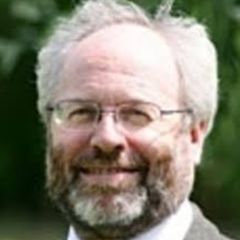
Tim Griffin, a smiling man with short grey hair and glasses wearing a blue t-shirt and a grey cardigan. He is outdoors standing in front of a bush.

Tim Griffin

Bio

Tim's research interests include network protocol design and analysis and mathematical models of Internet routing. He also serves on the Turing Programme committee at King's.

Read more
Tim Griffin
Aileen Kelly, a woman with short dark hair wearing a black top, geometric scarf and silver necklace.

Aileen Kelly

Bio

Research: Nineteenth- and early twentieth-century Russian intellectual history.

Read more
Aileen Kelly
Richard Lambert, a man with very short dark hair and glasses wearing a yellow shirt

Richard Lambert

Bio

Research: Development of new heterogeneously-catalyzed routes relevant to organic synthesis especially with respect to the production of fine chemicals and pharmaceuticals. Energy-related applications of catalysis, including high temperature fuel cells. Molecular self-assembly, chiral systems and enantioselective catalysis. Plasma-driven catalysis, nanoarchitectures for sensing and catalytic applications. New materials for hydrogen storage. Studies of high-energy helium and hydrogen ion implantation in alloys relevant to the operation of thermonuclear reactors. A wide range of experimental conditions are used ranging from single crystal surfaces in ultra high vacuum to nanoparticle systems in liquids under high pressure.

Read more
Richard Lambert
Ashley Moffett, a smiling woman with short grey hair wearing a blue and black scarf in a pale pink room

Ashley Moffett

Bio

Research: Interactions between maternal Killer-cell Immunoglobulin-like Receptor (KIR) and fetal HLA-C molecules. Culture of human trophoblast cells. Maternal Health Research Unit linked to Makerere University, Mulago Hospital, Kampala, Uganda.

Read more
Ashley Moffett

Bye-Fellows

David Arvidsson-Shukur, a man with short dark curly hair and round tortoiseshell glasses. He is wearing a lilac shirt and standing in front of a brightly coloured wall.

David Arvidsson Shukur

Bio
Research

Quantum Information
Quantum Algorithms
Foundations of Quantum Mechanics

Read more
David Arvidsson Shukur
William Baker, a smiling man with short grey hair and glasses wearing a white shirt and a jumper.

William Baker

Bio
Research 

Research focus is on adapting the work of Maxwell, Rankine, Airy, Cremona and Michell for the design of modern structures.

Read more
William Baker
A smiling woman with long blonde hair, wearing a dark top, with King's College Chapel in the background.

Kerri-Ann Butcher

Bio

Kerri’s main research interests include the phonetics-phonology interface and sociolinguistics, with a focus on sound and language change across time and space, drawing on methods and theory from sociology, spatial statistics and geography. She is particularly interested in conducting spatial analyses of language data that concern dialect transmission and the adoption/retention of linguistic variants by mobile speakers in England. Her work in acoustic phonetics applies instrumental and experimental approaches to understanding the links between speech perception and production – both in terms of social meaning and the raw speech signal – and how phonetic and/or individual variation might influence sound change.

In April 2025, Kerri was awarded an ESRC New Investigator Grant to undertake a three-year research project: “A Real-Time Approach to Understanding Language Variation and Change: The Social Variation of English in Norwich Revisited”. The project tracks language change over a time span of 60 years, elucidating in real time the underlying mechanisms and dynamics of the dialect levelling process, while addressing the fundamental – yet vexed – question of whether the individual’s grammar can change over the lifespan. Kerri is also collaborating with Professor Bert Vaux to produce the first data-driven Atlas of World Englishes. The project combines recent advances in online crowdsourcing, geospatial data visualisation, dialectometry, and statistical physics with a view to better understanding linguistic macrovariation, microvariation, and nanovariation in the English-speaking world today.

Kerri is a Lecturer in English Language at the University of Leeds and is also an affiliated member of the Phonetics Laboratory at the University of Cambridge. A King’s College alumna (PhD, Theoretical and Applied Linguistics, 2022), she served as a College Research Associate at King’s between 2023-2025 while undertaking research on language change in post-industrial coastal communities as part of an ESRC Postdoctoral Fellowship at the University of Cambridge. 

Read more
Kerri-Ann Butcher
A man in a blue shirt

Peter Frankopan

Bio

Peter is the foremost expert on the Silk Roads in the UK, Professor of Global History at Oxford University, Director of the Oxford Centre for Byzantine Research, Senior Research Fellow at Worcester College, Oxford and associate fellow at King’s College. He works on the history of the Mediterranean, Russia, the Middle East, Persia, Central and Southern Asia, and on relations between Christianity and Islam, and is particularly interested in exchanges and connections between regions and peoples.

Read more
Peter Frankopan
Jane Hall, a black and white image of a smiling woman with long dark, wavy hair and a nose ring wearing a striped top.

Jane Hall

Bio
Research

Dr Jane Hall is the inaugural recipient of the British Council Lina Bo Bardi Fellowship (2013) and a founding member of the architecture collective Assemble. In 2015, Assemble won the Turner Prize for their work refurbishing a series of houses in collaboration with residents in Granby, Liverpool and were recently elected as Royal Academicians. Jane completed a PhD at the Royal College of Art, London (2018) on the legacy of modernist architects in Brazil and the UK in the immediate postwar period. With Assemble, Jane has delivered a number of high profile public art and exhibition commissions, including The Brutalist Playground (2015), Skating Situations (2021), Charlotte Perriand (2021), Dreamachine (2022) and the recently completed Bill Brown Creative Workshops for Churchill College, University of Cambridge. She is currently the Project Lead for a new Maggie’s, a cancer care and support centre, in Maidstone, Kent.

Jane has been a jury member for the Stirling Prize (2017), and a visiting lecturer at the Architectural Association (AA), Royal College of Art (RCA), Bartlett School of Architecture and the University of Cambridge. Jane is the author of two books, Breaking Ground: Architecture by Women (Phaidon, 2019) and Woman Made (Phaidon, 2021), which are about the work of women architects and designers globally. She is currently writing a narrative history of gender, sisterhood and queerness in architecture.

Read more
Jane Hall
Richard Jozsa, a smiling man with white hair and glasses, He is at the beach and wearing a weatherproof jacket.

Richard Jozsa

Bio
Research

Quantum Computation, Quantum Algorithms and Computational Complexity, Quantum Information Theory.

Read more
Richard Jozsa
A smiling man with long, tied back, dark hair, a a beard and glasses. He is wearing a black T-shirt and is standing against a olive green background

Pedro Mendes Loureiro

Bio

Pedro Mendes Loureiro is the Director of the Centre of Latin American Studies (CLAS) and Associate Professor at the Department of Politics and International Studies (POLIS). Primarily a political economist, at the heart of his work is a commitment to interdisciplinarity and methodological pluralism, with interests ranging wide across the social sciences. Substantively, Pedro is a scholar of inequality and of development strategies, with the ultimate goal of helping combat social inequalities in all their forms and wherever they might arise. 

He has researched and published on the political economy of development strategies in Latin America; on the changing dynamics of race, class and gender inequality; on social policies and their politics; on inequality measurement; and on the history of Latin American social thought. Pedro also collaborates with development agencies and NGOs in devising frameworks and policies to tackle multidimensional inequalities. 

Pedro's current research focusses on the expansion of the prison system and the political economy of incarceration in Brazil. It is funded by the Leverhulme Trust and the Harry Frank Guggenheim Foundation.

Read more
Pedro Mendes Loureiro
Ferdia Stone Davis, a woman with short black hair wearing a purple top. She is standing in a study

Férdia Stone-Davis

Bio
Research

Férdia Stone-Davis’ research interests lie at the intersection of theology, philosophy, and music, focusing on the different ways in which music allows us to “make sense”. She has written about musical beauty and the sublime, as well as about musical “worldmaking” more generally. She is Director of Research at the Margaret Beaufort Institute, Cambridge. She is currently on research leave from this role, working on a three-year project “The Epistemic Power of Music”, funded by the Austrian Science Fund (FWF) and based at the University of Music and the Performing Arts, Graz. She has a developing interest in music and freedom. In 2025 she will become part of the AHRC-funded 24-month Abolition Song and Its Legacies (ASaiL) Scholar’s Network based at the Guildhall School of Music and Drama.

Férdia received BA in Theology and Religious Studies, MPhil in Philosophy of Religion and PhD from the University of Cambridge. She also has an MMus in Early Music Performance Studies from Trinity College of Music, London. She is committed to thinking across disciplines and facilitating their interaction, and is currently the chair of the Royal Musical Association Music and Philosophy Study Group, which provides a forum offering opportunities for those interested in music and philosophy to share and discuss their work.

Read more
Férdia Stone-Davis

College Research Associates
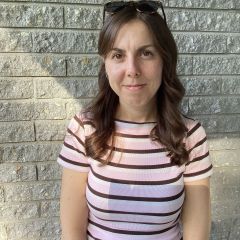
A smiling woman with long, dark hair in front of a white background.

Shruti Balaji

Bio

Shruti is a British Academy postdoctoral fellow at the Department of Politics and International Studies (POLIS). She is a theorist and historian of international relations and anticolonial women’s political thought in the twentieth century. Shruti received her PhD from the Department of International Relations, London School of Economics, where she wrote a thesis on the formation of elite Indian women's international thought on gender, race, and anti-imperial solidarities in late British India through multi-sited, archival research. Before commencing her PhD, Shruti was a candidate of the Double Master’s in International Affairs at Sciences Po, Paris, where she studied for an MA in International Security and at the London School of Economics, where she completed her MSc in International Relations (with Distinction). 

At POLIS and King’s College, she will work on her postdoctoral project, “At the Margins of the Cold War: New Theory of Indian women’s pacifist thought” and host a podcast series on ‘Forgotten Cold War women’.  

Read more
Shruti Balaji
A smiling bearded man with glasses, sitting in a train.

Nick Evans

Bio

Nick is an early medieval historian specialising in the Caucasus and the Eurasian steppe. Nick is an Associate Researcher in the History Faculty. His education was at the University of Oxford (DPhil in History, 2016). He has held research posts at the Austrian Academy of Sciences and Clare College, Cambridge, and teaching posts at King’s College London, the University of Leeds, and Birkbeck, University of London.

Nick is a researcher on the Ukrainian History Global Initiative (UHGI, https://uhgi.org/). The UHGI aims to offer Ukrainian and global publics a decolonised, long-term history of the territories that today form Ukraine. Nick’s focus within the project will be on the nomadic empire of the Khazars, which dominated those territories in the early middle ages. This builds on his previously published work and his monograph on the early medieval North Caucasus, currently under review with Oxford University Press.

While at King’s, Nick will be bringing his work on medieval steppe societies into dialogue with the work of the King’s Silk Roads Project. He will also be developing his parallel project on medieval economic anthropology, which uses medieval descriptions of other societies’ economic practices as sources for the wider history of economic thought.

Read more
Nick Evans
Ross Findlay is facing away from the camera. He is wearing a long white lab coat and is working in front of come machinery. He has long lark hair and is wearing a face mask and gloves

Ross Findlay

Bio

Ross Findley is a Postdoctoral Research Associate in meteoritics, funded by The Leverhulme Centre for Life in the Universe and based in the Department of Earth Sciences. He obtained is BSc in Geology at Durham University in 2016, followed by 18 months as a research assistant in the Arthur Holmes Geochemistry Laboratory at Durham researching a meteorite called Allende. Following this, Ross started his PhD in CM chondrite meteoritics at The Open University in 2018, with completion in late 2023.

His research interests revolve around using meteorites to decipher the earliest years of the Solar System through to the first stages of planet formation, with the over-arching aim to better understand the origins of the asteroids and terrestrial planets. This also encompasses broader questions concerning how our own planet eventually became habitable.

Over the course of his early career, Ross has worked on a range of different meteorites with a particular focus on the O-isotope composition of carbonaceous chondrites and materials brought back from asteroids Ryugu and Bennu by JAXA’s and NASA’s sample return missions Hayabusa2 and OSIRIS-REx, respectively. He is continuing this theme during his postdoc, utilising the Li-isotope system under the guidance of Professor Helen Williams to understand how water moved or flowed on early formed (primitive) asteroids.

Read more
Ross Findlay
A smiling man, wearing a coat and scarf, in front of a green meadow and cloudy grey sky.

Nicholas Fitzhenry

Bio

Nicholas Fitzhenry is a historian of health, inequality, and empire. He received his PhD in Economic History from the London School of Economics (LSE), where his doctoral research examined racial disparities in mortality and healthcare provision in 20th-century South Africa. He is currently the Economic History Society–IHR Tawney Postdoctoral Fellow at the Cambridge Group for the History of Population and Social Structure (CAMPOP) in the Department of Geography, University of Cambridge. Nicholas has taught courses on global economic history, Middle Eastern economic history, and historical inequality at the LSE, receiving recognition for teaching excellence. At King’s, his research will focus on the imperial geography of healthcare, reconstructing and analysing a comprehensive dataset of medical professionals across Britain and its empire between 1850 and 1960. This project investigates how networks of physicians, midwives, and nurses shaped the global distribution of medical expertise and health outcomes, drawing on newly digitised registers, archival sources, and digital humanities methods.

Read more
Nicholas Fitzhenry
A smiling man with short dark hair wearing a black shirt in front of a light grey background.

Kyriakos Flouris

Bio

Kyriakos Flouris is a Junior Group Leader at the Biostatistics Unit, University of Cambridge, where he is establishing a research programme at the crossroads of statistics, machine learning, and physics. His current work focuses on biomedical applications, exploring generative models for time-dependent data, latent dynamics through manifold learning, and the development of robust AI systems grounded in geometric and mathematical principles.

Before joining the University of Cambridge, Kyriakos was a Senior Research Scientist in the Biomedical Image Computing Group at ETH Zürich, following earlier research at the Institute of Astrophysics. He holds a BA and MSci in Physics from Cambridge and a PhD in Computational and Theoretical Physics from ETH Zürich. His career has bridged, biomedical imaging, physics, AI, and data science, reflecting a long-standing interest in using mathematical tools to make sense of complex systems. Outside the lab, he enjoys skiing,  biking, and the occasional football match.

Read more
Kyriakos Flouris
A smiling woman with glasses and long hair, wearing a blue shirt, in front of a colonnade.

Paula Garcia-Galindo

Bio

Paula is a Postdoctoral Research Associate in the Fusco Lab at the Cavendish Laboratory, University of Cambridge. Her research lies at the interface of theoretical evolution and ecology, with applications to molecular and microbial systems. Originally from Madrid, she completed a BSc in Physics at EPFL (Switzerland) and an MSc in Physics at Imperial College London.

During her PhD in the Department of Chemical Engineering and Biotechnology at the University of Cambridge, her interests shifted toward biophysics and evolutionary biology. Her doctoral work focused on the evolution of RNA phenotypic diversity and plasticity, using the genotype–phenotype (GP) map—a computational framework that quantifies how genetic change translates to phenotypic change.

At the Cavendish Laboratory, her research explores the co-evolution between bacteria and their viruses (phage), developing theory informed by experimental questions. She is broadly interested in how phenotypic plasticity shapes and is caused by evolution.

Read more
Paula Garcia-Galindo
A smiling woman with dark curly hair.

Becky Heath

Bio

I grew up on the outskirts of Southeast London before completing an integrated master's in Natural Sciences at Exeter University. I then spent 4 years at Imperial College London working on a PhD in Design Engineering and Life Sciences, specifically developing acoustic tools for autonomous monitoring of tropical rainforests.

I began working here at the University of Cambridge in the Department of Zoology in February 2023, where I have instead been researching sustainable tropical agriculture more broadly. Here we are using an interdisciplinary approach to understand the drivers and outcomes of differences in riparian buffer restoration in smallholder and industrial plantations alike. 

Beyond academia, I am passionate about widening participation and encouraging people from all backgrounds to feel comfortable in academic circles. I also really enjoy working with artists and musicians to create pieces inspired by the natural world and am always on the look out for collaborations.

Read more
Becky Heath
A smiling man with blond hair and beard with a blooming tree in the background.

Olaf Kranse

Bio

Olaf Kranse is a plant-parasitic nematologist. These plant pathogens account for at least £80 billion  worth of crop damage globally every year. His current focus on discovering naturally occuring loss of susceptibility or resistance of the host to these parasites in both crops and model plants.

The traditional assay to investigate this is both time consuming and laborious. As part of his work he develops machinery (both hardware and software) to laregly automate the lab work. These tools have allowed the lab to collect more data in one experiment, than the field has as a collective in the past 60+ years.

Read more
Olaf Kranse
A smiling woman with long blond hair with a lake and mountain in the background

Laura Martin

Bio

Laura studied Chemistry and Mathematics through the Natural Sciences program at Durham University, graduating in 2017, then spent a year working in industrial labs. In 2018-2019, she studied an MRes in Green Chemistry, Energy and Environment at Imperial College London, undertaking a 9-month research project with Profs Jason Hallett and Karen Polizzi on modifying and stabilising enzymes to improve biocatalysis for greener chemical processes. For her PhD at the University of Oxford, Laura’s research focussed on the sustainable and renewable production of biochemicals from bacteria and organic waste, where she was also awarded an EPSRC Doctoral Prize Fellowship. 

In Cambridge Laura is part of the Hollfelder group in the Biochemistry Department, and working on the Preventing Plastic Pollution with Engineering Biology (P3EB) project, using high-throughput screening methods to evolve plastic-degrading enzymes. The project is a collaboration between a number of leading UK universities to find a biological method for treating plastic waste. Laura will be bringing this interest in addressing plastic pollution and waste management to King’s by working with the college to monitor and improve its recycling rates and awareness.

Read more
Laura Martin
Samuel Moore, a smiling man with a shaved head and yellow glasses. He is wearing a tweed tailored jacket and is standing in building with large windows

Samuel Moore

Bio

I am the Scholarly Communication Specialist at Cambridge University Libraries & Archives and Principal Investigator of the research project Materialising Open Research Practices in the Humanities and Social Sciences (funded by Wellcome Trust, AHRC and the Research England Development Fund). My research sits within the digital humanities and focuses on topics relating to academic publishing, research practices in the humanities and social sciences, and critical issues relating to research communication. I have just published my first monograph with the University of Michigan Press entitled Publishing Beyond the Market: Open Access, Care, and the Commons.

Read more
Samuel Moore
Sarah Paris, a smiling woman with long hair, wearing a white turtleneck jumper and a black jacket.

Sarah Paris

Bio

Dr Sarah Paris earned her BA in Ancient History and Archaeology from the University of Manchester, followed by an MSc in Skeletal and Dental Bioarchaeology at University College London. She began her career as a commercial field archaeologist and later established an osteology laboratory. She then completed her doctorate in Biological Anthropology at the University of Cambridge, where her doctoral research explored taphonomy and the prehistoric use of ochre in burials at Khok Phanom Di, central Thailand (dating to 4,000-3,500 BP). After teaching roles at Anglia Ruskin University and a Senior Teaching Associate position at Cambridge, in 2023 she joined the Palaeoanthropology Workgroup at the University of Tübingen as a postdoctoral researcher focusing on the evolution of hominin behaviour. In 2025, she returned to Cambridge as a Research Associate for the Ng’ipalajem ERC Project, led by Professor Marta Mirazón Lahr, examining Pleistocene hominin fossils from the Turkana Basin and beyond to understand adaptive and phylogenetic changes over the past 1-1.5 million years. 

Read more
Sarah Paris
A woman with glasses and shoulder long dark blond hair in front of trees.

Alice Pearson

Bio

Dr Alice Pearson is a Leverhulme Early Career Fellow in the Centre for Research in Arts, Social Sciences and Humanities (CRASSH). Alice is an anthropologist and historian of economics, examining relations between capitalism, governance, and economics as a discipline. She holds a PhD and MPhil in Social Anthropology from the University of Cambridge and a BSc in Government and Economics from LSE. Her research combines ethnographic and archival methods, and has included 24 months’ ethnography tracing how economic expertise circulates, crystallises and coalesces in governmental, financial and academic institutions, encoding moral and political projects. Throughout her work runs an interest in relations between anthropological, sociological and economic theory. As a Leverhulme Fellow, her current research project reveals an unlikely history of how economics has reformatted the legibility and legitimacy of claims on welfare since the 1970’s.

Read more
Alice Pearson
A man with short, dark hair wearing a red jumper in front of a grey background.

Zelimhan Raduev

Bio

Zelimhan, born in Chechnya and raised in England, is a Postdoctoral Research Associate at the Whittle Laboratory, University of Cambridge. He completed his DPhil at the Osney Thermofluids Institute, University of Oxford, where he worked with Rolls-Royce to understand how in-service damage to turbine blades affects the performance and efficiency of jet engines. His current work investigates the design of novel heat-exchanger systems for hydrogen-fuelled jet engines, maximising energy recovery from exhaust gases and other engine flowpaths to improve overall efficiency and exploit hydrogen’s cryogenic properties. This work is part of his group’s broader effort to develop a next-generation hydrogen-powered engine with the potential to replace conventional kerosene-fuelled engines, enabling near-zero carbon dioxide emissions at the point of use and supporting the transition toward net-zero aviation.

Read more
Zelimhan Raduev
A smiling woman with glasses and long hair, wearing a scarf and jacket in front of an observatory.

Elisabeth Sola

Bio

I am a postdoctoral researcher working on the formation and evolution of galaxies through the study of faint, Low Surface Brightness collisional debris that result from galaxy mergers. These LSB features enable to probe the late assembly history of galaxies. I use deep images from ground-based (CFHT) and space-based (Euclid) telescopes. I am also interested in using machine learning to automatically find these structures in deep images.

Key words: Low Surface Brightness, collisional tidal features, stellar haloes, Galactic Archaeology, extragalactic astronomy

Read more
Elisabeth Sola
A man with short blond hair and beard, wearing a blue collared shirt with a stripey t-shirt underneath standing in front of a beige background.

Tom Thirkell

Bio

I’m a plant physiological ecologist with interests in sustainable agriculture, crop nutrition and soil microbial ecology. My work focusses on the interactions between crop plants and soil microbes, especially the arbuscular mycorrhizal fungi. At the Crop Science Centre, I'm using complimentary greenhouse and field trial experiments to investigate the role of mycorrhizas in crop nutrition. Specifically, I am looking at the role of plant nutrient sensing in determining mycorrhizal benefit to barley, and exploring the potential to breed cereals for improved interactions with these fungal symbionts.

Read more
Tom Thirkell
A smiling man with glasses and short light brown hair, wearing a light blue checkered shirt in front of a dark blue background.

Jonathan Van Buskirk

Bio

Jonathan is a Postdoctoral Research Associate in the Grey Group at the Yusuf Hamied Department of Chemistry. He employs a combined theoretical and experimental approach to investigating lithium-ion dynamics in rechargeable battery electrode materials to better understand these materials and design higher performing materials. Jonathan received his Ph.D. from the Department of Chemistry at the University of Wisconsin – Madison, in the United States, where he built tools to investigate atomic packing in intermetallic structures to better understand complexity in solids. 

At Kings College, Jonathan will build on his existing work to better understand the structure-property relationships that govern the correlation between atomic structure and ion dynamics to extract general design principles for battery materials. This includes performing calculations of the lattice vibrations of these materials and correlating lattice vibrations to ion hopping and other phenomena. The results of these calculations can then be mapped to observations made using experimental techniques such as diffraction and solid-state Nuclear Magnetic Resonance (ssNMR) spectroscopy.

Read more
Jonathan Van Buskirk

Honorary Fellows

Professor Danielle Allen

Mr Neal Ascherson

Professor Atta ur Rahman

Professor John Barrell

Professor Sir George William John Benjamin CBE

The Rt Hon Lord Clarke of Stone Cum Ebony

Professor Michael Cook

Miss Caroline Elam

Professor John Ellis CBE

Professor Carlos Frenk

Sir John Eliot Gardiner CBE

Professor Dame Anne Glover DBE

Professor Oliver Hart

Dr Hermann Hauser KBE

Lord King of Lothbury KG, GBE

Professor Sir Geoffrey Lloyd

Professor Dusa McDuff

Ms Frances Morris CBE

The Rt Hon Lord Phillips of Worth Matravers KG

The Rt Hon the Lord Rees of Ludlow

Lord Sainsbury of Turville

Professor Leslie Valiant

Professor Rana Mitter

Ms Judith Weir CBE

Fellow Benefactors

Mr Roger Evans

Ms Amy C. Falls

Mr Ian Jones

Dr Kahshin Leow

Mr Stuart Lyons CBE

Mr Malcolm McKenzie

Mr Simon Patterson

Ms Ek-Anong Phanachet

Mr Hartley Rogers

Mrs Hazel Trapnell

Fellow Commoners

Mr Jonathan Adams

Mrs Cynthia Bittner

Mr Peter Brewer

Dr Gemma Brown

Mr Nigel Bulmer

Mr Michael Carrell

Mr Suranga Chandratillake OBE

Ms Meileen Choo

Mr Francis Cuss

Mrs Rosalind Cuss

Mr Alan Davison

Ms Elizabeth Desmond

Mr Tony Doggart

Ms Alice Goldman Reiter

Mrs Julia Hands MBE

Mr Hugh Johnson OBE

Mr Nick Laird

Mr Tom McAuliffe

Mr Lars McBride

Dr Jonathan Milner

Mr Gavin Oldham OBE

Mr William Owen

Mr P.K. Pal

Mr Ian Phillips

Mrs Anna Phillips

Dr Mark Pigott Hon KBE OBE

Mr Benjamin Reiter

Mr Randal Schreiner

Dr Stephen Skjei

Mrs Priscilla Skjei

Mrs Vanessa Smith

Ms Zadie Smith

Mr Nicholas Stanley

Mr Adrian Suggett

Mrs Tessa Suggett

Dr James Tuohy MD

Mr Morris E. Zukerman