Engineering
Engineering at Cambridge is a broad-based course aiming to provide a scientific foundation on which to base the principles of engineering analysis and design.
At a glance
A Level requirements: A*A*A with A* in Mathematics and Physics
IB requirements: 41-42 points overall with 7, 7, 6 at Higher Level
Subject requirements: Mathematics, Physics, and Further Mathematics (A Level. If Further Mathematics is not available, we require another physical STEM subject)
Average students per year: 9
Admissions assessment: Engineering and Science Admissions Test (ESAT)
Written work: None
Admissions
Course overview
The first two years of the course cover General Engineering, including Mechanics, Structures, Materials, Thermodynamics and Fluid Mechanics, Electrical Engineering, Information Engineering and Mathematics. In the third and fourth years, students can either specialise in one of nine Engineering areas or they can study Manufacturing Engineering. In both cases, this leads to the awarding of the Master of Engineering (MEng) degree.
For more information about the course and its modules, visit the University website.
Admissions assessment
Candidates for Engineering must take the ESAT, which is a pre-registration required test. They will take Mathematics 1 and must take Physics and Mathematics 2. For more information about the test, please see the University website.
Interviews
Applicants invited for interview will have 35 minutes with two engineering academics in person at King's. Most of the time will be dedicated to answering technical maths and physics questions related to your A Level or equivalent courses. The aim here is not to catch you out or test very advanced material; instead, the questions are devised to determine how you think through a problem and reason your way to the solution.
An example question that has been used for engineering interviews at King's in the past is available for you to download and attempt. Download the question and the solution.
What we look for in an applicant
Being a vocational subject, we look for applicants who can demonstrate a passion for Engineering through hobbies or relevant experience.
Academically, we are looking for applicants who can apply their knowledge of maths and physics to unusual problems. They will need to be fluent in mathematics and be able to apply physical ideas from first principles.
A top tip for applicants
Do lots of maths and physics, especially tackling problems that require thinking ‘outside of the box’. Websites such as https://i-want-to-study-engineering.org/ are examples of excellent resources for aspiring King’s Engineers to hone their skills on.
Find out more
You can find our more about Engineering by visiting the University website and the Department of Engineering website.
King’s also runs Open Days and residentials where you can visit the College and get a taste of the subject.
King's Engineering Fellows Nick Atkins and Chez Hall have appeared on the King's of Curiosity podcast talking about their work in sustainable aviation. It makes a great super-curricular activity!
Life as a King's Engineering student
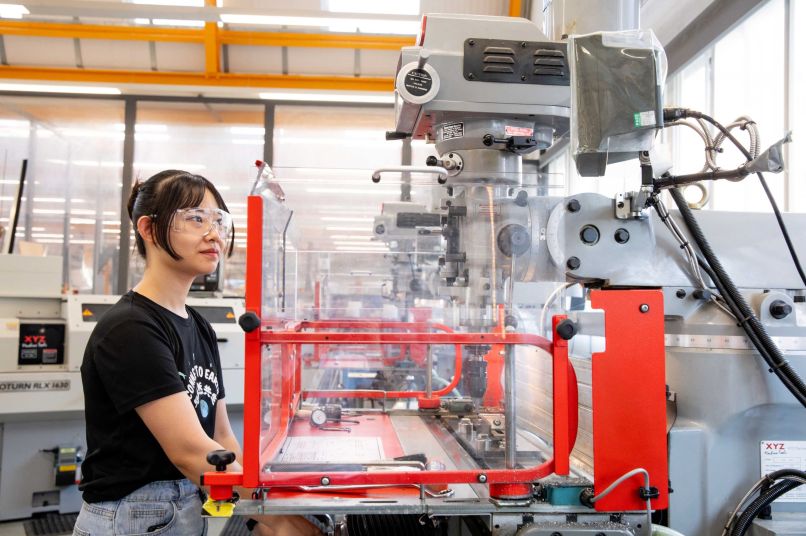
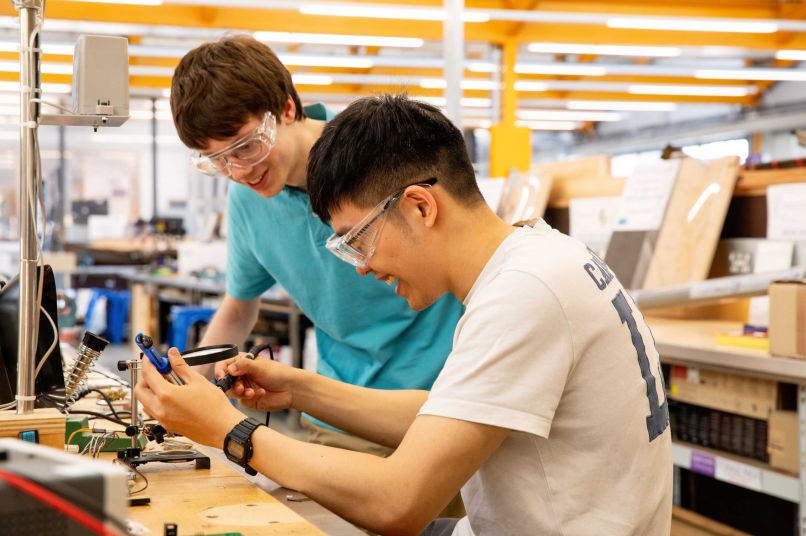
Engineering is a very practical course, and a typical day might involve a two-hour lab followed by two one-hour lectures in the morning. These would take place in the Engineering Department. Afternoons are mainly reserved for private study and supervisions. There are major projects in all years, such as the first-year structural design project and the second-year integrated design project, in which teams of students design, build and test an autonomous guided vehicle to perform a set of tasks.
Engineering at King’s is a medium-sized subject, typically admitting 9 students per year.
Supervisions in Engineering are focused around the examples papers, which are typically issued fortnightly in all the subjects being lectured. Supervision groups of two are the norm. Students are expected to prepare by attempting the current examples paper, reading the relevant lecture notes thoroughly, and knowing what areas they need help with.
Studying Engineering at King’s College has been one of the most eye-opening experiences in my educational career. I’ve learned so much in such a short time here, met academics who are experts in their field, and become part of such a diverse and versatile cohort.
- Chandan, 1st year
You get to know all the engineers within the College very quickly with the help of the Engineering Society at King’s. The Engineering Fellows at King’s are great. They're not only very knowledgeable about their subject specialities, but also great just to have a general chat with about anything.
- Dil, 2nd year
Careers and graduate opportunities
The Engineering course at Cambridge is very rigorous, and can lead to careers in many companies involved in product design and manufacture. It can also lead to work in engineering research and development. This applies across all engineering areas, from IT to structural design, aeronautical engineering, and microelectronics.
Students also learn generic skills in organisation, time management, problem solving, numeracy, and creative thinking, which can lead to careers in non-engineering areas such as financial services and management consultancy.