News

Kings logo
A smiling young man with dark hair wearing a blue top

E-Lab Research Associate awarded ARIA research grant for innovative project to address climate instability

Body
Chris Micklem has been awarded a £500,000 research grant from the Advanced Research + Invention Agency (ARIA), the largest award size possible for the grant.

A huge congratulations to Chris Micklem who has been awarded a £500,000 research grant from the Advanced Research + Invention Agency (ARIA), the largest award size possible for the grant.

It comes as a part of ARIA’s Programmable Plants opportunity space, led by Programme Director Angie Burnett, and it aims to support explorations into how we can programme plants to remove more CO₂, fight drought, and deliver medicines to those in need.

Chris, a King’s E-Lab Research Associate and a postdoctoral researcher at the Sainsbury Laboratory, is seeking to pioneer a new direction in synthetic biology through the design of gene circuits that use noise, instead of suppressing it. By embracing stochasticity, not fighting it, the aim of Chris’s project is to program plants more robustly and more effectively.

In this era of increasing climate instability, such unexplored approaches may hold the key to enabling a more sustainable coexistence of humanity with the planet and, for Chris, it is hoped that his project will help accelerate progress towards such a future.

Chris’s work has also been showcased for his use of AI as a part of a deep neural network-based approach to facilitate more effective use of photosynthetic bacteria for climate positive purposes.

Alongside James Beattie and Charles Emogor, Chris joined Coco Newton, Nadia Mohd-Radzman and Ismail Sami as E-Lab Research Associate this year. Read more about their work here.

On receiving the award, Chris said:

It is a huge privilege to be selected for ARIA’s Programmable Plants Opportunity Seed. What is so exciting about ARIA’s approach is the direct mandate to turn ambitious science into real-world solutions to humanity’s greatest challenges. This focus, coupled with the King’s E-Lab’s invaluable support, provides the perfect environment to pursue both groundbreaking research and its commercial potential, to drive transformative change.

About ARIA:

ARIA is an R&D funding agency created to unlock technological breakthroughs that benefit everyone. Created by an Act of Parliament and sponsored by the Department for Science, Innovation and Technology, we fund teams of scientists and engineers to pursue research at the edge of what is scientifically and technologically possible.


Read more
E-Lab Research Associate awarded ARIA research grant for innovative project to address climate instability
King's College first court. A central fountain stands on a large green lawn with the Chapel to the left and the gatehouse to the right.

New Dean of Chapel appointed

Body
The Reverend Canon Dr Hueston Finlay will succeed the Reverend Dr Stephen Cherry in 2026

King’s College is delighted to announce that Hueston Finlay, Vice-Dean of St George’s Chapel, Windsor, and Warden of St George’s House, has been appointed as the next Dean of Chapel. He will take up the post following Stephen Cherry’s retirement in January 2026.

Dr Finlay has been a canon at St George’s Chapel since 2004 and been the Warden of St George’s House since 2008, which convenes discussions on major social and ethical issues. He had previously been Dean of Chapel at Magdalene College, Cambridge and Chaplain of Girton College. He holds degrees from Trinity College Dublin in engineering and theology, a doctorate in philosophy from King’s College London and has studied pure mathematics at the Open University. He is currently an Honorary Research Fellow at the University of Aberdeen.

“King’s College Cambridge is one of the world’s leading academic establishments. Since 1441, education, religion, learning and research have been at the heart of its ethos. I look forward very much to joining the College, to working once again with students, and to immersing myself in the endeavours of this very special place. It will be a great privilege and a personal pleasure to be part of such a renowned institution.” -  Hueston Finlay.

Provost Gillian Tett commented “We very much look forward to welcoming Hueston Finlay to King’s as Dean of Chapel in the new year. I’d also like to thank Stephen Cherry for his many years of service to King’s, first as Chaplain between 1989 and 1994 and as Dean since 2014.”

Read more
New Dean of Chapel appointed
Five black and white profile photos of the entrepreneurs behind Axo Neurotech, Mobilytics and CAST Energy against a purple background

Winners of 2025 Entrepreneurship Prize announced

Body
Axo Neurotech, Cambridge Mobilytics and CAST Energy have been awarded prizes by the judging panel.

We are delighted to announce the 11th year of awards under the College’s annual entrepreneurship competition, intended to encourage King’s members (past and present) to develop their entrepreneurial ideas and convert their creativity and knowhow for sustainable commercial and social benefit.

This year’s top prize, with a value of £20,000, has been awarded to Axo Neurotech, a £10,000 second prize goes to Cambridge Mobilytics, and CAST Energy receives the third prize of £5,000.

Founded by Dr Amy Rochford (KC 2018, Engineering) and Nathan Jackrazi (KC 2018, Engineering), AxoNeurotech is on a mission to build a seamless natural interface. Axo's next-generation neural interface uses cutting-edge material science and a biology-first approach to solve the problem of integrating electronics with the body, with the clear aim of improving patients' lives. 

Listen to Amy here sharing her journey from academia to industry, focusing on neurotechnology's potential to transform treatments for brain and nervous system injuries.

Eliott Fournet (MBA student) founded Cambridge Mobilytics to aggregate underutilised charging data from electric vehicle infrastructure operators across Europe to create valuable predictive models and market intelligence. The company acts as a trusted intermediary, purchasing and standardizing charging data to offer (among other things) clean datasets for car manufacturers and financial institutions.  

CAST Energy is the early-stage startup led by Chris Tagnon (MPhil student in Industrial Systems, Manufacture, and Management) and Joseph de Solages. It offers a solar power generation system, designed for easy implementation in remote areas thanks to its containerized format. This innovative system is fully modular and transportable in a standard 20- or 40-foot container that can generate up to 240 kW and offer an impressive storage capacity of 960 kWh, surpassing most of the solutions on the market. The system is perfectly suited to transform access to clean energy in places previously difficult to equip.

**

The Entrepreneurship Prize competition was established in 2014 with a gift from Stuart Lyons CBE (KC 1962) and culminates each year in the ‘Lyons Den’, where finalists present their full business plans to an expert panel.

If you would like to find out more about the King's Entrepreneurship Prize and how to enter the competition, please email enterprise@kings.cam.ac.uk

Read more
Winners of 2025 Entrepreneurship Prize announced
Multiple reflective glass windows viewed from below framed by a tree and a sunny, cloudy sky

The compelling economic case for climate investment

Body

First published 12 March 2025

A report by the climaTRACES Lab with Boston Consulting Group and the Cambridge Judge Business School highlights the importance of investing in climate mitigation and adaptation and the significant economic consequences of failing to do so.

Allowing global warming to reach 3°C by 2100 could reduce cumulative economic output by 15% to 34%. Alternatively, investing 1% to 2% in mitigation and adaptation would limit warming to 2°C, reducing economic damages to 2% to 4%. This net cost of inaction is equivalent to 11% to 27% of cumulative GDP—equivalent to three times global health care spending.

These are among the findings of the Boston Consulting Group (BCG) Climate Change and Sustainability consulting experts, Cambridge Judge Business School, and the University of Cambridge’s climaTRACES Lab report, Too Hot to Think Straight, Too Cold to Panic: Landing the Economic Case for Climate Action With Decision Makers, published today.

“Research on climate change impacts across all regions and sectors is expanding rapidly,” said Kamiar Mohaddes, King’s Fellow in Economics, Co-Founder and Director of the King’s E-Lab, and Director of the University of Cambridge climaTRACES Lab. “What stands out is that productivity loss—not merely capital destruction—is the primary driver of economic damage. It is also clear that climate change will reduce income in all countries and across all sectors, affecting industries ranging from transport to manufacturing and retail, not only agriculture and other sectors commonly associated with nature.”

“The economic case for climate action is clear, yet not broadly known and understood” said Annika Zawadzki, BCG managing director and partner, and a co-author of the report. “Investment in both mitigation and adaptation could bring a return of around tenfold by 2100.”

Another challenge is that the costs and benefits of the transition are not evenly distributed among countries. Even so, the net cost of inaction is high enough that it will likely justify unilateral action from the world’s biggest emitters. The report looks at five priority levers that can be pulled to address these challenges:

  • Reframe the debate on the costs of climate change
  • Create transparency on net cost of inaction across
  • Strengthen national climate policies to accelerate mitigation and adaptation
  • Reinvigorate international cooperation on climate change
  • Advance our understanding of the net cost of inaction

**

climaTRACES Lab is an interdisciplinary initiative at the University of Cambridge focusing on climate, nature, and sustainability research. Their data-driven research and policy engagement covers the following four themes: Communication & Communities, Macroeconomics & Sustainability, Green & Sustainable Finance, and Nature & Biodiversity. Collaborating with a network of climate and nature experts globally, we conduct cutting edge research for wider societal benefit, and create and test innovative policy communications formats that translate the evidence and multidisciplinary research generated by the lab for policy and industry audiences.   

Read more
The compelling economic case for climate investment
Profiles of the nine Gates Scholars 2025 against a purple background

2025 Gates Cambridge Scholars announced

Body

First published 1 May 2025

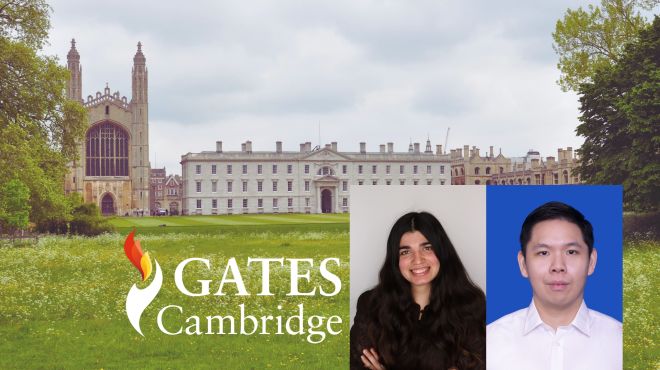
95 new scholars have been selected to form the Gates Cambridge Class of 2025, with 9 of them joining King’s next Michaelmas Term.

We are delighted to announce that 9 of next year’s Gates Cambridge Scholars Class of 2025 will be joining us at King’s – the second largest cohort we have welcomed since the programme was established 25 years ago.

Reham Aboud, Naina Agrawal-Harding, Asja Campara, Muaz Chaudhry, Joshua Heihre, Yu Huang, Ifeyinwa Nnakenyi, Abigail Schipper and Sam Shelton will be studying MPhil and PhD courses in subjects ranging from Stem Cell Medicine to Anthropocene Studies. They come from Egypt, Australia, China, the United States and Bosnia and Herzegovina, among other countries.

Professor Deborah Prentice, Vice-Chancellor of the University of Cambridge and Chair of the Board of the Gates Cambridge Trust, said:

“We are incredibly proud of all that Gates Cambridge has achieved. This exceptional programme is successfully producing the leaders that will address many of the common challenges facing humanity. As we celebrate 25 years of impact, we look forward with excitement to what the next 25 years will bring.”

Read about the journeys of the Gates Cambridge Class of 2024 scholars here.

About Gates Cambridge

The Gates Cambridge Scholarship programme was established through a US$210 million donation to the University of Cambridge from the Bill and Melinda Gates Foundation in 2000; this remains the largest single donation to a UK university. Since the first class in 2001, Gates Cambridge has awarded 2,218 scholarships to scholars from 112 countries who represent nearly 800 universities globally (more than 200 in the USA) and around 90 academic departments and all 31 Colleges at Cambridge.

Read more
2025 Gates Cambridge Scholars announced
King's College Chapel and the Gibbs Building with the Create Cambridge logo.

King’s partners with local organisations in the new cultural compact Create Cambridge

Body

First published 27 March 2025

Initiated by cultural organisations based in and around Cambridge along with the city’s universities, Create Cambridge aims to support the development of the cultural sector in the region.

Create Cambridge is a new cultural compact for the Cambridge City Region – an initiative born from a series of conversations hosted at King's that follows a proven model used across the country for catalysing cultural development through long-term cross sector partnerships.

As well as King’s College, Create Cambridge involves organisations such as Anglia Ruskin University, Cambridge City Council, Cambridge Curiosity & Imagination, Cambridge Junction, the Fitzwilliam Museum, Raspberry Pi Foundation, and Wysing Arts Centre.

The vision of Create Cambridge is to position Cambridge as a truly International City of Culture, one which embraces diverse perspectives and artistic expressions, building on the city’s strength in research and innovation, and enabling us to tell new stories that might also help us design a more inclusive and sustainable future.

Create Cambridge envisions a city where culture is not just celebrated but serves as a dynamic force for positive change, inclusivity, and the pursuit of shared ambitions.

By embracing collaboration, celebrating diversity, and surfacing and addressing inequities, Create Cambridge aspires to make Cambridge not just a city with a storied past but a city whose story is continually unfolding - with this new narrative shaped by its people and the genius of this place.

Find out more about Create Cambridge, how to get involved, and sign the Open Letter to the City here.

Read more
King’s partners with local organisations in the new cultural compact Create Cambridge
A large stately home with topiary next to an image of the Sanditon manuscript

Jane Austen’s 'Sanditon' manuscript goes on exhibition

Body

First published 1 May 2025

The autograph manuscript of Jane Austen’s final novel, 'Sanditon', has gone on loan to Harewood House in Yorkshire as part of their new exhibition ‘Austen and Turner: A Country House Encounter’.

The 'Sanditon' manuscript comprises three small booklets, the third of which features in the exhibition.  It is Jane Austen’s last novel, which she was working on towards the end of her life. The final page of the manuscript is dated 18th March 1817 and is followed rather poignantly by many blank pages. Austen died in July 1817, leaving the novel incomplete.

The manuscript was given to King’s College in 1930 by Jane’s great-great niece Mary Isabella Lefroy, in memory of her sister Florence and Florence’s husband, the late Provost Augustus Austen Leigh (1840-1905), who was one of Jane's great-nephews.

The exhibition at Harewood House, co-curated by Harewood House Trust and the Centre for Eighteenth Century Studies at the University of York, celebrates the 250th anniversaries of the birth of both Austen and the painter JMW Turner in 1775. Through Austen’s and Turner’s eyes, the show explores the world of the country house in their time and their impact on how we think about stately homes today.

This is the first time the 'Sanditon' manuscript has been exhibited in the north of England, and we are delighted that it is being made available to new audiences beyond Cambridge. King’s Library has its own plans to exhibit its extensive holdings of Jane Austen’s works this year, including the other two booklets of the 'Sanditon' manuscript, in September. Details will be announced in due course.

Further details of the exhibition can be found here.

Read more
Jane Austen’s 'Sanditon' manuscript goes on exhibition
King's College front court with King's Campaign banners hanging from a lamp post in the foreground

King’s fundraising campaign reaches £100 million goal

Body

First published 23 May 2025

The King’s Campaign has reached its £100 million goal, allowing the College to attract and enable more of the best students regardless of economic or social background, deliver exceptional teaching and world-class research, and preserve and enhance its historic buildings.

The King’s Campaign was publicly launched in December 2018 to raise £100 million, under the leadership of Provost Professor Michael Proctor. Thanks to the generosity of King’s alumni, friends and supporters a total of £102 million has now been reached, in the College’s most ambitious fundraising effort in its recent history.

During the Campaign more than 6,500 alumni, friends and supporters of King’s made a donation, at all giving levels and from members of the King’s community across the world.  In addition over £36 million has been pledged in future legacies.  £2.75 million has been raised from the College’s annual telephone appeals and the first King’s Giving Day in December 2024. 

'We are deeply grateful to those donors who commit to making regular gifts of all sizes over several years, providing a steady, guaranteed stream of income to benefit important areas of the College such as student hardship, bursaries, welfare and mental health, and the Chapel and Choir' said King’s Development Director Lorraine Headen. 'Some alumni have been giving this way since graduation, and we cannot thank them enough.'

The Campaign total was surpassed in May thanks to a £6 million gift from David Sainsbury (KC 1959) and the Gatsby Charitable Foundation, to support a new Executive Director post for the King’s E-Lab and create a new flexible meeting space in the southwest part of Chetwynd Court. The space will provide a greatly needed home for E-Lab and other College events, bringing the King’s community closer together and fostering innovation in line with one of the main Campaign priorities.

Encouraging the brightest and best

Over half of what has been raised has gone directly to supporting students, to help in multiple ways. At the launch of the Campaign a £33 million gift from an alumnus was announced, establishing the College’s transformative Student Access and Support Initiative.  A further philanthropic donation in 2020 set up the innovative Bridging Programme, which has now helped over 60 offer holders from traditionally low attainment schools spend time in King’s before their course starts and prepare for life and study at Cambridge. Recently the College partnered with IntoUniversity to open a new education centre in Middlesbrough to provide academic support, mentoring and aspiration-raising activities for young people in one of the most deprived parts of England.

At the other end of the educational journey, as King’s students start to think about life beyond their first degree, the King’s E-Lab, launched in 2021 thanks to a donation from Malcolm McKenzie (KC 1977), is fostering innovation and providing entrepreneurial and career skills. This builds on the success of the Entrepreneurship Prize Competition founded by Stuart Lyons (KC 1962) in 2014.  Since then the Entrepreneurship Prize has recognised 23 winning businesses, awarded over £325,000 in funding, and an expert panel of judges has provided valuable advice and mentorship.

A previous gift from David Sainsbury and the Gatsby Charitable Foundation is enabling  a Summer Research Programme aimed at inspiring talented science students to think about going on to a PhD and further research; and in 2024 the College appointed its first Futures Tutor, to provide students with careers advice and coaching to support them in their personal and professional development, thanks to a donation from an alumna.

The King’s Student Welfare and Mental Health Fund was established at the start of the Campaign from a legacy gift and has enabled the creation of a programme of care and activities directed at the welfare and mental health of resident students.  The Fund provided vital support through COVID, and further generous gifts have allowed the College to respond to the increasing complex needs of our students and recruit a Mental Health Advisor, and a Cognitive Behavioural Therapist.

Empowering Minds

The Campaign has also added to the College’s teaching excellence and boosted its research capacity, with a range of academic posts funded since its start. Recent gifts have included £1.75 million from Mervyn King (KC 1968) to create a new Research Fellowship in economic history; $5 million from Roger Evans (KC 1964) and Aey Phanachet to endow two named Research Fellowships; a gift from an alumna to establish the first Sydney Brenner Research Fellowship; and the Enactor Alan Turing Fellowship and PhD Programme is now in its sixth year. Graduate students contribute enormously to the research culture of the College and play a vital role in teaching, mentoring and inspiring undergraduate students, before going on to contribute to society in myriad ways. 

Protecting our Heritage

One of the Campaign’s key priorities has been the protection and enhancement of the College’s exceptional heritage and environment, both now and for future generations.

An early gift from alumnus Ian Jones (KC 1980) to support the Choir is also helping to maintain the fabric of the Chapel, including enhancing the lighting. Over the course of the Campaign more than £5 million has been given to support the Choir, in donations from alumni and friends around the world.

In 2023 the College completed work on a year-long conservation of the Chapel roof and installed 438 new solar panels, thanks to a significant legacy gift. A major project to restore the interior of the 300-year-old Gibbs Building has received generous initial funding from Malcolm McKenzie and other alumni.

Sarah Legg (KC 1986), Chair of the Campaign Advisory Board, said: 'This is a fantastic achievement and reflects the tremendous support and commitment of King’s alumni  around  the world. King’s was the making of me, and of so many of us; I’m delighted that thanks to the Campaign, more talented students who might not otherwise have the chance to come to King’s will get the support they need not only throughout their time here, but also be equipped with the skills to go out into the world and make a difference.'

The Provost Dr Gillian Tett said of the Campaign: 'King’s is an exceptional environment in which to be a student and an academic. Thanks to the generosity of the amazing King’s community, over this Campaign we’ve been able to create 15 new Research Fellowships; a fund of £5m for MPhil and PhD studentships, which have already enabled a large number of students to do graduate research; and welcome a record number of students from disadvantaged backgrounds and support them to thrive here. For our students and Fellowship alike, this is game-changing.  

Reaching our goal is not of course an ending. The Campaign is one part of the long story of this very special place and the people who believe in it, and we haven’t finished yet. We’re incredibly grateful to everyone for their support.'

Read more
King’s fundraising campaign reaches £100 million goal
Five people wearing smart academic clothes smile holding a book and a certificate. There is a smiling woman in the middle wearing a black gown with Red detail at the front. They are in a formal garden on a sunny day.

Provost’s Prize 2025 awarded to five students

Body
This year’s winners are graduate students Fee Robinson and Spencer Lee Boya and undergraduates Harry Gant, Jack Robinson, and Teddy Graham.

Established in 2018, the Provost’s Prize recognises those students who make a significant contribution to the College community during their time at King’s.

This year’s winners Fee, Spencer, Harry, Jack and Teddy received the award with the following citations:

The amount of work Fee Robinson has accomplished this year is astonishing. From the outside it appears she has single handedly kept the KCGU together, bridging gaps between College staff and the other members constantly. The grads would not have had anywhere near as many events and Formals this year without her. Her efforts on the Grad Bar and Formals MOU were huge. She stepped into the role of King’s Affair Food and Drink coordinator after the previous students dropped out and, although the road to the event has still been very rocky, Fee has negotiated everything brilliantly. On the committees we’ve been on together she has been a positive force, unafraid to ask questions and push at areas she believes will be a benefit to her fellow graduate students.  Despite all of this work Fee has remained level-headed and positive.

As a postgraduate student on a short course, the impact of Spencer Lee Boya in the King’s community is remarkable. In the last two years he has worn many hats, all with grace. He was President of the KCGS [now KCGU] and took active part in the Communications Committee meetings, always trying to find ways to better promote the research and achievements of postgraduate students. As Co-President of KCMS and conductor in many of their concerts, he has helped devise an interesting programme and made an effort to share their music-making with all at King’s, including staff. As a pianist he performed at a recent alumni event where he was not only a great instrumentalist but also a great representative of the student community. And, finally, as a boxer and change-maker at CUABC Spencer’s work will have a lasting impact so we are not surprised to see him shortlisted for a CU Sports Award in the ‘Unsung Hero’ category.

In the current climate of difficult choral recruitment, Harry Gant is the model Choral Scholar: flawless in preparation, delivery and teamwork. When he arrived at King’s he hit the ground running, most memorably stepping into a solo there and then at the Barbican in London, when one of his colleagues left the stage during the concert. More recently, he has delivered noteworthy solos on recordings and each year on TV.  As a college musician, he has taken a leading role in the running of KCMS, and this year he has directed the King’s Men. His greatest asset is his modesty: nothing about Harry is flashy or self-absorbed. His musical performance speaks of someone who cares first and foremost about the team and the end-product, and he is happy to be asked to do whatever is required to achieve our common and shared goals. His contribution to music within the College has been exceptional.

Jack Robinson has shown exceptional commitment and work in the context of the responsible investment working group. Over the academic year 2024/25, the group has been preparing a new and comprehensive responsible investment policy for King’s, reiterating the College’s responsibility towards future generations by confirming  divestment from fossil fuels and adopting a clear position of non-complicity with abuse and unjustified harm. As a student member who volunteered to be on the group because he cares deeply about King’s and the questions of responsible investment raised by the working group, Jack has been exemplary in attending meetings, doing significant amounts of work in support of the group’s drafting of a responsible investment policy, engaging constructively with other members of the group and helping to gather views from among the student community. Jack’s overall engagement has shown a level of commitment and excellence that we have rarely seen.

Teddy Graham has stood out as a truly engaged and impactful contributor to the College community. The range of their activities in College is impressive, from running the Art Rooms to assisting with the Student Loan Collection, helping in the Archives, and acting as President of KCSU. Teddy has been the lynchpin of the College Art Rooms for several years now, running events and classes, helping with exhibitions, reorganising the space, sourcing and stocking art supplies, redecorating the rooms, training students, liaising with external artists and societies, running social media accounts, and providing the main point of contact for Art Room Co-ordinator, Nigel Meager. Teddy runs the rooms as an inclusive and welcoming space that provides a creative haven for many members of our community. Alongside the Art Rooms, Teddy has been heavily involved with running the Student Loan Collection. They carried out an impressive summer research project in 2024 on the history of the Collection and spent a great deal of time not only identifying works, but also reorganising the storeroom at the top of A Staircase for ease of access. The chronological history of acquisitions built up by Teddy through their research will serve the College for years to come, and is an important piece of our collective history.

Just the other day someone noticed the small garden of arugula and strawberries that Teddy had planted with the Gardeners’ permission (and following their advice) in Bodley’s Court: all College members are welcome to take as much as they need, which is a very nice gesture!

Read more
Provost’s Prize 2025 awarded to five students
A smiling man with short white hair, a beard and glasses, wearing a pale blue shirt in a lab with bottles on a shelf behind him.

Azim Surani awarded 2025 Kyoto Prize

Body
Professor Surani is to be honoured with a Kyoto Prize by the Inamori Foundation for his significant contribution to the scientific betterment of humankind. The prize presentation will take place in Kyoto on 10 November.

Professor Azim Surani, Emeritus Fellow of King’s and Director of Research at the Gurdon Institute, is the winner of the 2025 Kyoto Prize in the Life Sciences and Medicine for his discovery of genomic imprinting in mammals and elucidation of its molecular mechanisms.

His research demonstrated that both paternal and maternal genomes are indispensable for normal mammalian development and subsequently discovered genomic imprinting that confers specific modifications and complementary functions to each genome. Furthermore, he has played a pioneering role in elucidating its underlying mechanisms, thereby making contributions to foundational scientific insights across a broad spectrum of life science fields.

On being awarded the Kyoto Prize, Professor Surani said:

I am deeply honoured to have been awarded the Kyoto Prize in Basic Sciences for my discovery of genomic imprinting in mammals nearly four decades ago – a discovery that was unexpected, opening up exciting new avenues of research, including epigenetics and human development that we have since pursued.

It has been a tremendous privilege to work with many exceptional young scientists in my laboratory, and I am immensely grateful to them for their invaluable contributions.

You can read more about Professor Surani’s research and the 40th anniversary of his discovery here, and hear him talk about his Journey of Discovery.

The activities of the Inamori Foundation reflect the lifelong beliefs of its founder that “people have no higher calling than to strive for the greater good of humankind and society” and that “the future of humanity can be assured only through a balance between scientific progress and spiritual depth.” The Foundation seeks to promote international mutual understanding and actively contributes to peace and prosperity among all people on earth. It does this through activities of public recognition, research grants, and social contributions towards creative activities to foster science, culture, and the enrichment of the human spirit.

Read more
Azim Surani awarded 2025 Kyoto Prize
Profile photos of two men and a woman smiling against a purple background. All are smartly dressed

King’s alumni recognised in the King’s Birthday Honours

Body
Dominic Richards (KC 1987) is recognised for his longstanding charitable work and leadership in heritage-led regeneration and sustainable urbanism, Michael Downes (KC 1987) for services to music and education, and Ruth Marshall (KC 1991) for services to evidence-based policy-making and innovation.

Our congratulations to the King's alumni who have been recognised in the 2025 King's Birthday Honours:

Dominic Richards (KC 1987) has been appointed a Lieutenant of the Royal Victorian Order (LVO) for his longstanding charitable work and leadership in heritage-led regeneration and sustainable urbanism. He is the Co-Founder and Chair of Our Place, a development company dedicated to creating walkable, mixed-use neighbourhoods that prioritise local character, sustainability, and social cohesion.

Having served as Vice Chair of The Prince’s Foundation, Dominic is currently Chair of The King’s Foundation Australia and a Trustee of The King’s Trust Australia. Under his stewardship, projects such as The Prince’s Terrace in Adelaide—Australia’s first 6 Star Green Star residential development—and the regeneration of Hillview, a historic rural estate in New South Wales, are bringing to life His Majesty’s principles of heritage led regeneration and place-making, championing traditional skills, environmental responsibility, and community wellbeing.

In receiving this honour, Dominic paid tribute to King’s and to the Prince of Wales’s Institute of Architecture, where his commitment to sustainable places and public service first took root:

King’s instilled in me the belief that beauty, community, and legacy matter — that we shape our places, and in turn, they shape us. That belief was given form at The Prince of Wales’s Institute of Architecture, founded by His Majesty 35 years ago, where I was taught the principles of sustainable place-making — ideas that were then visionary and are now, thankfully, gaining wider acceptance.

Dr Michael Downes (KC 1987), Director of Music at the University of St Andrews, has been awarded an OBE for services to Music and Education.

Ruth Marshall (KC 1991) has been awarded an MBE for services to Evidence-based Policy Making and Innovation. Ruth is Head of Futures Capability at the Government Office for Science, and her role focuses on building cross-Whitehall skills in futures and foresight, a strategic reform priority for the civil service identified in the Integrated Review (2021).

*

Former Headmaster of the King's College School Nick Robinson has also been recognised with an OBE for services to Disadvantaged Young People, to Charitable Fundraising and to Music. Nick is the co-founder and chair of Future Talent, a charity supporting young musicians across the UK. 

Read more
King’s alumni recognised in the King’s Birthday Honours
Jim Trevithick, sitting at a bar and reading a newspaper

James Trevithick (1945-2025)

Body

Jim photographed by Martin Bond (A Cambridge Diary)

It is with great sadness that we have learned of the death of Mr James (Jim) Trevithick, Life Fellow at King’s, on 29 May 2025.

Jim joined King’s as a Fellow in Economics 1977. He studied at the London School of Economics obtaining a B.Sc. and M.Sc. in Economics. He came to Cambridge in 1976 as an Assistant Lecturer in the Faculty of Economics after a stint as a Lecturer at the University of Glasgow. He was promoted to a full Lecturer at the Cambridge Faculty of Economics in 1979. In 2002 Jim took early retirement from both the Faculty and from his Official teaching Fellowship at King’s. That same year the College elected him to a Life Fellowship. 

From 1977 to 2002 Jim was one of most important faces of the teaching of economics at King’s. During this period, he was a Director of Studies in the subject and taught macroeconomics at all levels in the College.  His undergraduate lectures at the Faculty were widely acknowledged by students at the time to be amongst the clearest and best organised courses in the Economics Tripos.

Jim was interested in macroeconomic issues such as inflation and unemployment. His later works were mainly concerned with the evolution of ideas in macroeconomics. His academic publications included several well-known texts: The Economics of Inflation (1975), Inflation: A Guide to the Crisis in Economics (1977, second edition 1980), Involuntary Unemployment: Macroeconomics from a Keynesian Perspective (1992). These texts were widely used for undergraduate teaching and were translated into many languages (e.g. Spanish, Italian, Dutch, Portuguese, and Japanese).

Jim was extremely committed to the College, was Praelector in the early 1980s and served as University Proctor.

He lived in College throughout his Fellowship and will be remembered very fondly by many of his students and colleagues at King’s.

Remembering Jim Trevithick - his wake

In accordance with Jim’s will, his ashes will be interred in the crypt of the Chapel in a private ceremony, immediately following his funeral in a side chapel. These will take place on Thursday 19 June

Although Jim instructed in his will that there should be no memorial service, he did provide for a wake, and this will take place in the Fellows’ Garden from 6.00pm to 8.30pm on the day of his funeral. (College Hall in the event of inclement weather). All are welcome; entry to the Fellows’ Garden is directly from Queens’ Road. If you would like to come please register via this link.  

Also that day Jim will be remembered at the Sung Eucharist in Chapel at 5.30pm, and anyone who would like to attend this service is very welcome and can reserve a space by e-mailing kings.chapel@kings.cam.ac.uk


Read more
James Trevithick (1945-2025)