
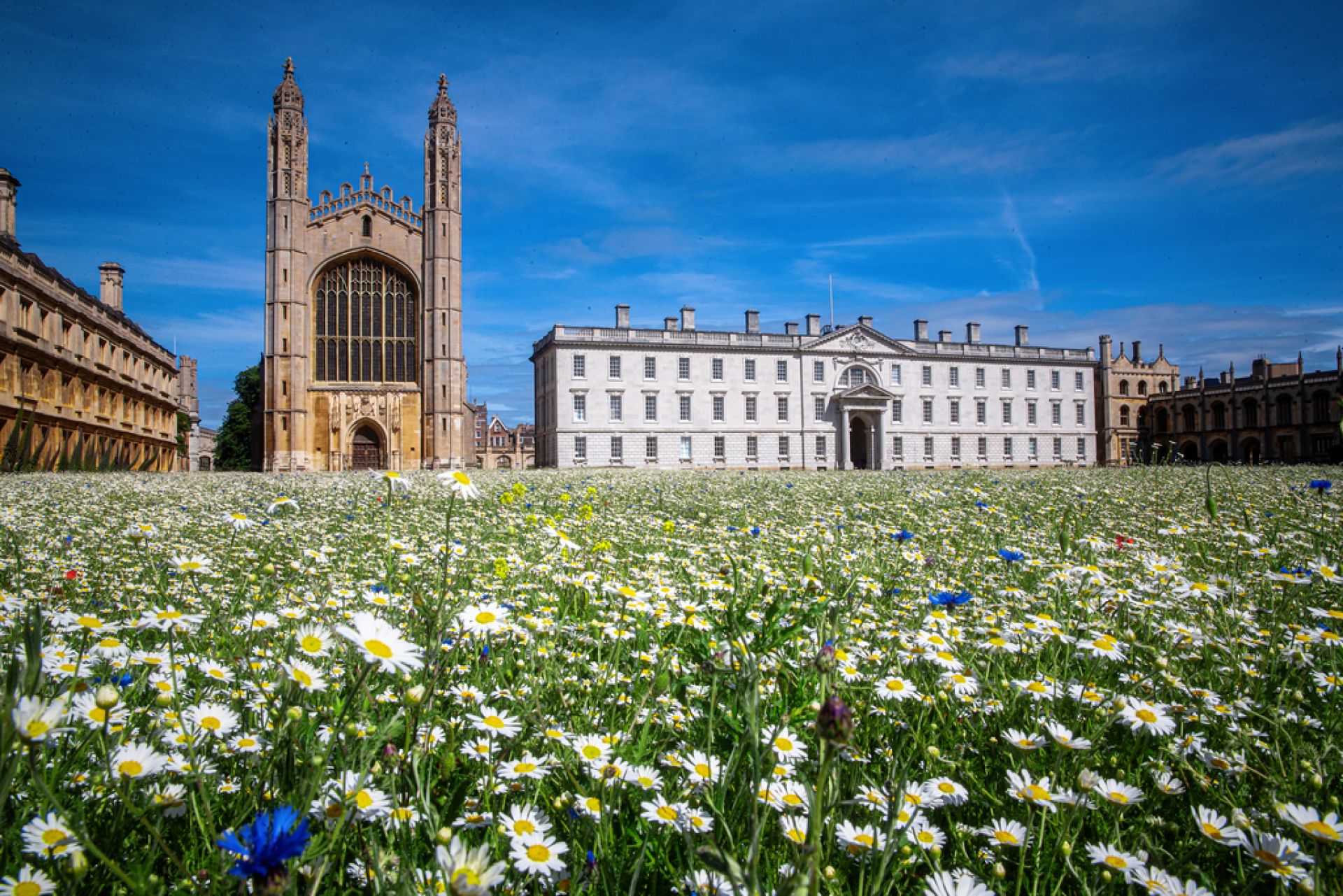

A Greener King's
King's is working towards improving biodiversity within the College grounds
Innovative gardening methods can help slow global warming by increasing carbon storage in soil and plants, and making green spaces more resilient to climate change
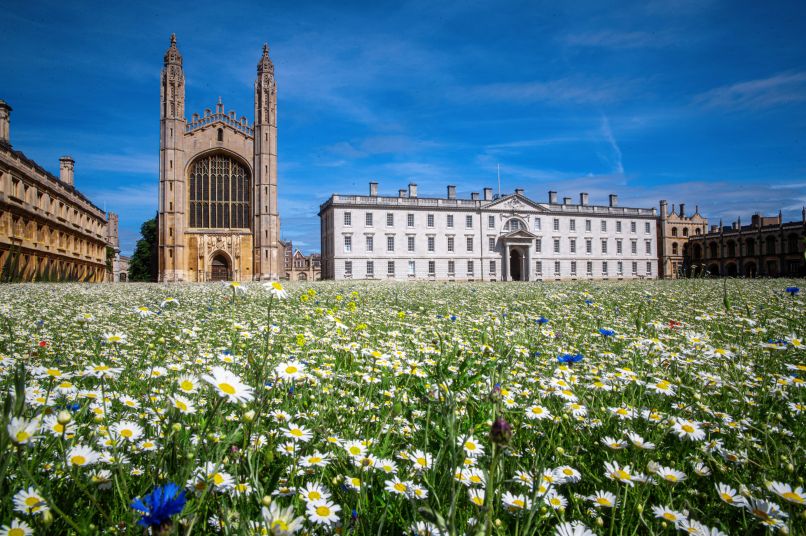
King's Wildflower Meadow
Overview
Wildflower meadows can play a vital role in enhancing species richness and give a helping hand to the pollinating insects that are so crucial to maintaining healthy ecosystems.
After three years of preparation, the King’s wildflower meadow first flourished in 2020 and has now seen the germination of perennial plans such as kidney vetch and small scabious as part of its transition towards a traditional East Anglian hay meadow. The meadow has already had a significant impact on biodiversity, with nationally scarce plant species finding their way into the sward, providing shelter for more than 130 insect species including bees, beetles, moths and butterflies.
This video explains more about the Wildflower Meadow.
Origins
The project was initiated by King's Fellow Geoff Moggridge back in 2018, and after widespread support from the Gardens Committee and the Fellows of King’s, Head Gardener Steve Coghill and his team worked with external consultants to make the meadow a reality. The transformation was of course a visual delight, but this is only one of the perks of having a wildflower meadow. The meadow’s true purpose is to positively impact species richness in what, since the 18th century, has essentially been a grass lawn monoculture, and to inhibit the decline of pollinating insects which are so crucial to maintaining healthy ecosystems and food security.
After three years of preparation, and a nervous wait for Steve and his team, the summer of 2020 bore witness to the stunning conversion of the College’s Back Lawn into a colourful wildflower meadow carpeted in poppies, cornflowers and oxeye daisies, stretching from the Chapel to the Cam. Its second year saw the germination of perennial plans such as kidney vetch and yellow rattle, as part of its transition towards a traditional East Anglian hay meadow.
As part of the meadow project, research is now being conducted to monitor its impact on biodiversity and in preventing the decline of pollinating insects, which are so crucial to maintaining healthy ecosystems and food security. Since 1980, changing patterns of farming, the use of pesticides, a warming climate, and the destruction of wild habitats, have all caused pollinators to disappear from many of the places that they were once found in Britain. It is hoped that the biodiversity surveys currently under way will provide valuable data on species richness in this new meadow.
Plant Species
The biodiversity of the meadow is being regularly monitored by academic staff across the University to understand its effect on species richness, as compared with the lawn which had occupied the space since the latter half of the 18th century. Research Fellow Cicely Marshall has reported significant findings from the study. In particular, we’ve found that the meadow supports three times more plant species than the lawn, including nationally scarce species like wild candytuft, and species like cornflower whose native populations have all but disappeared from the UK.
After its first year of flowering, 59 plant species were recorded in the meadow, compared with 22 plant species in the lawn. The perennial meadow species, including kidney vetch, sorrel, and oxeye daisies, were establishing well underneath the annuals, along with a fair number of other plants which had naturally found their own way into the sward.
Insect Species
The taller and more diverse meadow planting provides food and shelter for 130 insect species identified at the site, with iconic species like the elephant hawk moth and meadow brown butterfly being regular visitors. The meadow also supports larger bodied species and larger populations than the lawn, and this thriving insect population in turn has a positive benefit for animals which feed on the insects, such as bats. Five bat species use the King's grounds, with bats ten times more likely to feed over the meadow than the remaining lawn.
In July 2020, Cicely and her colleagues identified 13 species of pollinators over two hours of recording, including species of bumble bees, solitary bees, beetles, hoverflies and a meadow brown butterfly. Another highlight was the Lasioglossum smeathmanellum, a beautiful metallic green furrow bee reported to be declining nationally, most likely nesting in the King's/Clare wall.
Harvesting
In 2021 we were treated to the delightful sight of a pair of heavy horses working to harvest the wildflower meadow at the end of its second year of flowering. Shire horses Cosmo and Boy, from the nearby Waldburg stables, not only cut the meadow but also turned and carted the hay on a traditional wain, with the bales being used to create more wildflower meadows across the city of Cambridge.
From a biodiversity perspective, this traditional method of harvesting affords the animals within the meadow time to leave the area, whilst the mowing is an important long-term process to keep fertility low and create space for the wildflowers to regenerate.
The involvement of the Shire horses was thanks to an initiative involving the head gardeners of Christ’s College and Murray Edwards College. The resultant bales will be offered to other gardeners around the city and within the University, encouraging others to follow suit and similarly turn their lawns into wildflower meadows.
Sustainable Planting
Innovative gardening methods can help slow global warming by increasing carbon storage in soil and plants, and making green spaces more resilient to climate change. The gardens feature a range of plants such as Echiums that require very little water to grow successfully in the increasingly arid seasons experienced in Cambridge, thereby minimising the need for irrigation.
All green waste that comes out of the College is recycled, composted and spread back on the gardens, with woody materials chipped and reused.
This video explains more about King's Biodiversity efforts.
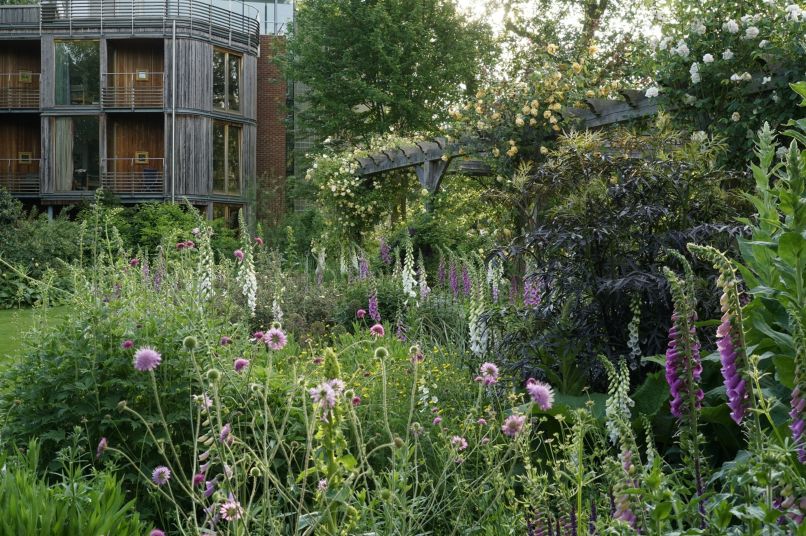
Fellows Garden
The Fellows' Garden, on the west side of Queen's Road, was created in the early nineteenth century from space previously used as paddocks for the Provost's horses. It took another century for the garden to be opened to junior members of the College, and it is now occasionally open to the public under the National Gardens Scheme. The tranquil garden acts as a wildlife corridor and a wonderful green wedge coming right the way into Cambridge. The garden contains a number of island borders and specimen plants, as well as housing a variety of trees of scientific interest. All green waste that comes out of the gardens is recycled, including all woody materials which are chipped and reused.
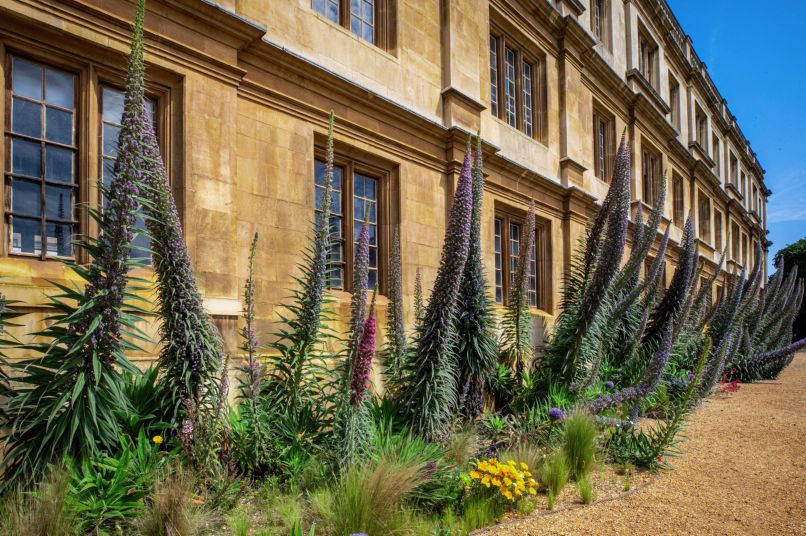
Clare Border
The Clare Border at King’s started life as an experiment in dry gardening, using a range of plants that require very little water to grow successfully. The site is water limited, being a sunny and exposed south facing border within Cambridge’s low rainfall area. The border was established in 2016, taking as its inspiration the dry garden designed by Norman Villis at Cambridge University Botanic Garden, and more recently the gravel garden designed and installed by Beth Chatto at Elmstead Market, Essex.
The typically arid growing seasons experienced in Cambridge are being exacerbated by climate change. By introducing plants that require little water into this border we are minimising the need for irrigation, and are hopefully inspiring visitors to King’s to grow some of the plants they see here in their gardens at home.
The plants that really stand out within the border and are certainly most commented on are the two species of Echium that seem to wander from the banks of the Cam all the way up to the west end of the Chapel, along the ancient wall which separates King’s from Clare College. These giant buglosses are endemic to the Canary Islands, found a few hundred kilometres off the African coast. Keep an eye out for the solitary bees living in the old stone Clare border wall – this rare habitat supports declining pollinator species like Lasioglossum smeathmanellum.
Allotments
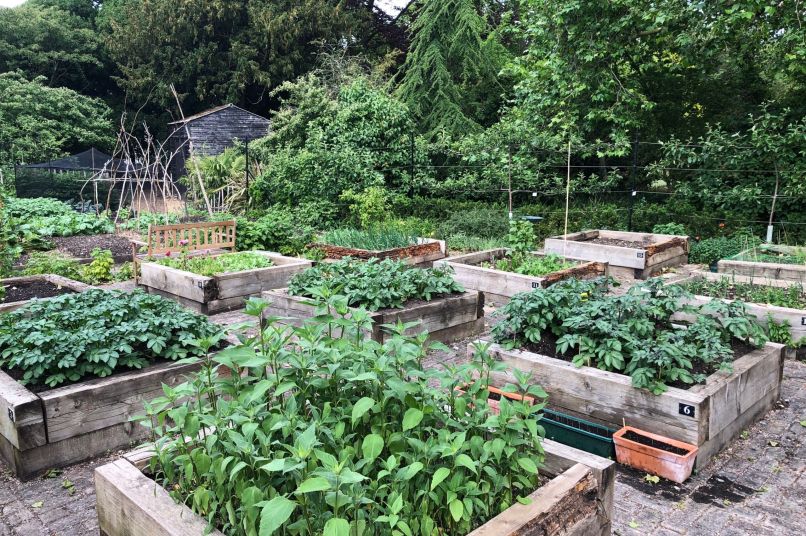
Our accommodation at Garden Hostel has a sizeable plot of allotments which are given over to students at the start of each academic year, comprising a series of raised beds alongside the main plot and the communal greenhouse. A 'no-dig' method is employed in order to not disturb the soil too much and foster soil development. In any given year you might find potatoes, onions, carrots and parsnips growing alongside maize, courgettes, flower sprouts, kohlrabi, rhubarb, celeriac, salsify, beetroot, turnips, beans, squashes and asparagus, with tomatoes, cucumbers and chillies getting going in the greenhouse. Companion planting with various herbs, and flowers such as nasturtiums and tagetes, helps to provide additional forage for pollinators whilst helping to ward off various pest species.
At the College's award-winning Passivhaus buildings on Cranmer Road, the landscape is also geared towards biodiversity and sustainability. A matrix planting scheme is in evidence with lots of herbaceous perennial plants, as well as another set of student allotments and fruit espaliers which not only give some privacy but also something to eat in the autumn.
The Orchard
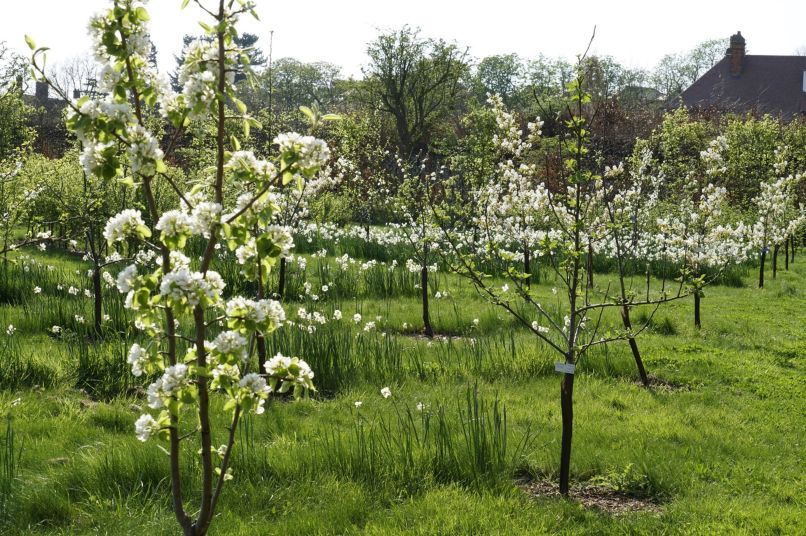
Situated next to Garden Hostel, the orchard consists of more than thirty fruit trees of all different varieties, including apple, pear, plum, greengage, medlars and quince. It's a tranquil space that the students can roam in and pick the fruit when it ripens, acting as something of a safety valve from the pressures of academic study. The orchard's also home to our amazing Edwardian revolving summer house!