
Undergraduate Silk Roads Summer Research Project
Second-year historian Anmona Siddaqua was one of 36 students taking part in 2022’s Summer Research Programme for undergraduates to sample what it might be like to go on to further study.
Mapping the past
Second-year historian Anmona Siddaqua was one of 36 students taking part in 2022’s Summer Research Programme for undergraduates to sample what it might be like to go on to further study.
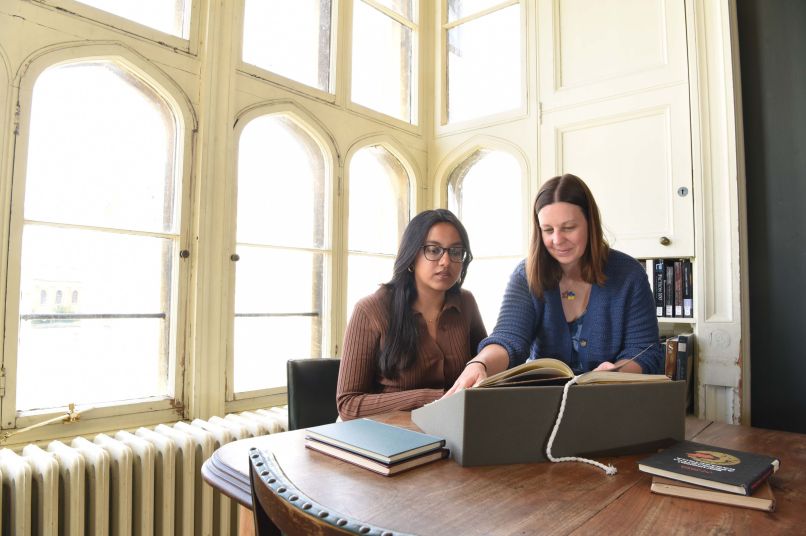
In 2022 Anmona has worked alongside King’s Fellow Katie Campbell on a project looking at the effects of the Mongol conquest on Central Asian cities, specifically concentrating on the city of Otrar in present-day Kazakhstan. “Otrar was abandoned in the 1800s but during the Middle Ages it was quite a strategic city with a population of more than 20,000. Previous archaeological work has uncovered a lot of material evidence of vases and kilns from that period which give us a good idea of where people lived and worked within the city.
“To help with future excavations, I’ve been creating a database of diagrams and maps from Soviet-era archaeology books about the city, and geo- referencing these directly onto modern satellite imagery using open-source software called QGIS.”
Overlaying the images has allowed Anmona to make use of her photo editing skills, but there are other challenges that are proving more difficult: “The hardest part is understanding the Cyrillic; I can now identify some key words like ‘horizon’ or ‘excavation’, but it would be a lot easier if I knew more Russian!”
Anmona has presented her findings alongside the other students on the programme at a showcase event in October 2022. How has she found the experience? “I’m really enjoying the computational side of it; my degree so far has mostly been spent reading, taking notes and writing essays, but the opportunity to work with diagrams, geospatial software and material culture has been really exciting – it adds another dimension to my understanding of the period and is something I’m hoping to do more of as I move into my third year. Another important part of the project is the chance to talk to Katie about the academic process, the hurdles she’s faced as a researcher, and whether it might be a possible future for me as well.”