Medicine
Our medicine course is intellectually stimulating and professionally challenging. We provide rigorous training in the medical sciences while equipping students with the communication, interpersonal, and clinical skills required by today’s doctors.
At a glance
A Level requirements: A*A*A with A* in Chemistry
IB requirements: 41-42 points overall with 7, 7, 6 at Higher Level including 7 in Higher Level Chemistry
Subject requirements: Chemistry, and two other from Biology, Mathematics, Further Mathematics, and Physics. Please see "What we look for in an applicant" for more information.
Average students per year: 8
Admissions assessment: University Clinical Aptitude Test (UCAT)
Written work: None
Admissions
Course overview
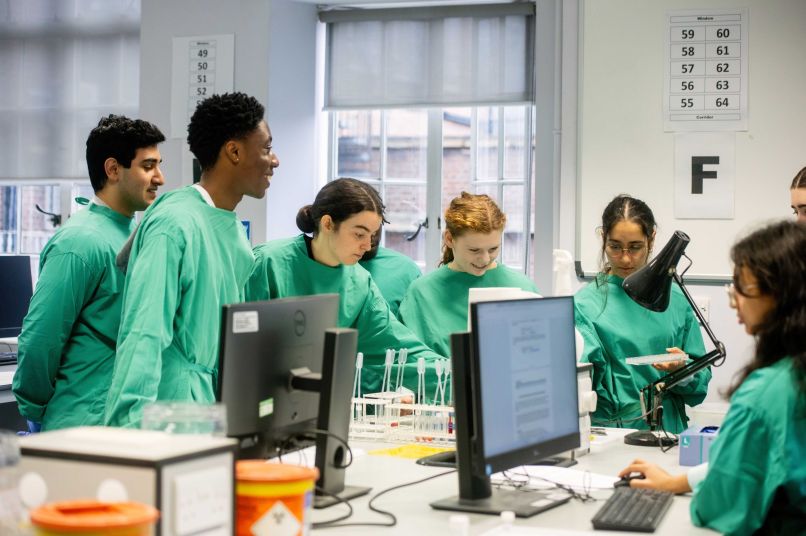
Medicine students will study medical sciences for the first three years before undertaking a clinical placement for the final three years. During your first three years, you will focus on the scientific principles underpinning medicine alongside a clinical strand. You will also get to conduct a medical dissection. The course is taught through a combination of lectures, practical classes, which include dissections, and supervisions.
During your first two years, you will cover the functional architecture of the body, the physiological systems that underpin the body’s regulation of its internal environment and its response to external threats, the biology of disease, mechanisms of drugs in action, neurobiology and human behaviour, and human reproduction. The clinical strand of your first three years will include foundations of evidence-based practice, the social and ethical context of health and illness, and aspects of patient care. In your third, pre-clinical, year, you can choose to specialise in one of a wide range of subjects from other Triposes (e.g. Natural Sciences, Anthropology, Management Studies, History of Medicine, Philosophy, etc.).
For more information about the course and its modules, visit the University website.
Admissions assessment
Candidates for Medicine must take the UCAT, which is a pre-registration required test. For more information about the test, please see the University website.
Interviews
The interview will consist of two 25-minute conversations with two of the Medicine Fellows at King’s. During the interviews, we may ask questions to which you may not know the exact answer. We are interested in seeing how you draw on your existing knowledge of Biology, Chemistry, Physics, and/or Maths to think through and approach new problems.
We encourage you to stay calm, listen carefully to the questions, and feel free to ask for clarification or request that a question be repeated if needed. Ultimately, we want you to engage in the conversation and enjoy the experience.
What we look for in an applicant
Candidates who take Chemistry and Biology, alongside one or two other maths/science subjects, tend to make the most competitive applications.
We are looking for students with a solid grasp of scientific principles, and the ability to apply those principles to new contexts. We are also looking for students with good interpersonal skills who can demonstrate empathy and a good capacity for engaging with a wide range of groups – from patients, to family-members, to fellow clinicians. Becoming a medical professional is also an extremely lengthy process that requires considerable commitment and passion, so we will also look for evidence that you are aware of what is involved, have explored different aspects of clinical practice, and are committed to putting in the work that will be required to qualify. Students should show capacity for logical reasoning and an ability to think analytically and creatively about new situations.
A top tip for applicants
Read widely around biology, evolution, medicine, and social policy. If you are able, it might also be helpful to obtain work experience in the medical field – even if this is just informally shadowing a GP, etc. However, not having formal work experience will not disadvantage your application.
Find out more
You can find out more about Medicine by visiting the University website and the School of Clinical Medicine website.
King’s also runs Open Days where you can get a taste of studying here.
Life as a King's Medicine student
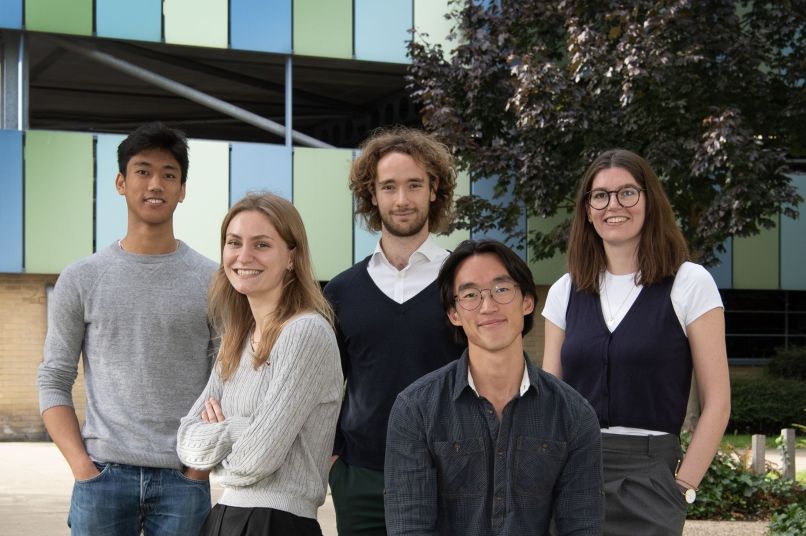
There are typically 20-25 hours of teaching each week. Outside of those hours, you will be expected to conduct readings, write essays, and prepare for supervisions. King’s admits eight students per year to study Medicine. There are several medical Fellows, many of whom are also practising clinicians. Lectures generally last around 50 minutes, and you can print a handout in advance to aid in your note-taking. After your lectures, you will likely attend practical sessions. These are interesting and interactive. During your supervisions, you will go through the work you covered in the lectures and the practical sessions. You will usually have one supervision a day, although this may increase in the lead up to the exam period. The rest of the day will usually be spent on private study in the library, but many students will spend the evenings playing sports, relaxing, or socialising with friends.
We are a medium-sized cohort with a real sense of community between year groups, fostered by the King's Medical Society and the many medics' dinners held throughout the year. The supervisors are chill and supportive, so if you prefer to learn at your own pace without being overwhelmed with homework every week, King’s is the place for you.
- Fabian, 2nd year
From meeting alumni at our annual MedSoc dinner, to partaking in anatomy supervisions in the operating theatre, to attending this year's East of England Undergraduate Cardiology Conference at King's, the College has definitely been a formative part of my academic journey so far.
- Tienson, 1st year

Careers and graduate opportunities
When you graduate, you’ll be able to get provisional registration with the General Medical Council (GMC). You can then go anywhere in the country to complete two years as a junior doctor. These are known as Foundation Years. At the end of these two years and after taking the Medical Licensing Assessment (MLA), you can register with the GMC as a doctor. You’ll be ready for a range of careers across general practice, medicine, psychiatry, and other specialities.