
King's Fellow and computer scientist Alice Hutchings wins the Alan Turing Cyber Leadership Award
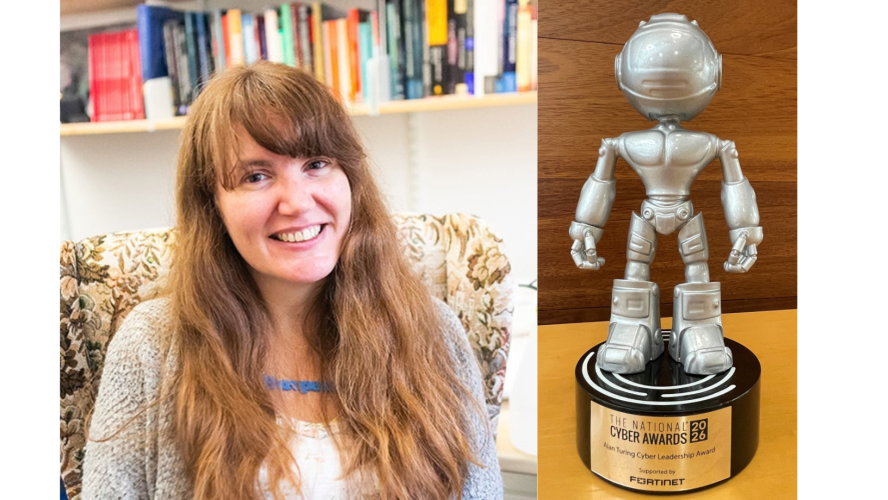
King's Fellow and Professor of Emergent Harms Alice Hutchings has won the 2026 Alan Turing Cyber Leadership Award on 28 September at the National Cyber Awards 2026.
The Leadership award is supported by Sir Dermot Turing (nephew of Alan Turing) and "recognises a senior technical leader who has made a significant contribution to the digital safety of society," say the awards organisers.
"This accolade," they add, "honours those whose technical expertise, leadership, and strategic influence have advanced cyber resilience and strengthened the security of the digital ecosystem."
Cambridge Cybercrime Centre
Alice is Professor of Emergent Harms at the University's Department of Computer Science and Technology and directs the Cambridge Cybercrime Centre here. This interdisciplinary initiative brings together a range of people working in computer science, criminology, policy and – where appropriate – law enforcement, to understand and disrupt cybercrime.
Over the 11 years of its existence, the Centre has collected some very substantial datasets relating to cybercrime which researchers mine for information about criminal activity. These datasets are used to devise ways of identifying cybercriminal activity, build systems to detect this type of crime when it occurs, and show ways in which extremely reliable evidence of wrongdoing can be collected.
Recently, for example, researchers at the Centre were able to show how, as law enforcement agencies are closing down more and more cybercrime marketplaces, bad actors are instead moving to other platforms, such as the messaging app Telegram.
The researchers called for Telegram to do more to ban so-called 'gateway' channels that allow cybercriminals rapidly to migrate from one channel to another to avoid detection, as this can facilitate cybercriminal activity online. But they also highlighted the effectiveness of policy changes made by Telegram, such as their decision to cooperate with law enforcement, "as these can drastically affect the [cybercriminal] ecosystem".
In presenting the Alan Turing Cyber Leadership Award last night, the judges commended Alice for "delivering outstanding, highly technical research with clear societal benefits".
Technology facilitated abuse
They also particularly highlighted her work "specifically in protecting vulnerable individuals from stalking and domestic abuse".
Alice has researched and written extensively on how technology is being used harm victims – for example, by abusers who hide gadget-finding devices in their victims' clothes or bag so they can more easily track their movements and stalk them.
Last year, Alice co-authored a paper on how internet-connected household devices that make homes 'smarter' can be used maliciously for unintended purposes, including for intimate partner abuse. And this year, she published work in the journal IEEE Security & Privacy on 'Technology Facilitated Abuse and the Security Paradox'.
This explored the paradox that while "computer security is built around protecting systems from unauthorized users, in intimate partner violence, it is often the administrator who is the threat".
Safety by design
In it, Alice argued that by failing to differentiate between 'care' and 'control', "the tech industry has effectively built an infrastructure of coercion".
Mainstream technologies enable abusers, she said, "while survivors are expected to manage their own safety with limited tools. To resolve this, we must move towards a paradigm of safety by design, whereby developers anticipate abusive users and integrate privacy protections by default."
Receiving the award, Alice said:
"It's always really nice to be recognised, so I'm very grateful to the National Cyber Awards for giving me this accolade. But the reality is that our work on identifying emergent harms is a team effort and none of it would be possible without an amazing team of researchers and PhD students. So my thanks go to them too."
Adapted from an article published by the Department of Computer Science and Technology, University of Cambridge