
Cambridge academic uncovers Alan Turing’s short story
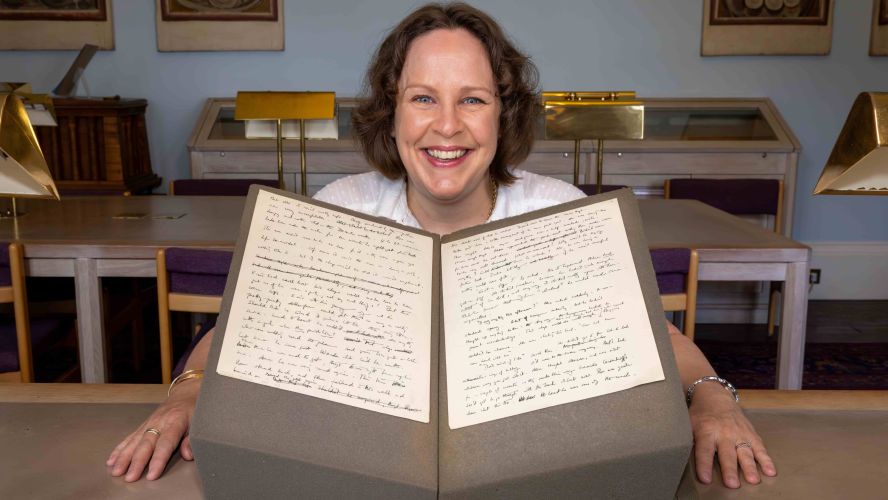
‘Pryce’s Buoy’ rips up Alan Turing’s ‘isolated mathematician’ image, revealing a playful man overcoming trauma and defiantly embracing his homosexuality.
A startling new study of a little-known, unpublished short story by Alan Turing (KC 1931) challenges our understanding of the man who played a key role in cracking the Nazi’s Enigma code, developed the theoretical underpinning of the first computers, and laid the groundwork for the development of artificial intelligence.
‘Pryce’s Buoy’, a six-page, scruffily hand-written fragment of a short story kept in the College Archives has been transcribed and fully studied for the first time. Professor Sarah Dillon’s findings, published today in The Review of English Studies, will surprise anyone who accepts The Imitation Game’s portrayal of Turing.
“We’ve distilled a version of Turing that is a two-dimensional stereotype,” says Dillon, a Professor at Cambridge’s Faculty of English. “He’s come to be seen as socially unaware, entirely concerned with logic and numbers, and pretty isolated. His short story reveals a very different man: playful, funny, cheeky, literary, and someone who really liked sex.”
“Turing died when he was only 41, and in those years running up to his death, he was trying to understand himself and his world. Literature offered him a really powerful way of doing that. This was the moment when he really felt a release, a chance to be more creative and playful.”
Dillon hopes that Turing’s love of literature will help challenge the polarisation and prioritisation of STEM subjects over the humanities.
“We need to stop thinking that the literary and the scientific are binary opposites. They're not,” she says. “Lots of scientists read and write literature, and lots of literary people are very skilled at science. If you polarise or aggrandise one over the other, you lose the mix we need to function as individuals and communities.”
Sarah Dillon is currently writing two books about Alan Turing: Turing and Me; and Turing's Literature: An Alternative History of Influence.
Read more here about this new study and 'Pryce's Buoy'.
**
Alan Turing (1912 – 1954) became an undergraduate at King’s in October 1931. He received a First in Part II of the Mathematical Tripos in 1934 and was made a Fellow in 1935 for his work ‘On the Gaussian Error Function’. He remained a non-resident Fellow of the College until 1952.
The Turing Collection includes Turing's letters, transcriptions of talks, photographs and unpublished papers, as well as memoirs and obituaries written about him. Many of these documents, including ‘Pryce’s Buoy’ have been digitised and can be viewed via The Turing Digital Archive.