
AI-powered nematode imaging for global food security
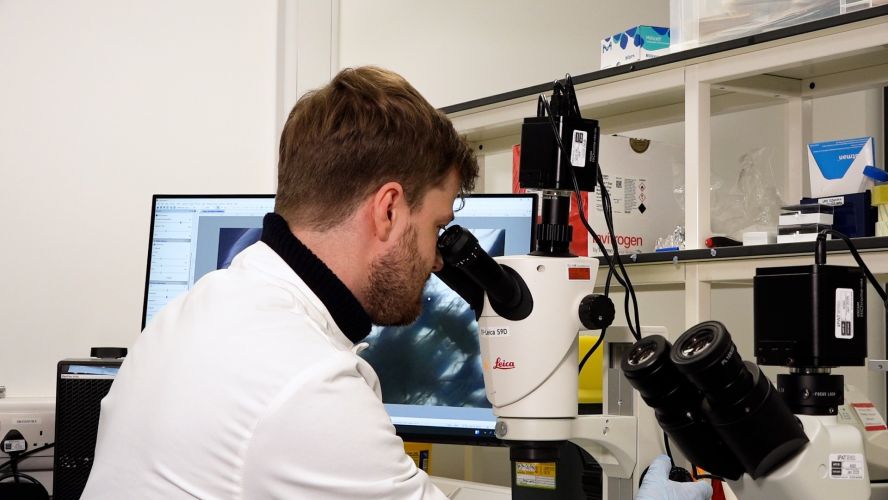
Researchers from the Crop Science Centre are using 3D-printed robots and AI to massively accelerate screening plants for nematode resistance – with the eventual aim of identifying genes that could help develop naturally resilient crops for global food security.
Plant-parasitic nematodes represent a significant, yet often invisible, threat to food security. These microscopic worm-like creatures infect the roots of every major food crop around the world, draining essential resources and causing billions of pounds of losses every year.
Traditionally, identifying plant varieties with natural resistance to these parasites has been a slow, manual process. However, researchers from the Plant-Parasite Interactions group in the Department of Plant Sciences, led by Professor Sebastian Eves-van den Akker , are using a combination of custom hardware and artificial intelligence to accelerate this work.
The team has developed 3D-printed robots and AI-powered computer vision models capable of imaging and analysing plant-nematode interactions underground at scale. By automating the process, the group has increased screening capacity from 90 plants a day to around 1,000 plants per hour. The technology also allows for 4D imaging – capturing the life cycle of a nematode over multiple days.
Dr Olaf Kranse, Postdoctoral Research Associate in the Plant-Parasite Interactions group, said:
Essentially, we have opened up a new field within nematology where we can study phenotypes that have been unstudied so far. These might lead to new discoveries that then might lead to new avenues to control.
The research focuses on understanding the molecular dialogue between the parasite and the host. By correlating a plant’s genetic characteristics with the number and size of infecting nematodes, the team aims to pinpoint the specific genes underlying a plant’s susceptibility to nematode infection.
While the team are currently working on model plants, the next step would be to apply this technology to food crops like potatoes, where the potato cyst nematode is a key threat to yields.
Professor Eves-van den Akker said:
The ultimate goal is to try to develop some understanding that would ameliorate the problem in agriculture of plant-parasitic nematodes. The ideal long-term objective would be to identify a number of resistance genes that allow us to control plant-parasitic nematodes across the world.
Can AI-based nematode imaging improve food security? Watch this video.
Read more about Professor Eves-van den Akker’s work: Can we feed the world without breaking the planet?
Reference: Siyuan Wei et al. ‘3D printing and deep learning enable holistic and dynamic analyses of tens of thousands of parasites infecting hundreds of genotypes.’ bioRxiv. DOI: 10.64898/2026.08.13.744426