
My PhD with Ayur Zhanaev

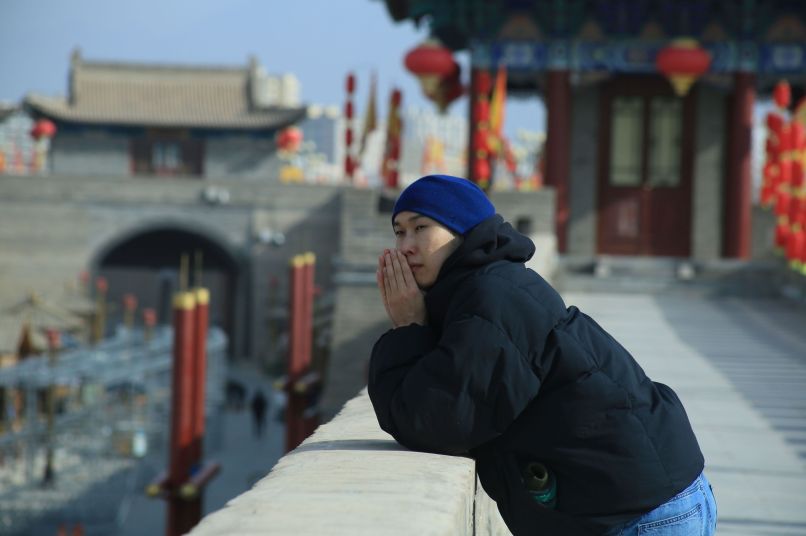
Ayur’s research has taken him on a geographical journey from East to West, a journey which chimes with the spirit of the Silk Roads Programme, which he joined in 2022.
For my project I completed a year of field work in China. I was based at the University of Inner Mongolia in Hohhot and regularly traveled to Bayanhot, the site of my fieldwork, for two weeks at a time. Bayanhot is the capital of the Alashaa league in westernmost Inner Mongolia and is beautifully located between the Alashaa Mountains on the east and the Gobi Desert on the west.
Previously known as Dingyuanying, Bayanhot was established in the early 18th century as a Qing period garrison town and later became the centre of the Alashaa Mongol banner (administrative division). Located on the historical Silk Roads, Dingyuanying was the crossroads of long-distance caravans from Russia’s border to Tibet and China proper on their way to Xinjiang. Due to its political importance, strategic location, and trade opportunities, the town flourished and earned the nickname ‘Little Beijing.’ With a multiethnic population of around 10,000 people by the mid-20th century, the town now has more than 100,000 residents. Still considered a small city by Chinese standards, Bayanhot continues to grow quickly, so even local people are not sure what their town looks like in some districts. The old part of the town and city walls, which were largely destroyed in the second half of the 20th century, were recently restored.
I am interested in the urban lifestyles of the Mongols throughout history. Mongols were commonly defamed as those who destroyed cities rather than built them, whereas the much-romanticised word ‘nomadism’ has become the standard keyword in conceiving their history and culture. Mongols were primarily nomadic people, but there is a great deal of historical evidence linking cities with Mongols; and in modern times, most Mongols live in urban areas.
Compared to other urban centres associated with Mongols, there has been little anthropological and historical research on Bayanhot. Using archival materials, travellers’ accounts, local memories and interviews, my project seeks to introduce the lesser-known historical instance of Mongol urban life to Inner Asian and Silk Road studies.
A Qing-period document I recently discovered describes how Alashaa elites travelled between their banner and the distant capital. In around 1764, Alashaa Prince Luvsandorji went to Beijing to visit the Imperial court and his entourage consisted of four noblemen, 12 women and children family members, 16 officials, three lamas (spiritual leaders), and 52 soldiers – a total of 87 people. They travelled with 110 horses and mules, 121 camels, and were armoured with four arrow cases, three guns, and four swords. The caravan must have been an impressive sight!
My previous research project, supported by The Robert H.N. Ho Family Foundation Program in Buddhist Studies, looked at Buddhist didactic literature written for Buryat-Mongol laity between the 18th and the beginning of the 20th century. Lamas compiling and distributing these texts intended to ‘improve’ the society according to their vision of the Buddhist order. By the second half of the 19th century Buryats were increasingly concerned about their ‘traditional’ way of life. Their social and economic reality was rapidly changing due to the disadvantageous land reforms and increasingly assimilative policies from the Russian state. These texts provide fascinating insight into how Buddhism spread in Inner Asia and influenced local forms of social reflexivity.
During this period, Inner Asia, like many other regions, experienced the emergence of new ideas and institutions in response and sometimes in opposition to what we generally call modernity. To fully understand them today we need to trace their history and interconnectedness.
As I research Bayanhot, I continue to move within the Mongol and Inner Asian regions, with their shared history and culture. Due to the distant geographical, political, and cultural settings, I have been developing new skills. While I rely on my knowledge of Mongolian (including classical script) and Russian, I am also spending time improving my Mandarin Chinese and have even started learning Manchu.
My academic journey started in my hometown Ulan-Ude, continued in Warsaw, and for the past couple of years has been associated with King’s College and the Mongolia and Inner Asia Studies Unit (MIASU) in Cambridge – and now also Hohhot. MIASU is an internationally important centre for Inner Asia studies, and I have been familiar with the research work of the unit for a long time. My own academic outlook developed taking research by MIASU’S specialists as inspiration. In the spirit of the Silk Roads, I maintain connections with all those academic centres and value the experience I gained there, moving back and forth (often virtually) to pursue my research interests.
I am grateful for the opportunity to be a part of the Silk Roads Programme, which has broadened my understanding of this extensive region and the world at large. I have been given the chance to gain a comparative perspective, which deepens my understanding of the wider interconnectedness and distinctiveness of my fieldwork site. I humbly hope my research project will bring a new facet to the Programme.