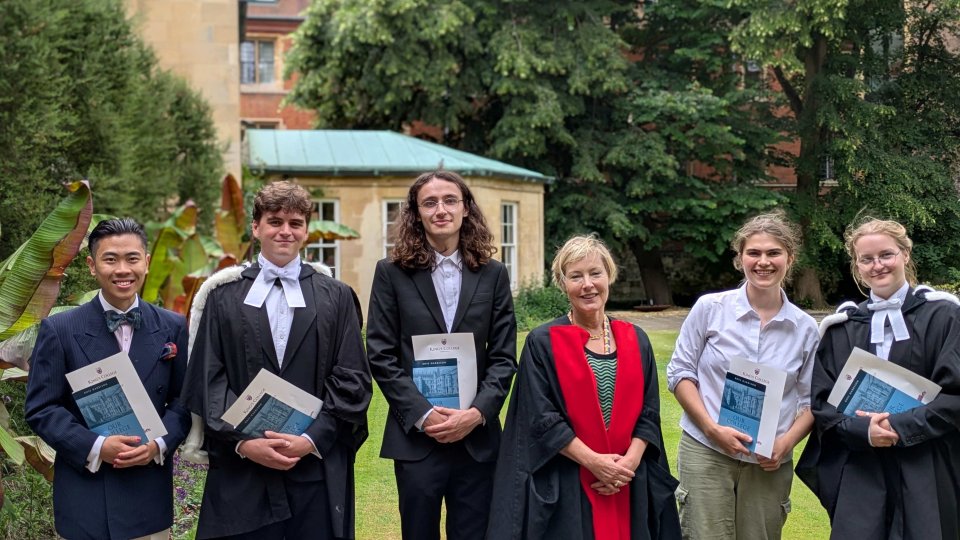
Psychological and Behavioural Sciences (PBS) is a three-year course covering social, developmental, biological and behavioural psychology within the broader context of the behavioural sciences. It will appeal to students interested in the development of social behaviour, psychopathology, cognitive psychology, language, brain mechanisms, gender, family relationships and influences, personality and group social behaviour amongst many other topics.
Course Structure
In the first year (Part I), students take two compulsory papers introducing them to psychology and psychological inquiry and methods, and two optional papers selected from Humans in Biological Perspective; Language, Communication and Literacy; Evolution and Behaviour; Analysis of Politics; British Economic History; and an introduction to Computer Science.
In the second year (Part IIA) all students take four papers. Everybody studies social psychology plus a specialist paper chosen from a range of about nineteen options including biological or social anthropology, sociology, criminology, the sociology of education etc. For the two remaining papers students can either take Biological and Cognitive Psychology and a second specialist topic, or choose Experimental Psychology and undertake a research project (assessed by a 5,000 word essay).
In the final year (Part IIB) all students undertake a research dissertation (6,000 - 10,000 words) on a psychology topic of their choice as well as three further papers which may be selected from the Part IIA specialist list which includes Development and Psychopathology, Experimental Psychology and Cognitive Neuroscience, or additional psychology papers.
Psychological and Behavioural Sciences (PBS) at Cambridge
Undergraduate students and staff talk about studying Psychological and Behavioural Sciences (PBS) at the University of Cambridge. To find out more about this course, see www.undergraduate.study.cam.ac.uk While every effort has been made to ensure that the information contained in this video is accurate at the time it was uploaded, changes are likely to occur. It is therefore very important that you check the University and College websites for any updates before…
PBS at King's
King's has always admitted a particularly large number of students in Psychology and related disciplines and provides a stimulating and supportive intellectual environment both inside and outside of the formal course curricula. PBS students would normally attend two lectures a week for each paper as well as one or two college supervisions where they discuss written work and develop their reasoning and ideas.
After graduating, many PBS students pursue further study and research, or undertake professional courses in clinical, educational, forensic, or applied psychology. Other King's students have opted for alternative careers: the skills and knowledge you acquire on the PBS course could lead to careers in the media, management, government administration, finance or business, for example.
Fellows at King's in PBS:
Experimental psychology; language as a cognitive and neural system; neural processes; processing of linguistic information.
Human communication; new informational and communication technologies; the evolution of language and intelligence.
Experimental psychology; cognitive neuroscience; brain and cognitive development in infants; computational modelling.
Applying for PBS at King's
We welcome applications for King's PBS from a wide range of academic backgrounds in the UK and beyond. Candidates are assessed strictly on the basis of their academic promise.
Subject Requirements
We require candidates to have studied at least one of Mathematics, Biology, Chemistry, Computer Science, Physics, in addition to other academically demanding subjects in sciences or humanities/social sciences. A level Psychology is not a requirement for the course.
Written Work
You will not be asked to submit any written work as part of your application.
Interviews
Most (but not all) candidates are invited for interview in King's, which take place in early December. You will be asked to collect a text to read and think about in the half hour before your interview. You will then discuss the text with the interviewers.


Reading, Resources and Events
There is no prescribed reading for PBS applicants, but you may find the PBS reading suggestions below useful.
Events which may be of interest in the year before you apply (year 12 in the UK) include Oxford and Cambridge Student Conferences, CU Science Festival, CU Masterclasses, and King's Open Days. Students from backgrounds where there is little tradition of entry to Higher Education might like to think about applying for the Sutton Trust Summer Schools or the CUSU Shadowing Scheme.