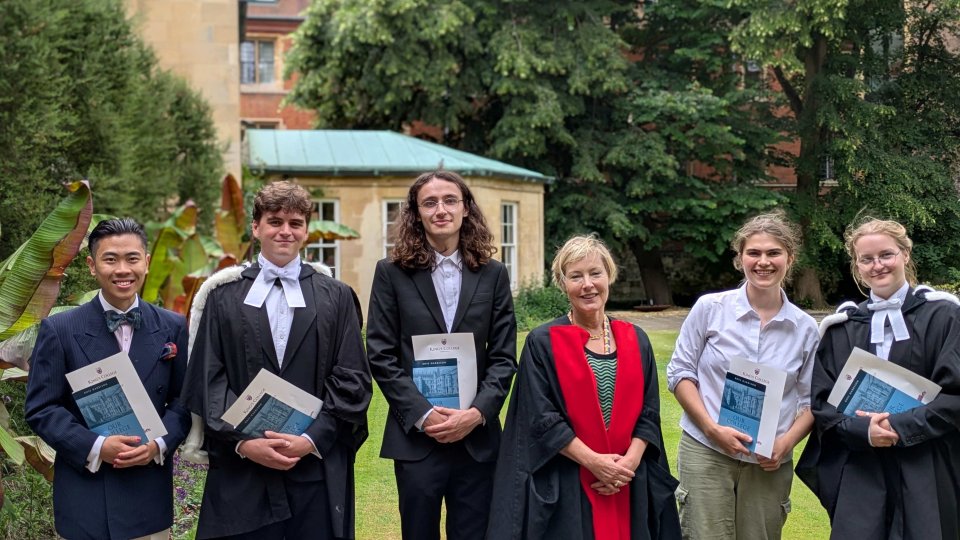
Cambridge is renowned for the excellence of its Mathematics course. Equally challenging and rewarding, it offers the opportunity to study a wide range of subjects: everything from abstract logic to black holes. Since Sir Isaac Newton was Lucasian Professor (1669-96), mathematics teaching and research here have been enhanced by a string of brilliant mathematicians, including six Fields Medallists and even Nobel Prize winners. Most current Faculty members are leading international authorities on their subject.
During the first two years (Parts IA and IB) there are courses on a wide range of mathematics. In the latter part of the second year there are also some optional courses available. The third year (Part II) is a unified course with subjects available to those intending to pursue further study of maths and also subjects of a more general nature. The intention is to offer each student the opportunity to pick-and-mix, to choose a combination of courses tailored individually to their abilities and aspirations.
After completing the degree students enter a variety of professions. About one third of King's students do further work in Mathematics, often taking Part III of the Mathematical Tripos before doing research.
Typically there are two lectures a day, Monday to Saturday. Each hour contains highly condensed material, and it usually takes a further hour by oneself to unravel it. First and second year lectures take place in the centre of Cambridge, very close to King's - highly convenient for the late riser! Third and fourth year lectures are about 15 minutes' walk away at the Centre for Mathematical Sciences, a prestigious, (architectural) prize-winning new complex, which is an exciting place in which to learn, research or teach.
Mathematics at Cambridge
Undergraduate students and staff talk about studying Mathematics at the University of Cambridge. To find out more about this course, see www.undergraduate.study.cam.ac.uk Disclaimer: While every effort has been made to ensure that the information contained in this video is accurate at the time it was uploaded, changes are likely to occur. It is therefore very important that you check the University and College websites for any updates before you apply for the course by visiting…
The differences between the colleges occur in the supervisions they offer. The norm is for each pair of students to have two one-hour sessions alone with a suitable teacher to sort out the new material and check the understanding of the old. Currently the maths teaching staff at King's consists of a Lecturer, a Reader and five Professors. In addition, we use the four King's Research Fellows and several excellent research students for specialist teaching.
There's a good sense of community amongst the Mathematicians at King's. The "mathmos" get to know each other well, and since everyone gets stuck sometimes, it is really useful to have other students being helpful as well as supervisors.
The Turing Maths Society was set up by students to encourage dialogue between all Maths undergraduates at King's, regardless of which stage they might be at in their degree. The Society arranges a termly meal for all Maths students and organises talks by academics and researchers which are open to the entire King's community.
Fellows at King's in Maths:
Pure mathematics; algebraic geometry; mirror symmetry; string theory; differential geometry; punctured logarithmic curves.
Statistical physics of soft materials; applied mathematics; probability theory; problems in the natural and social sciences.

Mathematical physics; theoretical physics; particle cosmology; astrophysics; string theory; theories of gravity.

Abstract mathematics; category theory; proof theory, theoretical computer science; semantics; higher dimensional algebra.
Quantum Computation, Quantum Algorithms and Computational Complexity, Quantum Information Theory.

We welcome applications for Mathematics from suitably qualified applicants at all kinds of schools, all over the world. It is a King's tradition to welcome applicants from a wide range of backgrounds. Women are also particularly underrepresented in university Mathematics courses, and we therefore actively encourage applications from women to study Mathematics at King's.
The course is difficult, and we therefore have to select those candidates we think will benefit from the challenge. The number of offers for Mathematics varies from year to year, but we would expect to make between fifteen and twenty offers. It is not necessarily more difficult to gain admission to Cambridge if you apply to a prestigious college, and it has, in the past, been easy to persuade other colleges to take some of our gifted candidates through the pool system in years when we have been over-subscribed.
When you apply you will be asked (on your additional questionaire) to enter your option preference for your first year. You must choose either Mathematics or Mathematics with Physics.
Subject Requirements
For students taking A-Levels, it is required that you are taking A-Level Mathematics and A-Level in Further Mathematics. We also require that you take the STEP paper - see below for more details. An A-Level in Physics can also be very helpful. If your school does not offer teaching for Further Mathematics, you may be able to get help from the Advanced Mathematics Support Programme and Integral. We have had successful applicants who started Further Mathematics at the end of year 12. You can find links to these programmes below.
For students who are taking the International Baccalaureate, Higher Level Mathematics is required, along with the STEP paper (see below). IB applicants starting the new IB Mathematics syllabus are expected to take IB Higher Level 'Analysis and Approaches'. Higher Level Physics is also recommended.
Written Assessments
Students who are invited for interview at King's are also asked to take a written test set by the Director of Studies, lasting one hour. We will automatically organise this written test for you as part of your interview timetable - you do not need to register. Your performance in the test will not be considered in isolation, but will be taken into account alongside the other elements of your application.
Written Work
You will not be asked to submit any written work as part of your application to King's.
Interviews
Candidates invited for interviews at King's have two interviews with college mathematics staff, in which we assess your mathematical skills and motivation.



Ellen has written about her experiences of studying Mathematics at King's, including the transition from school maths, supervisions, the workload, the application process, STEP, and the best and worst things about Cambridge Maths. This account is well worth reading to get a sense of what being a King's mathematician is really like.

There is no required reading for Mathematics candidates but you may be interested in the Faculty reading suggestions and Plus Magazine, see below. There is also extension material available on the NRICH Mathematics website - a good place to start is this explanation of 'rich' tasks, curriculum links, Developing as Mathematicians, and NRICH and Olympiads.
If you are studying in a different qualification system and wish to consult an A-level textbook, we suggest L. Bostock and S. Chandler (2013) Core Maths for Advanced Level, 3rd edition. Cheltenham: Nelson Thornes. If your school does not offer Further Mathematics, you may be able to get support through the Further Mathematics Support Network if you want to take it. You can also view a helpful flowchart below.
King's holds an annual Year 12 Maths Open Morning in April each year, and other events which may be of interest in the year before you apply include CU Masterclasses, Oxford and Cambridge Student Conferences, and King's Open Days. Students from backgrounds where there is little tradition of entry to Higher Education might like to think about applying for the Sutton Trust Summer Schools, or the CUSU Shadowing Scheme.