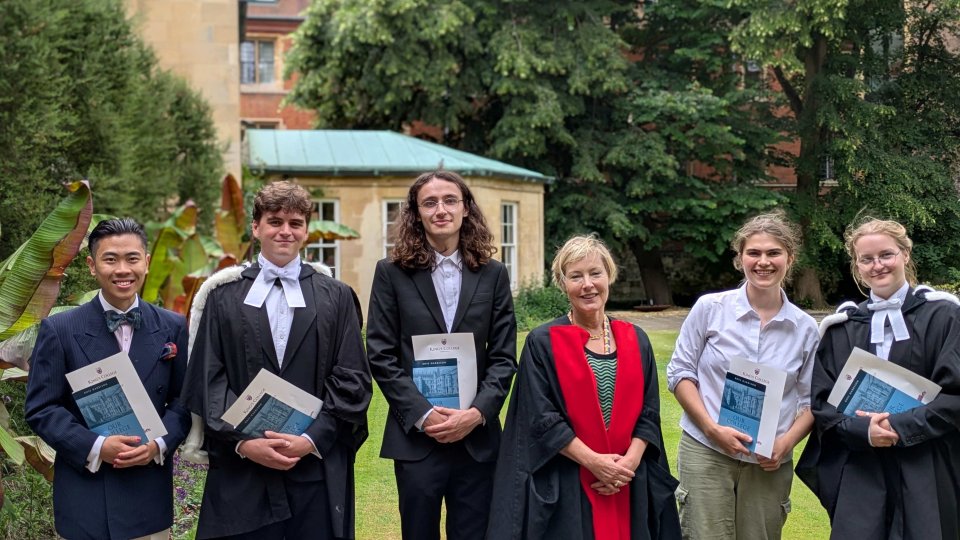
Chemical engineers design and operate industrial processes that convert raw materials into valuable products. The need for more sophisticated products and sustainable processes means chemical engineers are in great demand. Chemical Engineering graduates go on to successful jobs in a broad range of fields, and a large number pursue careers in the chemical and related industries. Cindy Crawford and the President of Trinidad and Tobago, His Excellency Professor George Maxwell Richards, both studied Chemical Engineering (the latter is a graduate of the Department) – so really you can go on to do anything!
The Chemical Engineering and Biotechnology Tripos is a direct entry course for students applying for October 2023 entry or onwards. All applicants applying this year will no longer be able to apply to the previous Chemical Engineering course, which required students to study Engineering or Natural Sciences in their first year of University.
Course Structure Outline
Part IA - Introduction to Pure and Applied Sciences
- Introduction to Chemical Engineering, Biotechnology and Sustainability
- Fundamental Mathematics, Chemistry and Cell Biology
- Introduction to Product Design
- Practical and Project Work
Part IB - Fundamentals in Chemical Engineering and Biotechnology
- Principles behind chemical and biochemical transformations
- Computational Skills
- Practicals and Project Work
Part II - Applications and Design
- Advanced topics in Process Engineering and Biotechnology
- Process design and operations
- Design Project - Conceptualisation to detailed industrial design
Part III - Advanced and broadening topics
- Energy Technology and Sustainability
- Advanced Design
- Choice of advanced topics
- Research Project
For more specific enquiries about the course, please contact admissions@ceb.cam.ac.uk.
Chemical Engineering at Cambridge
Undergraduate students and staff talk about studying Chemical Engineering at the University of Cambridge. To find out more about this course, see www.undergraduate.study.cam.ac.uk While every effort has been made to ensure that the information contained in this video is accurate at the time it was uploaded, changes are likely to occur. It is therefore very important that you check the University and College websites for any updates before you apply for the course by visiting…
King’s first Fellow in Chemical Engineering was also the first head of the Chemical Engineering Department, founded with a bequest from Shell in 1948. He was Terence Fox, famous in the Chemical Engineering world for stating that, ‘God’s greatest mistake at the creation was to frame the Navier Stokes equations in such a complex form.’ King's second Fellow in Chemical Engineering is the current Director of Studies, Geoff Moggridge. Thus the subject has a short, yet distinguished, history in the College.
Fellows at King's in Chemical Engineering:

Design and development of chemical products; production and control of microstructures; environmental issues.
Typically two to four students are accepted each year to read Chemical Engineering at King’s, although there are no quotas. Applications are welcome from suitably qualified students from anywhere in the world, and we actively encourage applications from female applicants, who are underrepresented in university Chemical Engineering courses.
Subject Requirements
A Level Entry Requirements: A*A*A with Mathematics and Chemistry as essential. Candidates should then take Physics and/or Further Maths and/or Biology at A Levels as their third subject.
IB Entry Requirements: Overall score at least 42 with 7,7,7 in Higher Level Subjects, with Higher Level Mathematics and Chemistry and a further mathematical/science subject as their third Higher Level subject.
For any other qualifications, applicants should check the University website for information about what the entry requirements are based on the qualification in their country.
The typical offer is A*A*A, and we will often ask for an A* in Maths, Further Maths or Chemistry.
Pre-registration required written assessments
All candidates for Chemical Engineering at King's are required to take a pre-registration required written assessment for Natural Sciences, which will take place in assessment centres (NOT in your school). You must register YOURSELF in advance to take the assessment. Your performance in the assessment will not be considered in isolation, but will be taken into account alongside the other elements of your application.
All applicants for courses with pre-registered assessment must be registered in advance. Late registration will not be possible and may result in the application being invalid. Students self-register for the test – their school cannot do this for them. Please make contact with your nearest test centre as soon as possible.
Applicants applying in the 2024 application round for entry in 2025/26 will have to take the ESAT (Engineering and Science Admissions Test) for Chemical Engineering.
Written Work
Applicants for Chemical Engineering do not need to submit any written work as part of their application.
Interviews
Most (but not all) candidates are invited for interview with King's. You will primarily be interviewed by staff from the Department of Chemical Engineering and Biotechnology.


There are no particular books that prospective Chemical Engineers are required to read, but do look at the Faculty reading advice. Your schoolwork in Mathematics is essential preparation for Chemical Engineering at Cambridge. If you are studying in a different qualification system and wish to consult an A-level textbook, we suggest L. Bostock and S. Chandler. 2013. Core Maths for Advanced Level. 3rd edition. Cheltenham: Nelson Thornes.
The NRICH website has some excellent resources for extension work. See in particular the article about mathematical issues, curriculum links, and chemNRICH, as well as engNRICH, and physNRICH. If your school does not offer Further Mathematics and you would like to take it, you may be able to get support through the Further Mathematics Support Network. See the flowchart linked below.
Events which may be of interest in the year before you apply (year 12 in the UK) include the Oxford and Cambridge Student Conferences, Headstart, CU Masterclasses, CU Science Festival, and King's Open Days. Students from backgrounds where there is little tradition of entry to Higher Education might like to think about applying for the Sutton Trust Summer Schools or the CUSU Shadowing Scheme.