Our admissions principles are exactly the same for international students as for any other applicant: we are looking for academic potential. We make offers to those students who we think show the most academic promise. We can admit as many international candidates as we want to based on the strength of the applications. There is therefore no set number or proportion of places for international students: we are only interested in your academic ability. The one exception to this rule is for Medicine applications. The number of places available across the University of Cambridge for overseas Medicine students can be found here.
It is important to be aware that applications must be submitted a full year before the October in which you hope to start your course at King's. Applications to the University and College are submitted via UCAS and you can find further guidance, including important deadlines here.
Applying with predicted grades
Many students apply in the September/October of their final year of school with predicted grades for school-leaving examinations which they will take in the summer. If we make an offer in January, it is conditional on examination performance and we write to confirm conditional places in late August once examination results have been achieved. This enables students to start at King's the October after they leave school.
Students (e.g. Australian students) whose academic year ends in December can still apply with predicted grades in September/October but will have a gap between the end of their school year and starting at King's the following October.
Applying after you have taken your school-leaving exams
The other option is to apply to King's the October after you have received your school-leaving exam results, and take a gap year between school and studying at Cambridge. If you have already met our entrance requirements, an offer we make in January would not normally have academic conditions.
Applying for deferred entry
We welcome applications from international students wishing to defer entry by 1 year. While a 2 year deferral may be considered in exceptional circumstances, applicants who require a 2 year deferral, such as for the purposes of military service, are advised to wait and apply either after they have completed their military service, or when they would be in a position to make an application for a standard (1 year) deferred offer.
Financial support
You can find the financial support we offer to our undergraduates here - https://www.kings.cam.ac.uk/study/undergraduate/fees-and-finance. Alongside other forms of financial support, there are a small number of studentships available to overseas undergraduates at King's which can be found here. Please note some financial support might have an eligibility criteria attached to it. The Cambridge Commonwealth, European and International Trust offers awards (mostly part-cost) to overseas students. You cannot apply for funding through the Trust until you've been offered a place at one of the Colleges. At this point, the College will send you full details of the Trust awards and an application form. All awards are means-tested. To browse available awards by country, see the Trust website.
Admissions assessments
International students follow the same basic application procedure (although if they have not studied GCSEs they will need to provide a transcript). It is important to check before you apply whether there is a pre-registration required admissions assessment in your course that you need to register for. You can find out more about assessments here.
Sending written work
Candidates for some subjects are required to submit written work as part of the application process - see more here.
English Language Requirements
If you're not from a majority English speaking country (as defined by the UK Home Office), your English language skills must be good enough for you to:
- take part in an academic interview
- study a Cambridge course that is taught and examined in English
If you have not already taken one of the English Language qualifications as stated below, offers from Cambridge may include an English language condition either as part of any visa requirements or if there are any concerns raised during your application.
Minimum English language requirements
- IELTS Academic – normally a minimum overall grade of 7.5, usually with 7.0 or above in each element
- TOEFL Internet Based Test (IBT) – normally a minimum overall score of 110, with 25 or above in each element
- EU students – competence in English at C1 standard in the appropriate component of a school-leaving exam (for example, the Abitur)
- Cambridge English: C2 Proficiency – accepted with a minimum overall score of 200, with no element lower than 185
- Cambridge English: C1 Advanced – accepted with a minimum overall score of 193, with no element lower than 185, alongside other evidence of competence in English
- If you have followed the Singapore Integrated Programme (SIP), please contact us.
UK Visas and Immigration is your primary source of information, and on their website you can check whether you will need a visa. Please also see the information from Cambridge International Student Team. You should find their information on visas for interview candidates and their page for new and prospective students particularly useful.
King's cannot provide advice about visas, but you may wish to contact the University's International Student Team.
The academic year at Cambridge runs from October to mid June each year, split into three terms:
-
Michaelmas term (early October to early December)
-
Lent term (mid January to mid March)
-
Easter term (mid April to mid June)
The exact dates vary a little depending on when Easter falls in that year. Students are expected to do some work during the vacations as well.
Terms in Cambridge are short and very intensive. They officially last eight weeks though there will be meetings and social activities in the few days either side of lectures. In Easter term, there are four weeks of teaching before the exam period, and the final week (called May Week though it actually takes place in June!) is a fun week of end-of-year parties and activities of all kinds to celebrate the end of exams.

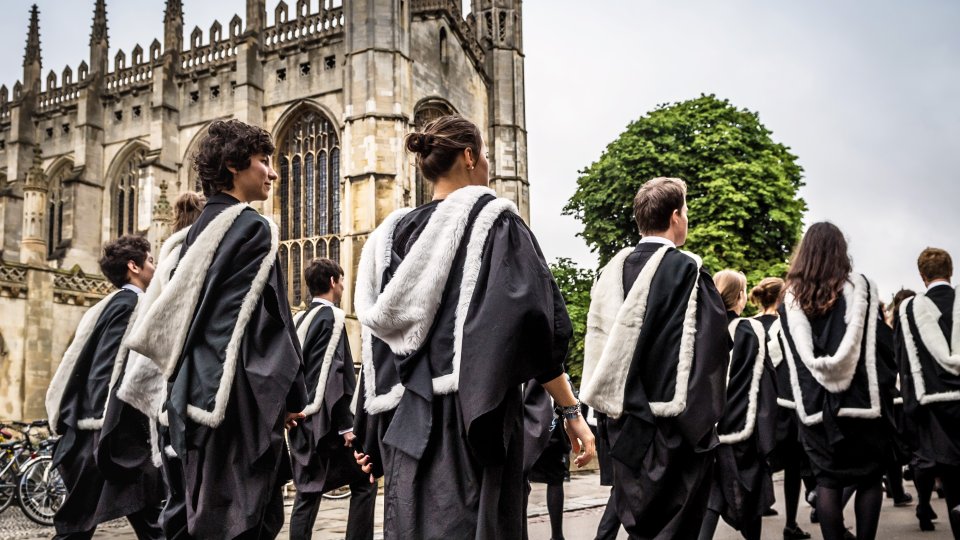
What do international students say about studying at King's? In the documents below, current students have written about their experiences, including what attracted them to the Cambridge course, the application process, teaching, the workload and what they do in their spare time.