Past exhibitions
Paintings by Bob Crack
21 January - 4 February 2012

Born in 1941 Bob has lived, worked and painted in Cambridgeshire all his life. Having trained at Cambridge College of Art and Technology, he began life as a sign writer. Some of his early heraldic work can still be seen today in and around the colleges of Cambridge.
Much of Bob's working life was spent in the graphic industry using litho and screen printing techniques.
Painting became a passion early in his life and using oil on canvas, wooden panels (the floorboards series) and mixed media Bob has created figurative images which give a narrative of the world around him.
In recent years Bob has concentrated on creating finely detailed portraits. Whilst full of realism, these portraits have a stark, somewhat menacing undercurrent.
"The images I paint are reflections of the world around me - personal, political and religious." - Bob Crack

Colour coding Julien & Jasper, Agnès Poitevin-Navarre
Fellow Artists - Fellow Muses
Agnès Poitevin-Navarre
11 - 26 November 2011, King's Art Centre
'Maps have the capacity to open worlds of reality and imagination' wrote Professor Jeremy Black in Remarkable Maps – Examples of How Cartography Defined, Changed and Stole the World. The art practice of Agnès Poitevin-Navarre epitomizes that idea. The exhibition at King’s College Arts Centre is a wonderful platform to explore and engage with this conceptual artist’s past and new body of work.
‘The Art of Being Anecdotal’ could be the subtitle of this exhibition that includes the ‘Colour Coding’ series, ‘The Reader’ and the magnificent ‘Fellow Artists, Fellow Muses’ installation that was shown last year at the Royal Geographical Society in London. This solo show also features new work such as the artist hair embroidered floorplans series as well as the newly commissioned ‘Proustian Map of Cambridge’, a collaboration with Cantabrigians that elaborates on the locals’ greatest achievements and pearls of wisdom.
Agnès Poitevin-Navarre is a conceptual artist interested in the limits of categorizations and semantics. She graduated with an MA from the Slade, UCL, in 1997 and has since been exhibiting locally, nationally and internationally. She works across a range of media but is known primarily for her cartographic and anecdotal work. She uses maps as a shorthand to explore notions of identity, nationality and social codes. She also composes collages and masterminds installations, giving them a poetic twist. See the artist's website for more about her work.
Phantom City
An exhibition by Edita Gazibara , 15 - 28 May 2011
Private view Saturday 14 May 6-8pm
Artist's statement

Bhodisattva
I was born in Sarajevo in 1984, in the year when my hometown was the host to thousands of people from all over the world which participated in the Olympic games. Sadly, the spirit of unity and happiness was replaced by the most brutal destroying of human dignity in the years that followed. As a child, I witnessed the longest siege in modern history. This was the time when I started to reshape my world.
I studied Graphic design, and at the moment I'm a postgraduate at the Academy of Fine Arts in Sarajevo.
While reading the Lotus Sutra, I came across many beautiful stories which have been a great inspiration when making a certain illustration. These stories are abundant in metaphors which may be understood in lots of different ways. And with each new reading I perceive a new association. I start to play with shapes. And I illustrate what I feel. I have made ten illustrations which represent ten worlds from Buddhist philosophy.
The idea was to express the personal attitude and feeling through the ten worlds of Buddhism. These ten worlds are closely linked, inseparable from our daily lives. They represent what we feel and what we go through on a daily basis. In creating this work, I did not want to imitate Eastern atmosphere nor the content of ‘ukiyo-e’ (pictures of the floating world) and their topics, though they are present in this work and they guided it to a certain extent. Inspired by ‘ukiyo-e’, I created these works while placing them in the realm of my own life.
My work is presented in three layers: abstract aesthetic forms, semantic drawing and text. Such exhibition is used as a metaphor of the world we live in, where everything can be found in layers: our body, the planet Earth, as well as this world.
The entire process of making this work was very inspiring for me. I think I have reached another level of understanding the philosophy of Buddhism. I have come to know many beautiful and ugly sides of my environment. I have sharpened my perception.
It has meant a lot to me that so many people were involved in this very process related to this work. All the final results have been a direct development of the relationships with people around me.
Autobiographical Terrains
Lisa Wigham, 24 April - 7 May
Private view: 23 April 6 - 8pm

Sixteen Pages on Elevation and Loss, Rif Mountains Series
This exhibition at Kings College Art Centre brings together a body of work that explores landscape from a Romantic point of view, in which horizons, seascapes, mountains and woodlands are represented in series to describe changing views and emotions of journeys.
The work is made using etching processes derived from drawings made while en route around the English Lakes, across the Pennines and to and from the south of England. Some of the work is drawn from memory of travel overseas, through Asia and North Africa.
These drawings are collected in sketch books and journals, where the intimate space of the page is used for a fathoming of experiences and observations. The importance of this approach to the book form and is referred to in the display of the work.
The moments that induce the work into being are those that disrupt monotony, views captured at pivotal moments in time, when a sensation of being alive to surroundings overwhelms, emotionally connecting to a view or form where the drama of natural light or forms play out a scene of perceived significance.
This work is driven by a fascination with the dramatic tension of fragility and weight in mark making. Etchings reference panoramas and maps using line that holds tactile qualities to suggest imminence of experience, movement and the passing of time.
Landscape is explored in this work as an autobiographical equivalence. Narratives can be teased and assumed from the sequences, intended as a mirror to project though or desire.
Lisa Wigham is co-founder of the Two a.m. Press, this makes and disseminate artists multiples taking the form of books or editions of prints. Lisa Wigham uses digital or traditional printmaking, such as etching for the expression of contemporary ideas. Please visit: www.twoampress.com for more information.
Paintings and Stories
New Work by John Clark, 3 - 16 April
Private view: 2 April 6 - 8pm
Artist's statement

Professional Detachment
The world is sodden with narrative in film, in photography, in games and elsewhere in the media. The art world too has its stories, although they tend to take a more reflexive form. Taken together they present an enormous challenge if, like me, you're interested in narrative painting. Questions of futility must naturally arise. The work on this exhibition plots my recent path through this tricky but entertaining terrain, ranging from the lighhearted to the sombre. I hope you enjoy some of it.
All the Colours
Paintings by Emily Kirby, 6 - 19 March 2011, King's Art Centre
An exhibition of acrylic paintings by Zambian-born artist Emily Kirby.

Three Generations
Artist's statement
"I was born into a family of artists in Zambia in the early eighties. These roots have always had a deep impact on my painting. The majority of my work has drawn on the study of people I met during time I spent in Africa, Brazil and Europe. I have always been moved by the exotic and now living and working in London, I feel immersed in a fresh and exciting cultural melting pot.
I am fascinated by the concept of tribe and subculture and consider it to be a route of exploration offering endless possibilities. My primary aim is to explore techniques in which to portray people in a free and powerful way, in a celebration of their identity.
I have always been primarily concerned with the study of people, finding the figure to be a landscape in itself and people’s emotions an invigorating challenge to capture. A loose style and bold colour combinations have become a defining aspect of my work."
'What is Belarus?'
Paintings by Helena-Alexandra Reut, 20 - 26 February 2011
Artist's statement

"Where are you from?"
"From Belarus"
"Where's that? What's that? How do you spell it?"
This is a conversation which is heard often by people from Belarus, the country where I was born. These questions led me to think - "but seriously, what is Belarus?"
It's a country of indescribable beauty. Not a radiant beauty, it doesn't blind you - it's a weightless beauty, like a wisp of smoke, light as a cloud, transparent and spectre-like. Our fairytales and legends embody this beauty. Belarus is called the blue-eyed country, because there are so many lakes, from the great lakes you can see from outer space to the tiny lakes hidden in the forest, so deep that people call them bottomless, full of life and mystery. The forests are still inhabited by strange and magical creatures. The entire atmosphere engulfs and captivates. There is not a living soul who could forget or remain indifferent to this country if they went there.
This exhibition presents a series of paintings where I try to convey the atmosphere of this country: this feeling of attraction enveloped in a cloud of mist.
A larger selection of my work is available on my website: www.reut-studio.eu
'Between two worlds'
Algimantas Ramanauskas, 1-14 November 2010
The Lithuanian artist Algimantas Ramanauskas creates paintings in acrylics. His works are in a romantic abstractive style and are a pathway between reality and the artist's imagination. You can find a list of his paintings on the Saatchi Gallery website.
John Devlin
12 - 25 June 2010
This exhibition of 22 architectural sketches in a naive, intuitive idiom looks at a fanciful expansion of King's College, Cambridge in the spirit - if not the letter - of the man who founded it in 1441, the saintly king Henry VI.
They are 8.5 x 11 inch sheets, executed in ball point pen, crayola crayon, Laurentian colour pencils and simple marker pens to give a sense of the quickness of doodling, which may also be architectural sketching.
John studied architecture at Dalhousie/TUNS in Canada graduating in 1977, before going on to Cambridge (St Edmund's) to study theology for a year in 1979.
Berber Pot by Sian Griffiths
Paintings by Sian Griffiths (KC 1979)
19 February - 5 March 2010
Paintings are oil on panel, still life and landscape.
King's student exhibition
31 January - 17 February 2010
The King's Draughtsmen
Drawings from the King's College Art Room
11 - 29 January 2010
Art to die for
Deanna Tyson, 13 - 27 November 2009
Inspired by Africa and the African Diaspora, artist Deanna Tyson brings her narrative, textile based work to Kings. Her work is strongly influenced by political cartoonists from Gillray to Scarfe and takes the form of gowns (kimono), wall hangings, pictures and soft sculptures.
Africa at Kings is part of a tripartite exhibition that makes reference to the long term effects on Africa and its peoples of the Triangular Trade in human beings that linked together three continents, Europe, Africa and The Americas.
Deanna has exhibited widely with solo exhibitions in Bali, Jamaica, Mexico and the UK. She is a Fellow of the Royal Society of Arts and will be discussing her work with RSA Fellows on Monday 23 November at 7pm. Theodore Menelik who leads an educational project in Kinshasa, Democratic Republic of Congo will also speak with reference to the importance of developing the arts in Congo.
The King's Art Centre is open from 11am to 5pm daily and entry is free. Follow the signs from the front of the College or enquire at the Porters' Lodge.
36 Views of King's College Chapel
Photographs by Tony Eva, 17 - 29 October 2009
Tony Eva calls his exhibition '36 views of King’s College Chapel' in homage to Hokusai's 'Thirty Six Views of Mount Fuji'.
Like Hokusai, Tony Eva has created images of a famous landmark from unusual viewpoints. We see the Chapel reflected in a window or a puddle, or on a CCTV monitor in the basement of the Guildhall.
Eva's photos are accompanied by haikus by Graham High, and the exhibition is curated by King's Fellow Dr Ken Moody. The Art Centre is open from 11am to 5pm daily. Follow the signs from the front of the College or enquire at the Porters' Lodge.
The photos have been published in a book - 36 views of King’s College Chapel - to mark the 500th anniversary of the bequest of King Henry VII in 1509 which enabled the completion of the Chapel. In 1509 the Chapel still had no corner turrets, roof or windows. The book costs £12.99 and you can buy it from the Shop at King’s on King's Parade, Cambridge.
You can see a slideshow of some of the photos on the BBC Cambridgeshire website.
Evolving Darwin's Gaze
Steve DiPaola, 5 - 18 July 2009

This installation of generative abstract paintings attempts to embody a cognitive approach to modelling portraiture. The exhibition asks the question - can you bring the ghost (creativity) out of the machine (the computer)?
Artist Steve DiPaola attempts to define the answer by applying Darwinian evolutionary techniques to the architecture of a computer program that generates unique expressions of the gaze of Darwin's face in John Collier's 1883 portrait (which has travelled back to Cambridge and will be at the Fitzwilliam during the show). The ever evolving families of related generative portraits strive to resemble the original, while at the same time are infused with computational interpretations of creativity.
In DiPaola's work, achieving Darwin's exact resemblance is not the goal, rather, it is to explore the creative process and evolutionary techniques as a medium for contemporary portrait painting. Evolving Darwin's Gaze coincides with the Darwin 2009 Festival, see www.darwinsgaze.com for additional information and to interact with a version of the paintings.
Rhonda Whitehead
24 April - 14 May 2009

Rhonda Whitehead is returning to Cambridge for her solo exhibition at Kings Arts Centre. All works included in the exhibition are from her recent Australia series.
She lives and works on the Norfolk/Suffolk borders. Since leaving London in 2003 she has been professionally active, having had five solo exhibitions. Two were at the Grapevine Gallery in Norwich, reviewed enthusiastically by the critics Christopher Smith and Mary Rudd, two were at at the AWD gallery in Halesworth, Suffolk and one at Clare Hall Gallery in Cambridge. Her painting 'Venice Ochre' won first prize at the Byard Open exhibition in 2006 in Cambridge. She has also taken part in various mixed shows and open studio exhibitions.
"Rhonda Whitehead paintings reveal a kaleidoscopic response to her experiences of Australia, Italy and Istanbul, capturing the effects of time and erosion on both natural and man - made materials. Remnants of urban posters appear torn, their layers stripped away to reveal luminous areas of pure colour in her studies of Italy. The atmosphere of Istanbul is captured in a work that abstracts the light falling on the weathered surface of a building. Her paintings represent the essential nature of surfaces, materials and structures observed in close - ups that are both 'details' and total views reminding one of the work of Tapies. The emphasis on the physicality of the paint and spontaneity of technique, together with a sense of meditative contemplation create not only carefully observed studies but also heightened realities. "
- Imma Ramos.
Ray Whewell
27 March - 9 April 2009

Ray has lived in Cambridge over the past 20 years. Ray's work is strongly influenced by High Renaissance painting subject matter, and the architecture of both Italian cities and Cambridge.
The exhibition will include oil paintings, watercolours and drawings, with a small selection of prints. All works are for sale, with prices on application.
Life and Likeness
Bing Jones, 20 February - 6 March 2009

Bing Jones paints portraits from live sittings. He believes that mastering traditional methods is the best way to express the subtlety of the human face.
This exhibition is of recent work, including formal commissioned oil and tempera portraits. It also includes more intimate paintings and drawings in chalk, graphite and ink. A portrait of Dr Geoffrey Cook, retired Vice-Master, has kindly been lent by St Edmund's College.
The artist is both a painter and a doctor. He trained in Bristol and at Sheffield School of Art. Commissions include Presidents of Medical Royal Colleges and Senior Academic, Sporting and Business figures. Please visit www.bingjones.co.uk.
King's student exhibition
16 January - 5 February 2009
The King's College Student Exhibition shows works from all student years without preference for style or type. It includes sketches, paintings, pastel-works and photography.
Students exhibiting work this year include N. Amladi, A.T. Addis, Christina Bouthillier, Diane Doliveux, Quinby Frey, Heenali Patel, Cameron G.W. Foote, Madeleine Golding, Kat M. Ailes, Ji H. Moon, Rebecca Clayton, Halliki Voolma, Sandy Peng, S.C. Rochard, Jessica Middleton-Pugh and James Hillson.
Kate King and Renee Spierdijk
14 November - 5 December 2008

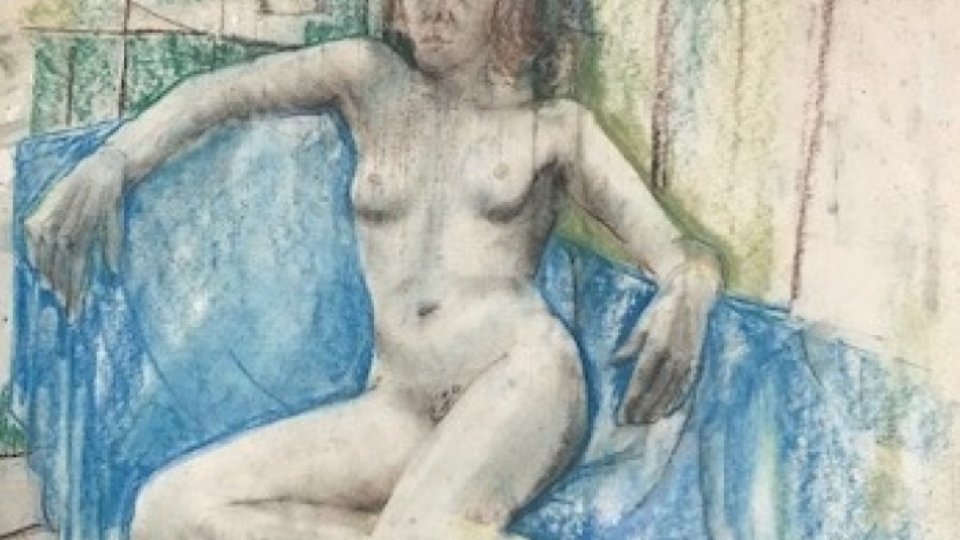
Kate King teaches fine art at Cambridge Centre for Sixth Form Studies and life drawing at King's Art Centre. She is exhibiting her small oil pastels together with more experimental mixed media pieces using layers of wax, gesso, ink, bleach and paint.
She has gathered her subject matter from years of photographing details of beautiful juxtapositions of colour and shape in the environment which often just happen for a fleeting moment.
Kate King studied fine art and ceramics at Cheltenham and Farnham Colleges of Art and Goldsmiths College, London. She has exhibited nationally and in Cambridge at Primavera and Ely Fire Engine House Gallery.

For more information, contact Kate on kate [dot] king4 [at] ntlworld [dot] com.
Renee Spierdijk's work is inspired by photographs of unknown children, mostly girls. She finds them in albums, newspapers, and on the internet. They are formal portraits reworked in colour.
As Sandy Goldbeck-Wood quotes in her essay on Renee's work: "But though wan, these girls are not dead. There remains a sense of their potential for breaking free and recovering from their half hidden psychic imprisonments. Some appear patient, others quietly mutinous, as they wait, and hope, to become themselves".
Large bodies
Richard Swift, 11 - 31 October 2008

Richard Swift's show consisted of a series of dramatic, large-scale paintings of the human body.
'Swift's paintings confront the body of the spectator through an immediately felt identification. It is through the physical sensate body that all experience flows,' says Roger Cook of the Fine Art Department, Reading University, where Swift studied. 'There are no expressionist brush strokes, but a painstaking and 'hard-won' pictorial process of finding, losing and refinding the image by a technique which allows it to emerge, disappear and re-appear out of the darkness.'
Swift studied at the University of Reading and the Courtauld Institute of Art, London. He co-founded the Chisenhale Art Place in East London (an international centre for contemporary art and dance), and was a prize winner in the Tolly Cobblod Eastern Arts fifth national competition. He has shown his work at a series of solo exhibitions including Esbank Istanbul, Sutton House London, the Towngate Gallery Basildon, and Churchill College Cambridge.
For more information, including prices, please visit www.richardswift.net; email richard [at] richardswift [dot] net.